Bill Whatcott’s high powered election song, performed by the Heavenly Grammy Award winning, Florida Christian conservative, trailer park music legend, James Cabanaro.
Dear Friends,
Join Bill Whatcott at this important all candidates forum as he shares his Conservative, Christ Centred, pro-life, pro-family, pro-gun, pro-free market, pro-freedom, pro-animal eaters rights, vision for the University-Rosedale riding of downtown Toronto and indeed all of Canada. Ask a question if you wish to all of the candidates this coming Tuesday at the all candidates meeting at the Miles-Nadal Jewish Community Centre, 750 Spadina Ave, Toronto, ON, 7-9 PM.
The Candidates who are running in the University-Rosedale Byelection:
Election Donations (tax receipt available only for Canadian residents) can be made via e-transfer to my official agent Tim Millar’s election bank account: billwhatcott.2026@gmail.com
For those who would like to help with my survival for the next three months in Toronto’s high cost of living environment (Election Day is Monday April 13, 2026), and then I have to remain in Toronto to stand trial a second time (I was acquitted once already) for the so-called “hate crime” of sharing the Gospel with sodomites and others at the Toronto unGodly Pride Parade while disguised as a Gay Zombie Cannabis Consumer (it’s the only way they would let me in their parade) back in 2016.
No tax receipt available for supporting this life saving ministry, anyone from anywhere can support this cause and provided you believe Christ rose from the dead, died for your sins, you are trying to live a Godly life, and you donate with a pure heart, you might be eligible to receive treasure in heaven (not up to me, it’s between you and God) ……….. See Matthew 6:19-21
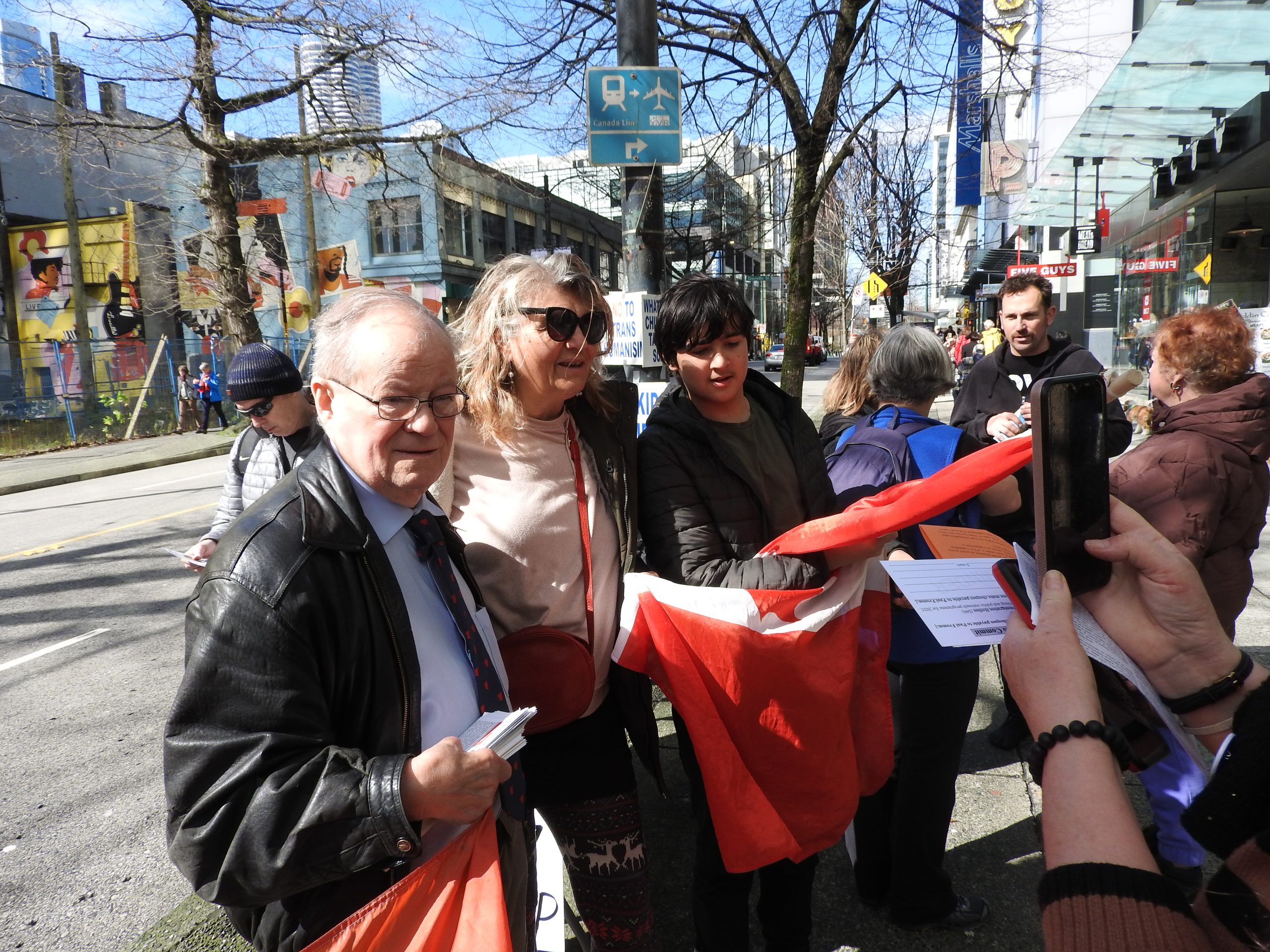
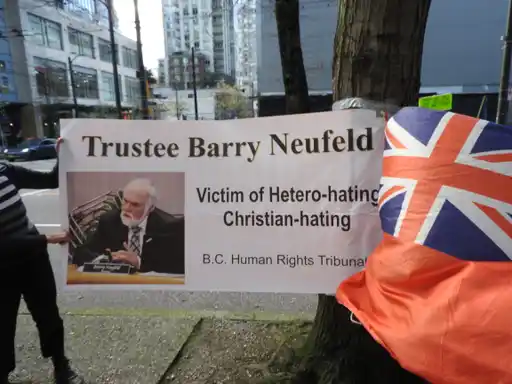
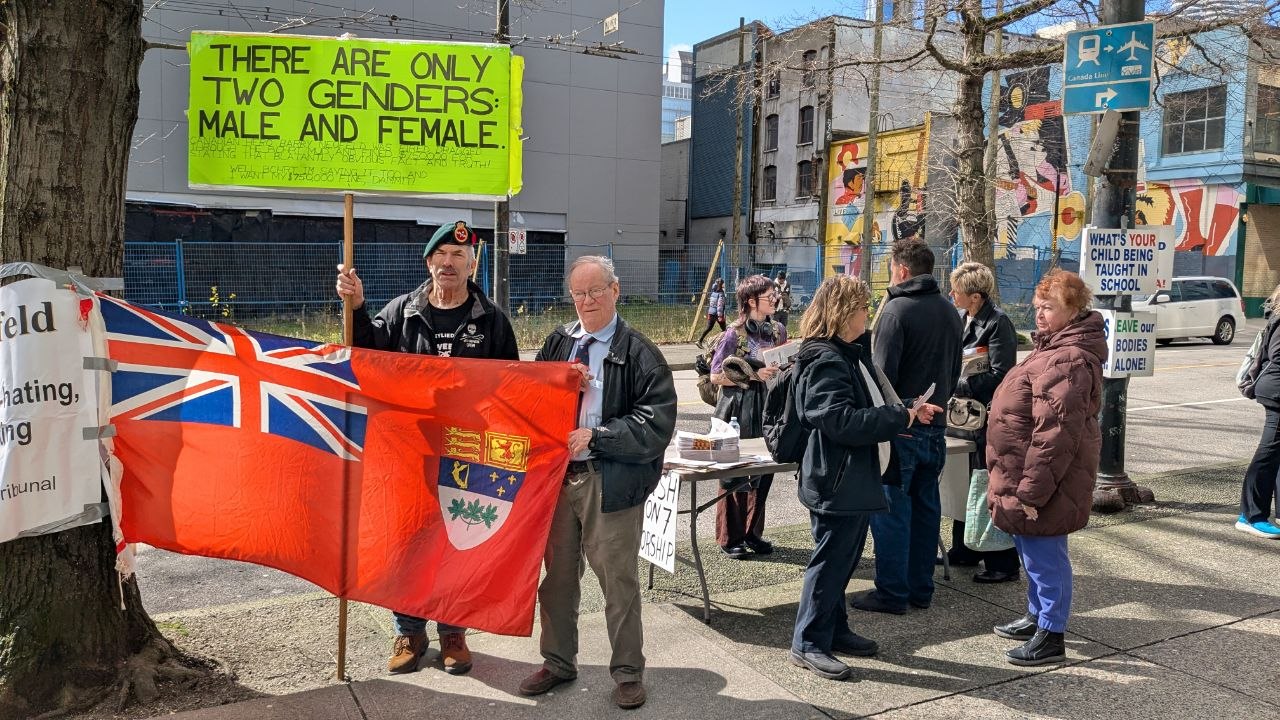
Paul Fromm Speaks to Truthseekers in Vancouver: The Martyrdom of Barry Neufeld at the Hands of the Christian-hating, Hetero-hating B.C. Human Rights Tribunal & Thoughts on the Insane War in the Middle East
I knew the Finnish Supreme Court was about to deliver its verdict in Päivi Räsänen’s case –
You remember … the Finnish politician with whom we’ve been standing for years now, dragged through years of investigations and trials simply for publicly expressing her Christian faith.
After everything she’s been through… I truly believed this would finally be over – that she would be fully acquitted.
And then I heard the news:
They unanimously acquitted her for the 2019 tweet, where she simply quoted a Bible verse and questioned her church’s support for a Pride event.
Thankfully, the court admitted this did not meet the threshold for “hate speech”.
But at the very same time, in a narrow 3–2 decision, Päivi was convicted by the Supreme Court for a church pamphlet she wrote back in 2004!
It was a text explaining traditional Christian teaching on marriage and sexuality.
She was convicted for this on the grounds that it “insulted” a particular group.
The court claims that by keeping this pamphlet available and sharing it again in recent years, it “insulted” a group, even though they acknowledge there was no incitement to violence.
Now Päivi faces heavy fines, and they’ve ordered the pamphlet removed.
It’s unreal!
Päivi, advised by ADF, who are leading her legal defence, is now considering an appeal to the European Court of Human Rights. But this is no longer just about her.
It affects you. It affects me. It affects every Christian, every free thinker, every person who still believes that freedom of speech means something in Europe.
You and I have stood alongside Päivi from the very beginning. And if anything, this verdict only makes it clearer why that fight matters.
But today… I can’t stop thinking about what this really means today.
Because this isn’t only about Päivi.
This is about whether, in a democratic Europe, you and I can still speak openly about our faith… or whether our Christian beliefs can be turned into something punishable.
This is about whether Christians are still free to speak in the public square, or whether that space has been closed.
And it should worry you like it worries me.
That’s why I wanted to write to you today.
Not just to inform you but to remind you that what we’re defending here is something significant:
Your voice. My voice. Our freedom to speak the truth without fear.
So let’s stay close. Let’s stay strong. And let’s not back down.
Thank you for standing with Päivi all these years. It truly matters. We continue.
Sebastian and the entire CitizenGO team
The radical globalists and woke elites want to erase our values—but together, we stand strong. CitizenGO is a movement of millions around the world, fighting every day to defend life, family, and freedom against those who seek to undermine them. We are faithful, so we will never quit.
Finland’s Supreme Court Convicts Christians of ‘Hate Speech’ for Saying Men and Women Are Different
Friday, March 27, 2026
In a case with global implications, Finland’s high court rules discussing what the Bible says about sexuality is ‘hate speech.’
In a decision released this morning, Finland’s supreme court voted 3-2 to convict a bishop and a member of parliament for publishing a pamphlet explaining Christian theology about sexual differences. The decision could tacitly ban orthodox Christianity in Finland by banning Christians from speaking about what the Bible clearly says.
Bishop Juhana Pohjola and Member of Parliament Paivi Rasanen face thousands of euros in fines and their challenged Christian speech “removed from public access and destroyed,” the court ordered, unless they successfully appeal to the European Court of Human Rights. If they appeal, the case could affect speech and conscience rights worldwide.
“I am shocked and profoundly disappointed that the court has failed to recognize my basic human right to freedom of expression,” Rasanen said in a statement after the verdict was announced. “I stand by the teachings of my Christian faith, and will continue to defend my and every person’s right to share their convictions in the public square.”
The ruling is the latest in a growing pattern of anti-Christian speech repression spreading across formerly Christian European countries. England now jails more people per day for alleged speech crimes than Vladimir Putin’s Russia, according to a former U.S. ambassador, even imprisoning and prosecuting people for praying silently on public property.
Last year, British authorities arrested Irish comedian Graham Linehan for criticizing transgender policies. Glasgow, Scotland is prosecuting a grandmother for offering to talk with people outside a hospital. Sweden is prosecuting a family for “religious extremism” for attending church regularly and not allowing their teen to own a cell phone.
New internet censorship laws in Europe also effectively criminalize and ban Christian speech and any speech opposing identity politics. As The Federalist reported last year, “Last year the European Union, of which Finland is a member, implemented a Digital Services Act that imposes a vast web of internet censorship, potentially across the entire world, by regulating social media monopolies. The act could subject Europeans to even more fines, raids, and imprisonment for posts that observe men and women are different.” The Federalist is a specific, named target of European censorship, which also controls what Americans can read online.
Numerous U.S. states and cities have passed similar “hate speech” laws and regulations that apply similar legal prejudices to Christians and any citizen who questions identity politics. New teacher licensing requirements in Minnesota, for example, effectively ban faithful Christians from teaching in state-run schools.
Rasanen wrote the banned booklet judged to violate Finnish “hate speech” laws in 2004, seven years before the law being used to criminalize it was passed. Pohjola published the booklet online and in print as part of a theological education series. Finland’s top prosecutor began to prosecute them in 2019, after Rasanen tweeted a Bible verse to publicly rebuke Finland’s state church for sponsoring a queer parade.
The tweet led to a government investigation into Rasanen’s writings and speech spanning her three decades as a public official. The investigation included 13 hours of police interrogating her. It also uncovered the booklet Rasanen wrote and Pohjola published. It is titled, “Male and Female He Created Them.”
The case is known as “the Bible trial” in Europe. In its judgment out Thursday morning U.S. time, Finland’s Supreme Court unanimously acquitted Rasanen of one charge, based on her tweeting a Bible verse, while judging her and Pohjola criminally liable for producing “Male and Female He Created Them.” That booklet title is a quote from the Bible’s first chapter, in the book of Genesis.
According to Alliance Defending Freedom International, which has provided legal support in the case, “The Court found Räsänen and the Bishop guilty for having ‘made available to the public and kept available to the public opinions that insult homosexuals as a group on the basis of their sexual orientation.’ It held that: ‘it must be taken into account that the text forming the basis for the conviction did not contain incitement to violence or comparable threat-like fomenting of hatred. The conduct is therefore not particularly serious in terms of the nature of the offense.’”
Rasanen and her lawyers have maintained throughout her seven-year prosecution that she supports freedom of speech for all people and believes that all are equal before God regardless of what group they identify with. Rasanen, a medical doctor and pastor’s wife, has steadfastly argued that speaking the truth as God defines it is an act of love, not hatred.
Finland’s hate crimes law is a part of its “war crimes and crimes against humanity” code. Its provisions protect people based on identity politics categories and are patterned after Soviet speech-crime laws, ADF counsel Paul Coleman told The Federalist in a previous interview. Two lower Finnish courts unanimously acquitted the pair on grounds of freedom of speech and religion.
In the ruling, the high court essentially accepted the argument Finnish prosecutor Anu Mantila made in a lower court: “You can cite the Bible, but it is Räsänen’s interpretation and opinion about the Bible verses that are criminal.”
The fact that men and women are different is at the heart of Christian teaching about marriage. If men and women are different, then two men or two women in a sexual relationship are not the same as a man and a woman. That confusion is at the heart of U.S. Supreme Court Justice Neil Gorsuch’s illogical and unconstitutional majority opinion in 2020’s Bostock v. Clayton County, which forces employers to treat men and women as interchangeable.
The Finnish Christians’ lawyers point out that even if their clients are ultimately acquitted — an uncertain prospect — their prosecution itself chills speech and religious freedom globally. Anyone who wants to voice non-state-approved ideas in Finland and across Europe, including Christian beliefs, is now on notice that doing so could mean years of investigation, prosecution, court appearances, legal costs, and punitive fines.
In 2014, Pohjola was ejected from Finland’s state-controlled church for adhering to orthodox Christian theology about male and female differences. Besides overseeing Finland’s non-state Lutheran church, Pohjola is the chairman of the International Lutheran Council, a missions organization of biblically based Lutheranism. Forty-five Lutheran church bodies across the world issued public letters of support for Pohjola and Rasanen “for expressing biblical views on human sexuality.”
“The vast majority of Christians in all nations, including Catholics and Eastern Orthodox, share these convictions,” the pastors noted. “… democratic societies worldwide guard religious freedom and freedom of expression as vitally important. Legal protection of these rights is founded on the inherent dignity of the human person who has the natural right to engage in public discourse on issues related to the meaning and purpose of society and human flourishing.”
Finland is the second-newest North Atlantic Treaty Organization member and recipient of immense U.S. financial and military benefits. As a senator, current U.S. Secretary of State Marco Rubio publicly stated Finland’s prosecution of Rasanen was “ridiculous.”
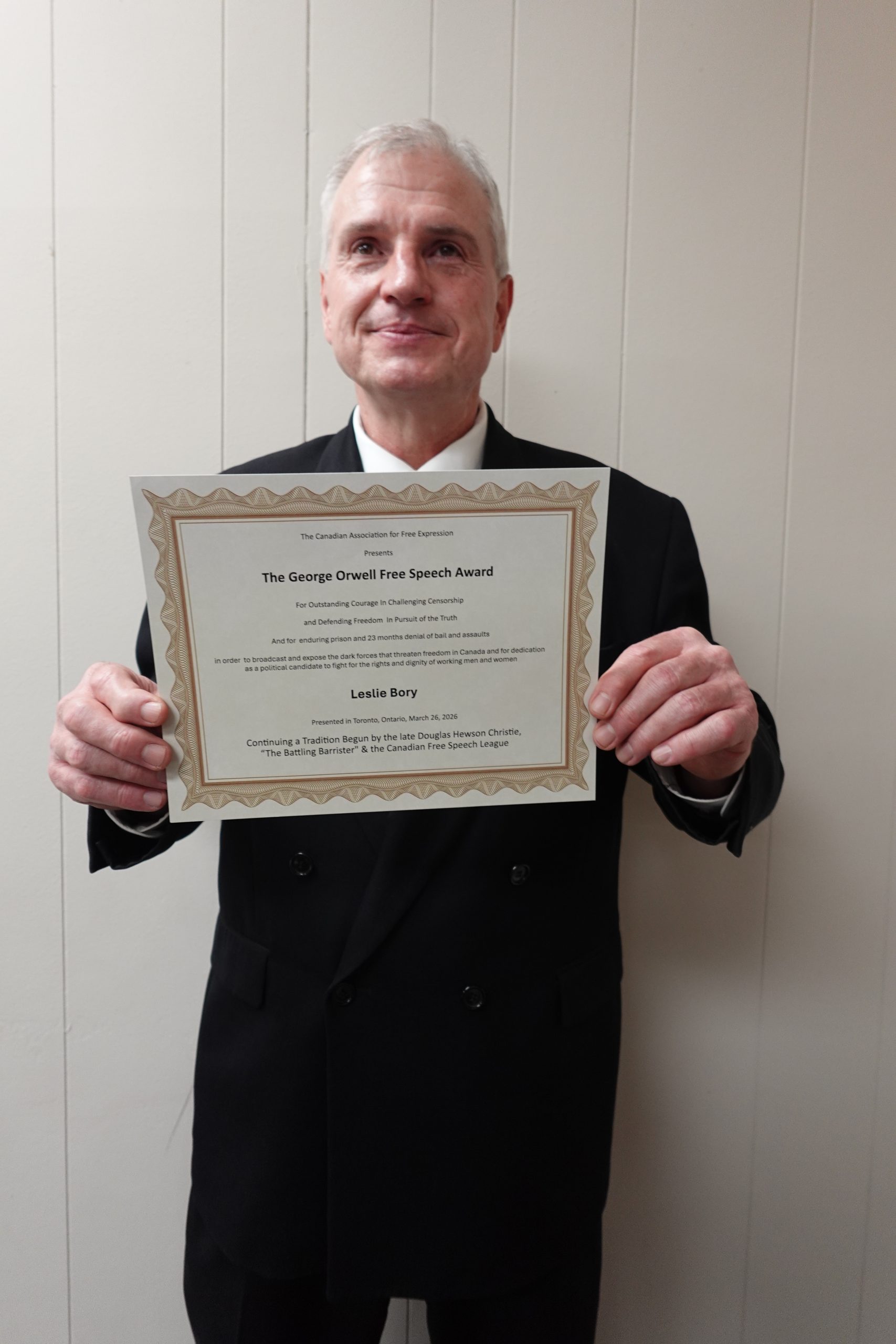
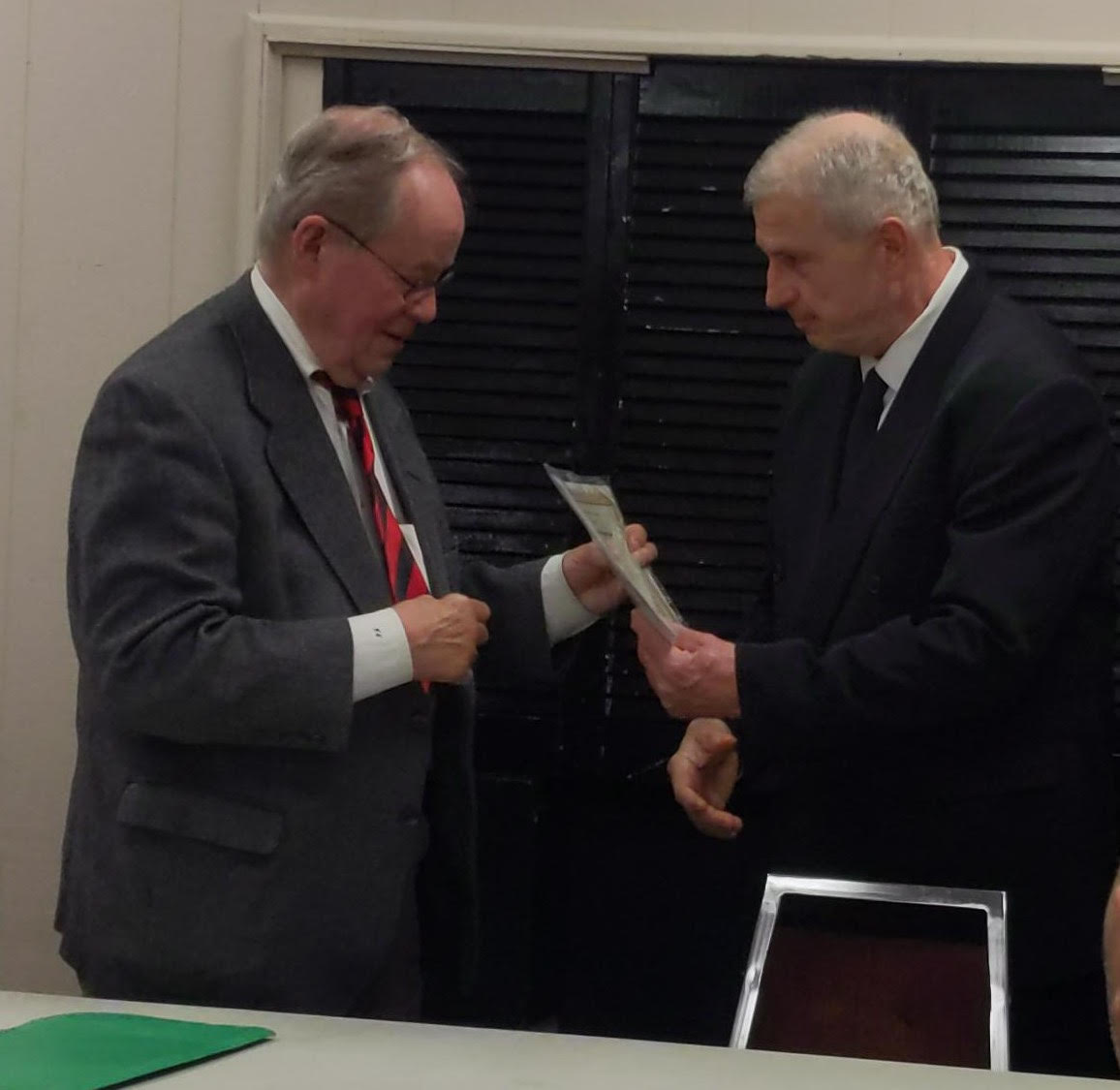
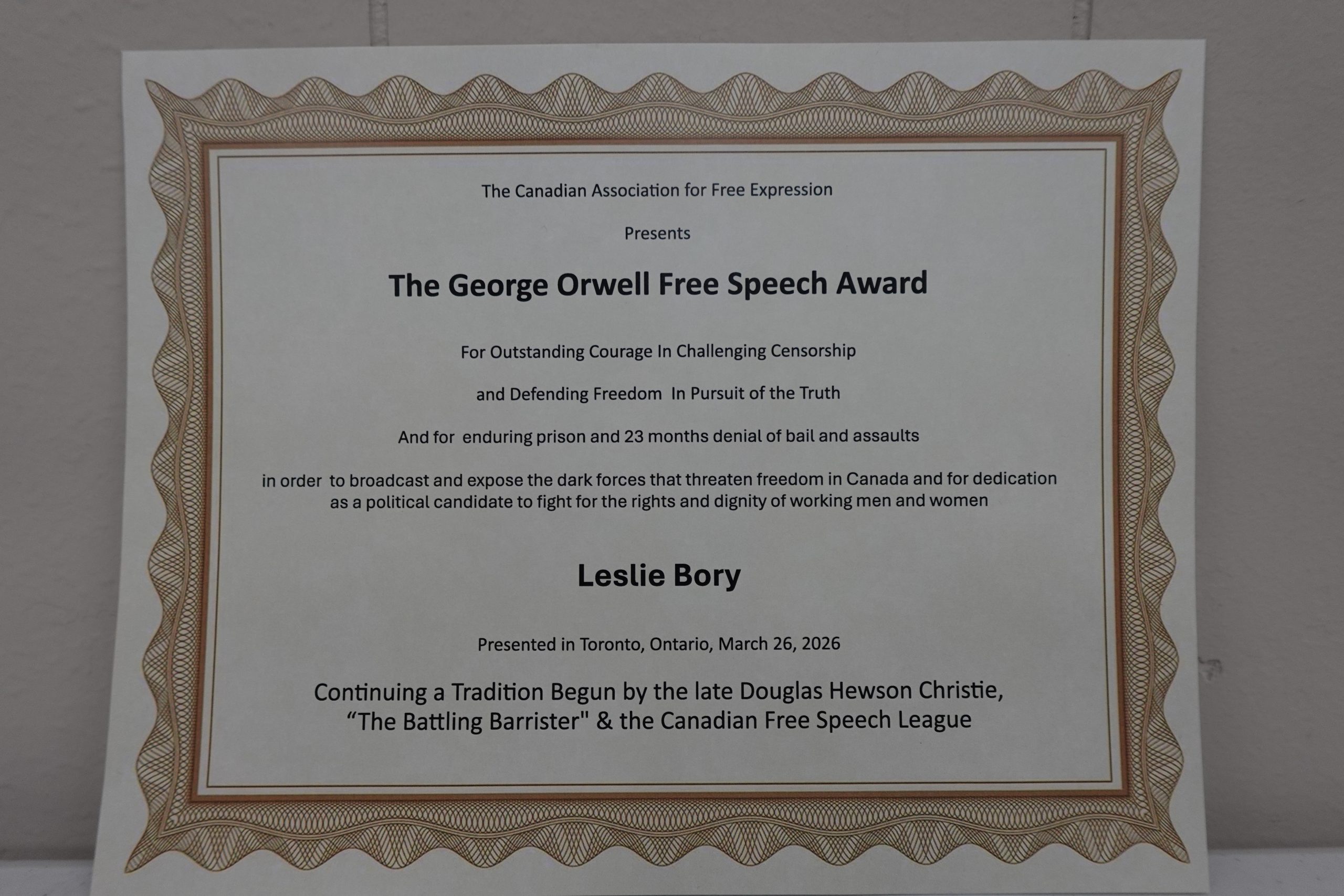
Political Prisoner Leslie Bory Receives 2025 George Orwell Free Speech Award TORONTO, March 26, 2026. Tonight Canadian political prisoner Leslie Bory of Brantford received the 2026 George Orwell Free Speech Award from the Canadian Association for Free Expression. Mr. Bory was arrested at his place of work in February 23, 2024. He was charged under Secs. 319 and 318 of Canada’s notorious “hate law” for “wilfully promoting hate against” one of Canada’s privileged protected groups; namely, Jews. He was also charged with promoting genocide in broadcasts on his Brantford News podcast. While gunmen, even murderers, are granted bail in Canada’s notoriously lax “justice” system, just as in the former Soviet Union, political dissidents are often denied bail. This was the situation with Mr. Bory who spent 23 months in the Maplehurst detention Centre, denied bail. He was twice beaten while in prison. At trial, in early 2025, he was found guilty and sentence to time served. Both the Crown and Mr. Bory are appealing. Mr. Bory complains that he was unable to mount an adequate defence, including quoting from the Talmud to argue the truth of his statements. In making the presentation, CAFE director Paul Fromm stated that Mr. Bory was receiving the Orwell Award “for Outstanding Courage In Challenging Censorship and Defending Freedom In Pursuit of the Truth and for enduring prison and 23 months denial of bail and assaults in order to broadcast and expose the dark forces that threaten freedom in Canada and for dedication as a political candidate to fight for the rights and dignity of working men and women.”
CAFE took over the annual Orwell Awards in 2021 continuing a Tradition begun by the late Douglas Hewson Christie, “The Battling Barrister” and the Canadian Free Speech League. Mr. Bory received greetings from a number of well wishers across North America. Texas videographer Diane King, who with Jim Rizoli, concentrate on truth telling about WW II, wrote: “When I learned of this 2026 event, I wondered as I always have, who has been selected to receive the award. Every time when I learn of the recipient’s name, I think to myself, “what a perfect choice!” That’s how I felt when I saw Leslie Bory’s name on the invitation. Congratulations, Les. I’m truly glad it’s not necessary to extend to you these congratulations in prison. I’m further glad that I no longer need to correspond with you during your prison confinement as you await your sentencing (after 2 years) for your crime against the state in exercising your free speech. However, just a tip: I’d highly recommend that you receive this award quickly before they charge you again with yet another inevitable free speech crime making you a candidate for the 2027 George Orwell Award. Congratulations!!!! Best to you IN CHRIST.” Former political prisoner (in Germany) Monika Schaefer, who, with her brother Alfred, who is again in prison in Germany, received the 2022 George Orwell Free Speech Award, messaged:” First let me say, what joy I felt when I learned that you were to receive the 2026 George Orwell Free Speech Award. Congratulations! You well deserve this honour! I wish I could celebrate this honour with you in person, but that is not to be right now. And thank you Paul, for being such a dedicated truth warrior and free-speech advocate and for keeping this tradition of the Orwell Awards alive, among all the other work that you do, so tirelessly. Thank you Paul! Okay, I think the first time that I ever talked with Leslie Bory must have been almost 10 years ago, when he phoned me from Ontario just to give me encouragement and moral support, from both himself and his wife, after I had made that fateful video “Sorry Mom, I was Wrong About the Holocaust”, and was experiencing some pushback (putting it mildly). He let me know that he agreed with my interpretation of history, and that he and his wife both wished me all the very best, and if I ever needed help that I could ask and he would do whatever was in his power to help me. Sometime after that I did meet Leslie in person, and we have been friends ever since. What I found so refreshing is Les’ great sense of humour, which came out in some of his videos. These videos had me in stitches, like when he talked about the “lampshade people” or the “lampshade mafia” at his all-candidates forums. Speaking of all-candidates forums, Les Bory has incredible perseverance and tenacity, running in so many elections, always sticking his neck out, saying what needs to be said, though not always the popular thing. What this perseverance says about Les Bory is that he has this quality of never losing hope, always with a positive energy, a can-do attitude, always working towards making things right. Les Bory is a man of strong principles combined with a compassion for his fellow man, and these principles are what led him to make some bold statements which got him into trouble with the PTSNB (Powers That Should Not Be). While in jail, Les faced incredible hardships, and yet, he kept his spirits up (as far as I could tell, from his letters!) and carried on with good work, writing several short books, and educating his fellow prisoners. Undaunted, Les doesn’t just sit back on his laurels, he continues to work hard, trying to enlighten people about what’s going on, and in true optimistic fashion continues within the political sphere. This year’s George Orwell Award is going to a truly deserving man, and I whole-heartedly applaud you my friend, Leslie Bory!
A fellow Canadian Wilton wrote: ” “Covid was a hard go for me, being fired from 2 jobs because I refused to take an experimental gene therapy class drug. I was disillusioned and angry because my concept of the True North, Strong and Free was shattered into 6 million pieces. During my forced downtime I happened upon Les’ Bitchute channel Brantford News, and he spoke to something truly Canadian inside of me. Les’ passionate rants about the utter tyranny we were experiencing in Canada gave me a sense of community, that I wasn’t the only one feeling so outraged. Les is a beacon of light in a deepening twilight, and I hope he becomes the leader Canada needs.
A fellow Canadian Wilton wrote: ” “Covid was a hard go for me, being fired from 2 jobs because I refused to take an experimental gene therapy class drug. I was disillusioned and angry because my concept of the True North, Strong and Free was shattered into 6 million pieces. During my forced downtime I happened upon Les’ Bitchute channel Brantford News, and he spoke to something truly Canadian inside of me. Les’ passionate rants about the utter tyranny we were experiencing in Canada gave me a sense of community, that I wasn’t the only one feeling so outraged. Les is a beacon of light in a deepening twilight, and I hope he becomes the leader Canada needs.
This week, Members of Parliament voted to adopt Bill C-9, ushering in a dangerous roll-back of civil liberties that will be used to target the Palestine solidarity movement.
The bill was adopted 186 to 137 with Liberals and Bloc MPs voting in favour, while the NDP, Green, and Conservatives voted against.
As CJPME has long argued alongside our partners, C-9 criminalizes protest, suppresses dissent, and expands police discretionary power. The bill was rushed through Parliament without full review or debate, ignoring the significant concerns raised by civil society.
This legislation to restrict dissent was passed just days after Israel’s Ambassador called for Canada to limit certain “freedoms,” and amid escalating Israeli violence in Palestine, Lebanon, and Iran.
However, the fight is not over. Now that the Bill has passed the House of Commons, it moves to the Senate. Senators will have an opportunity to properly review and debate the bill, bringing in expert witnesses. We need the Senate to have a full hearing on C-9 so that they can understand its full implications. Please use our email tool to send an email to Senators to express your concerns.
Red China-Born Lawyer Opposes Law Society Demands That Lawyers Be Social Justice Warriors
Beijing-Born Alberta Lawyer Says ‘Wokeism’ in Canada Increasingly Resembling Communist China’s Ideological Tyranny
November 14, 2025
Alberta lawyer Roger Song filed a court action against the Law Society of Alberta in 2023 for mandating “cultural competence” training. Courtesy of Roger Song
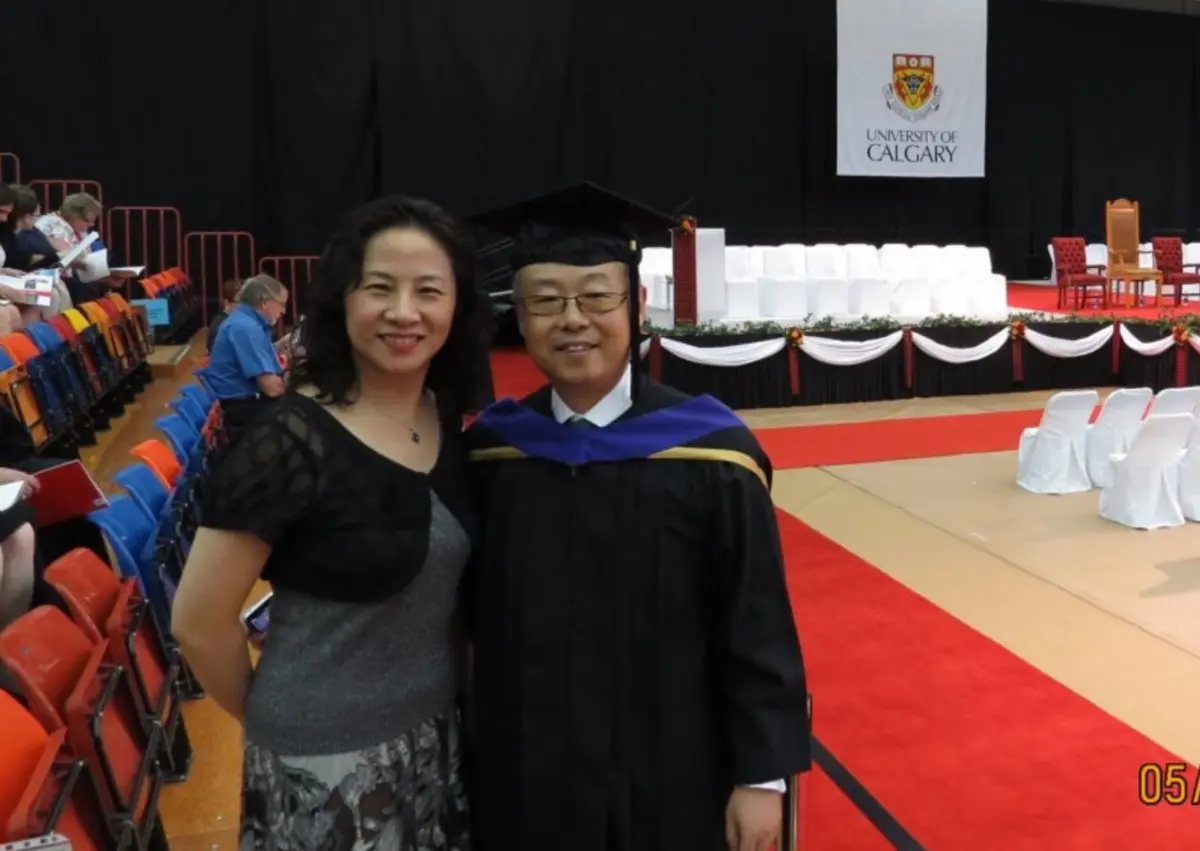
Alberta lawyer Roger Song moved to Canada 25 years ago from China to distance himself from a regime he says he could no longer live under.
Having witnessed the 1989 Tiananmen Square massacre–when government forces opened fire on unarmed students demanding democratic reform–he says he saw Canada as a place of freedom where he and his family could start over. He was a law professor at Peking University at the time, and says he witnessed how the regime used its authority to suppress students’ “legitimate demands” for democracy. “I couldn’t allow my children, my next generation, to be still subject to this type of dictatorship,” he told The Epoch Times in an interview. “So that’s why I decided to leave China at that moment.”
But now, he is raising the alarm over what he says is a growing ideological push in Canada that increasingly mirrors the ideological tyranny of communist China. Song filed a lawsuit against the Law Society of Alberta in 2023, over concerns about mandatory cultural training for lawyers imposed by the society–a move he says is similar to what he saw growing up in China.
“Canada is now moving toward the place where I escaped from,” he said.
In 2019, Song was required to complete “cultural competence” training to maintain his legal credentials in Alberta. He says the society’s professional development program–which covers topics such as diversity, equity and inclusion (DEI), gender identity, and promotes the need to “dismantle systemic inequalities and barriers”–imposes “politicized” requirements and redefines legal competence as adherence to “woke” political beliefs.
He launched a legal challenge in 2023, asking the courts to remove these requirements for lawyers, but the challenge was dismissed this year, with the Court of King’s Bench ruling in a Sept. 12 decision that the training requirements fall under the law society’s scope.
“Having a basic understanding of the people and communities you serve as a lawyer does not work against the public interest. Nor does cultivating a safe work environment built on the principles of evolving human rights law,” reads the decision.
It adds that the law society sees its professional development requirements as “necessary to achieve a greater societal good, and it was within their authority to do so.”
Song argues that compelling lawyers to adopt specific viewpoints goes against the principle of independence of the bar, which the Supreme Court of Canada has described as “one of the hallmarks of a free society.” This principle refers to the ability of lawyers to act in their clients’ best interests, free from undue state or public influence.
“In the area of personal belief, ideology, political issues, it’s an alarming sign if you’re forced to take any type of mandatory training, because if you’re taking mandatory training, that means the content of the mandatory training is considered as the dominant notion, dominant view, dominant attitude, dominant culture of this society,” Song said.
He adds he felt pressured to complete the training because he did not want to lose his licence. “The thing is that if you fail to submit that certificate by deadline, your licence is automatically suspended,” he said.
Song says the law society’s training violates his Charter rights to freedom of conscience and expression, amounting to “compelled speech, forced ideological conformity, and suppression of conscience and expression,” according to the Justice Centre for Constitutional Freedoms, which represents Song in the case.
According to Rule 67.4 of the Law Society of Alberta, the society can “prescribe specific continuing professional development requirements to be completed by members, in a form and manner, as well as time frame.”
Lawyers who do not complete the mandatory training “shall stand automatically suspended” the day after the deadline to complete the course, the rules say.
Law Society’s Position
The law society told The Epoch Times it does not comment on matters before the court.
The society says that Song’s allegations are based on subjective views, and that there is no basis to find that the society has infringed on Song’s Charter rights, according to the Sept. 12 decision.
The society also maintains that its rules and codes of conduct “fall within a reasonable interpretation” of its mandate under the Legal Profession Act, which grants it the authority to regulate the legal profession. It also says that the words, scheme and object of the act support an “expansive construction” of the society’s rule-making authority.
“In [the society’s] view, the competency of the profession, which includes cultural competency and elimination of discrimination and harassment, are inherent to protecting the public’s confidence in the profession,” the document says.
Life Under Communism
Song says that when he first received the law society’s notice on the mandatory training, it “immediately” reminded him of the concept of “political competence” on which he was educated in China.
He recalls that in his home country, people are judged by their acceptance of communist ideology. Those who conform have opportunities to climb the corporate and social ladder, he says, while those who don’t face “social death”–the practice of excluding people who hold differing opinions–which he says is the equivalent of “cancel culture” in Canada.
“Under the communist regime, the trick to survive is to unconditionally support the dictator,” he said. “If you say you unconditionally support the leadership of the Communist Party of China, you may have a good life.”
Song says that after he began voicing his opposition to the Law Society of Alberta’s training, some people around him, including colleagues, began to distance themselves from him.
“People online label me as a racist,” he said. “I’m a Chinese, I was born and raised in China, Mandarin is my native language, and suddenly, just because I express some view that is different from those people, I was labelled racist.”
He added he has also been told to go back to China by people who say he doesn’t conform to Canadian values. “I think that is the culture of cancel culture,” he said.
In China’s case, however, Song says that not conforming to the Communist Party’s ideology can lead to more serious consequences than social exclusion.
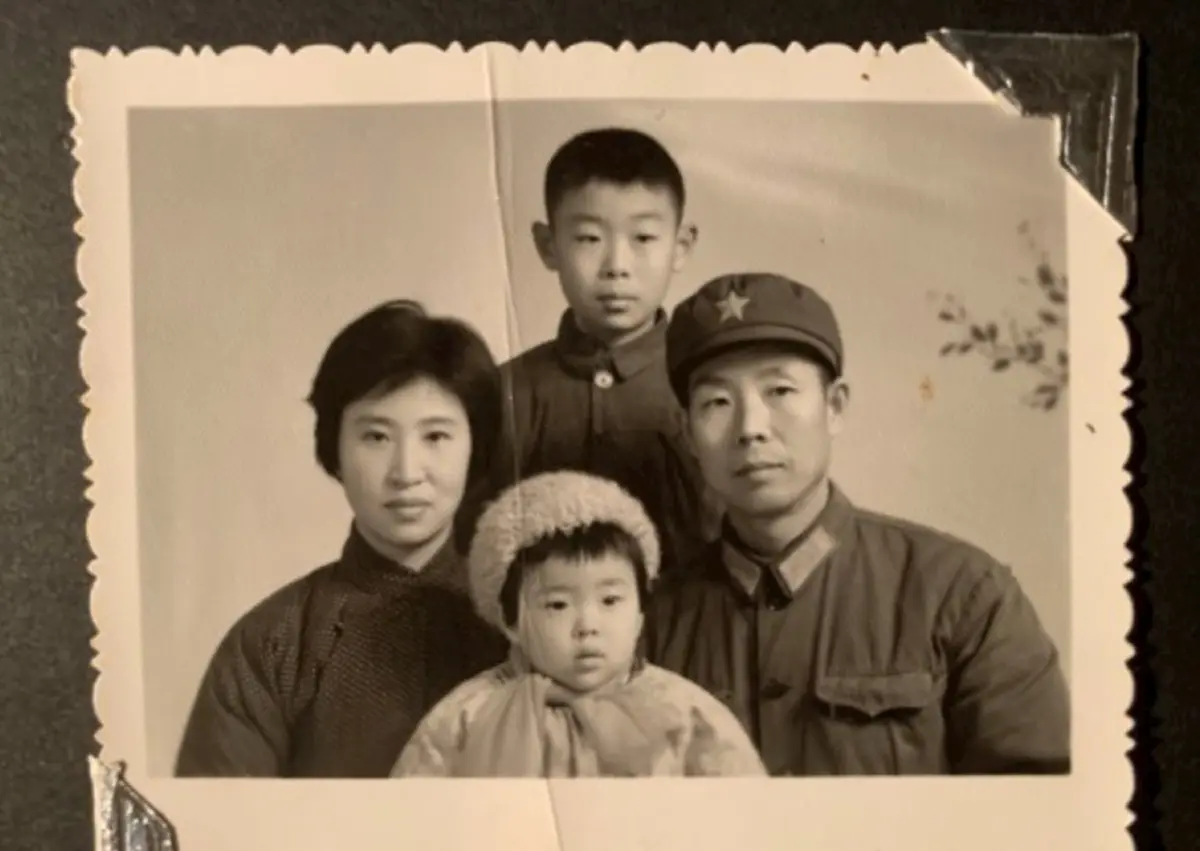
He cites the case of his father, Ziling Xin, who, despite being a retired high-ranking army officer in China, was placed under house arrest for three years for promoting constitutional democracy and criticizing corruption among Party officials. Song said his father did not receive any formal legal trial or document imposing the penalty.
“From my dad’s experience, you can see that people in China don’t really have the protection of the law,” he said.
Song says that when he came to Canada, he realized the importance of the rule of law and the supremacy of God, since unlike in China, where the law is tailored to serve the regime’s interests, these principles ensure that the law is applied independently of political influence.
But if lawyers are not allowed to think independently, as he says is the case when regulatory bodies impose mandatory cultural training, it directly undermines the foundation of the legal profession and ultimately affects citizens’ access to fair legal representation.
“If those judges and lawyers don’t have an independent mind to implement the laws, if those judges and lawyers are subject to all kinds of political influence of authorities, then all the rights granted to the citizens under the laws will come to nothing,” he said.
“Canada is moving away from the foundation.”
‘Social Struggle’
Song says that a sign of communism taking root in Canada is the classification of people into various “identities” to distinguish those who are generally favoured from those who are “discriminated against” or, in communist terms, “oppressed.”
He says this is evident in Canada’s use of gender and racial identity as criteria in a wide range of contexts, from government programs to employment and research funding, under the DEI framework.
“This is not some new trick,” he said. “It’s just another version of communism–playing class identities.”
He recalls that in China, where communism has instilled the ideology of class struggle, a person’s worth is often measured based on their political profile as well as their allegiance and ties to the Chinese Communist Party. He notes that a similar dynamic played out during China’s Cultural Revolution, when supporters of the leftist ideology were favoured, while landlords and wealthy farmers were targeted as class enemies.
“The strategy of wokeness to grab power and control is to engage the struggle of leading the ‘oppressed groups of people’ by identities like gender, sexual orientation, or black or First Nations’ race, to fight against the ‘oppressing group of people’ by identities, like Christians, white, straight, male,” he said.
“Such strategy of social struggle is very effective to create social unrest, division and chaos, and destroy the existing legal regime and social order as Canada already experienced.”
The law society’s professional development documents state that lawyers can demonstrate their cultural and inclusive“competency” by recognizing “how systemic inequalities and barriers affect individuals and groups” as well as “take action to dismantle systemic inequalities and barriers.”
They also encourage attorneys to “develop and promote a deeper understanding of sexual orientation and gender identity” and practice “anti-discrimination and anti-racism.”
Song says that by promoting these views of identity among lawyers, the law society is straying from the principles that everyone is equal under the law and before God.
“The law society is trying to educate lawyers to convert them into a bunch of social justice agents,” he said. “That is very harmful to our legal system and to the protection of the citizens under the law.”
Human Rights legislation originally sought to outlaw discrimination in employment and housing. In the intervening decades, human rights commissions have become more and more sinister, seeking to control speech. Sec. 7 of the B.C. Human Rights Act reads:
7.(1) A person must not publish, issue or display, or cause to be published, issued or displayed, any statement, publication, notice, sign, symbol, emblem or other representation that
(a) indicates discrimination or an intention to discriminate against a person or a group or class of persons, or
(b) is likely to expose a person or a group or class of persons to hatred or contempt because of the Indigenous identity, race, colour, ancestry, place of origin, religion, marital status, family status, physical or mental disability, sex, sexual orientation, gender identity or expression, or age of that person or that group or class of persons.
The bland sounding words “is likely to expose [a privileged group] to hatred or contempt” is so loosey goosey that a defence is almost impossible. Any comment critical of a privileged group, in the case below the LGBTQ crowd, is likely to expose them to “contempt.” Contempt is a negative feeling. Thus, if the critical comments are believed, any criticism possibly might expose the group to contempt. And no actual harm has to be proved. Incidentally, truth is no defence. This has been CAFÉ’s experience in over a dozen “human rights” cases.
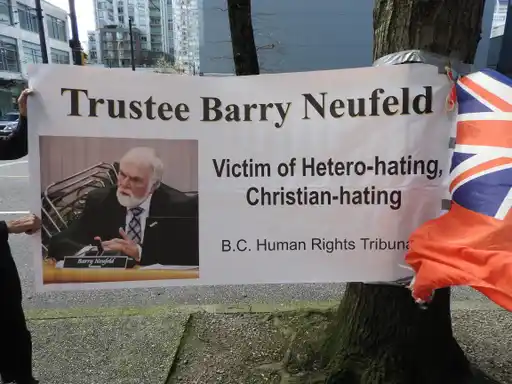
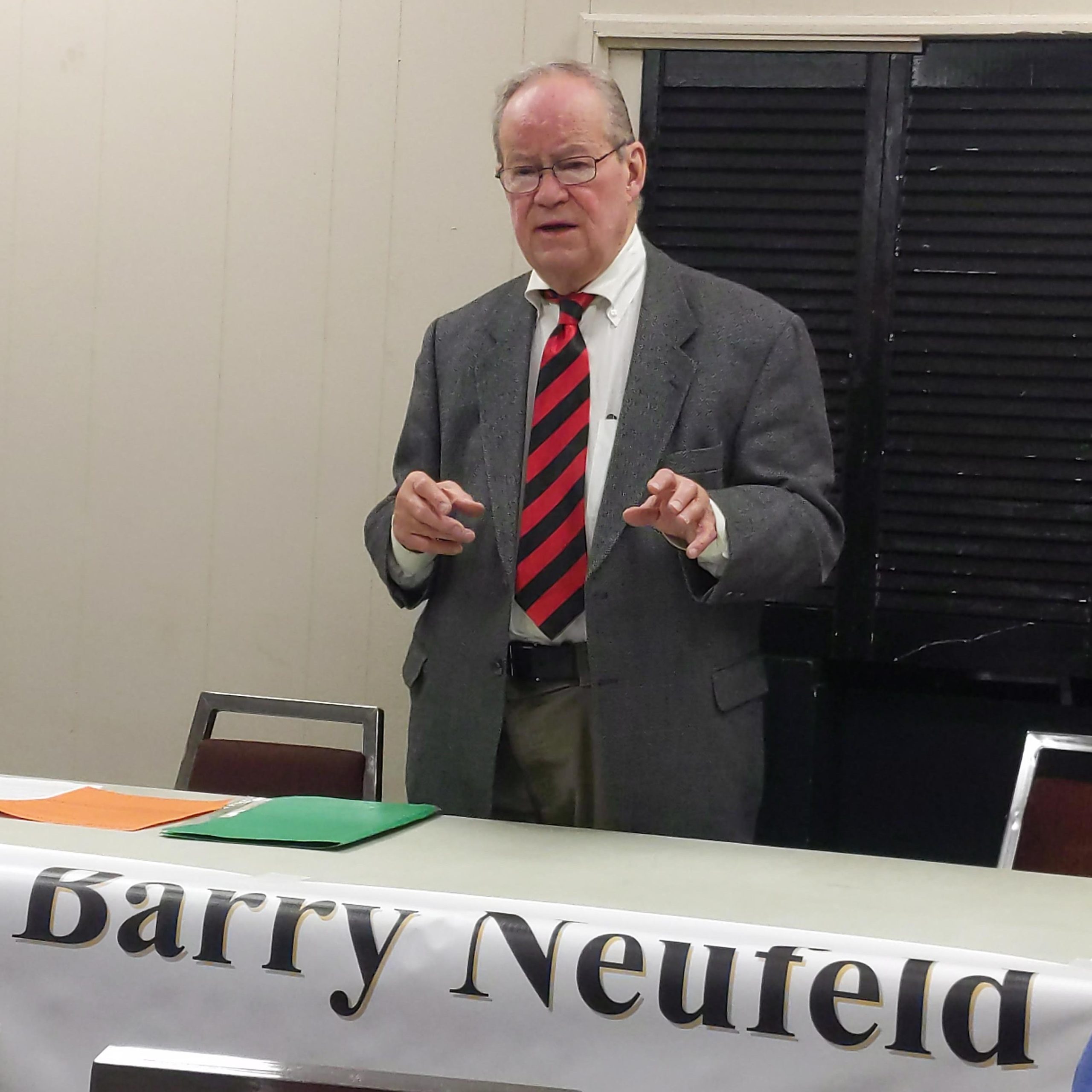
Consider the case of Barry Neufeld:
Committed Traditional Christian & Former School Trustee Barry Neufeld Fined A Crushing $750,000 By BC Human Rights Tribunal For Criticizing the LGBTQ Agenda
[Since our beginning in 1983, CAFE has warned that one of the most sinister enemies of free speech and opinion are human rights commissions. The Charter’s weak guarantees of freedom of expression, belief and religion mean nothing to them. Infected with hatred for traditional Christians and obsessed with gender bending LGBTQ ideology, they tolerate no dissent from the LGBTQ agenda and punish dissenters with fines more in keeping with a shipping company guilty of an environment wrecking oil spill. The complaint against Mr. Neufeld was made by the B.C. Teachers’ Federation. There was a time when the teaching profession stood for free speech and inquiry. In B.C., the BCTF is committed to leftist indoctrination of their young charges and pushing the radical, anti-Christian LGBTQ agenda. BCTF president Carole Gordon gloated at the victory and crowed: ” The BCTF will always stand firmly in support of 2SLGBTQIA+ students, families, and teachers. Today’s outcome sends a clear message: inclusion and respect are not optional in British Columbia’s schools.” Don’t let the touchy feely words “respect and inclusion” fool you. There’s no respect for traditional Christians in the BCTF’s opinion and, if you dissent from the LGBTQ agenda and the glorification of transgenderism, you will not be included. It’s our sincere hope that this totalitarian and vengeful decision will be the subject of a judicial review (appeal).]
“A B.C. Human Rights Tribunal has released its decision against former trustee Barry Neufeld on Feb. 17, 2026. (Progress file) A B.C. Human Rights Tribunal has released its decision against former trustee Barry Neufeld on Feb. 17, 2026. (Progress file) Former Chilliwack school trustee Barry Neufeld has been ordered to pay $750,000 by the B.C. Human Rights Tribunal for violating the Human Rights Code with “heated public speech” exposing LGBTQ people to hatred or contempt. The tribunal issued its final decision this week, issuing two sets of costs orders in the matter of the BCTF (on behalf of) the Chilliwack Teachers’ Association v. Neufeld, one ordering the payment of $750,000 in costs to the CTA, and a concurrent order of $10,000 for improper conduct during the lengthy process. The decision finally rendered after years of deliberations determined that Neufeld violated sections 7(1)(a), (b), and 13 of the Human Rights Code and the orders constitute the remedies against him.
The B.C. Human Rights Tribunal is seriously biased against Christians and heterosexuals, in particular member Devyn Cousineau who wrote this decision. Back in 2018 in the Whatcott case she was challenged for bias but refused to recuse herself. Bill Whatcott is a committed evangelical Christian who circulated a leaflet criticizing NDP candidate Ronan (“Morgane”) Oger who was a transgendered activist. Whatcott argued that if the candidate couldn’t get his sexuality right, he should not be entrusted with political or financial decisions. Oger was an NDP provincial vice-president, Cousineau had supported the NDP and many LGBTQ causes. Oger was a well known volunteer at Qmunity, an LGBTQ Vancouver group. In the Qmunity 2016 annual report Devyn Cousineau (the woman tasked with impartially adjudicating Oger vs Whatcott) was recognized for financially donating to the homosexual activist organization.
Devyn Cousineau delivered the brutal judgment in Barry Neufeld’s case. In her decision on costs in this case, she wrote: “I have noted above that the primary purpose of an award of costs under s. 37(4) is punitive. Punishment of a wrongdoer, however, is not an end in itself. It also, of course, serves as a deterrent to discourage and prevent others from committing the same or similar wrongful acts.”
Mr. Neufeld had every right as a concerned citizen to speak out against SOGI (Sexual Orientation and Gender Identity) sex ed programme. As an elected trustee, he had an even great right to make known his views. The B.C.Human Rights Tribunal has again tried to beggar and silence a man with traditional Christian views sexuality. The Neufeld decision is an outrage.
It’s time to send the censors packing.
“ I am Canadian, a free Canadian, free to speak without fear, free to worship God in my own way, free to stand for what I think right, free to oppose what I believe wrong, free to choose those who govern my country. This heritage of freedom I pledge to uphold for myself and all mankind.” These inspiring words of former Prime Minister John Diefenbaker form the opening of the Canadian Bill of Rights (1960). What an inspiring vision of a free and constructive society!
CANADIAN ASSOCIATION FOR FREE EXPRESSION (CAFÉ), P.O. Box 332, Rexdale, ON., M9W 5L3. (416)-428-5308. http://cafe.nfsthost.com
Emergencies Act appeal to the Supreme Court shows Mark Carney is not so different from Justin Trudeau after all
6
Protestors set up a blockade at the foot of the Ambassador Bridge, sealing off the flow of commercial traffic over the bridge into Canada from Detroit, on Feb. 10, 2022. The Freedom Convoy protests and blockades were nothing police couldn’t handle using the Criminal Code, writes Josh Dehaas. Photo by Cole Burston/Getty Images
There was never any question what Prime Minister Mark Carney thought about the Freedom Convoy protesters in Ottawa. In a Globe and Mail op-ed published on Feb. 7, 2022, the “Ottawa resident and former governor of the Bank of Canada and the Bank of England” wrote that the convoy was “terrorizing” people, that women were being forced to “flee abuse,” and that the elderly were “afraid to venture outside their homes.” He accused the organizers of “blatant treachery” and “sedition,” and proposed the government respond by “choking off the money.”
A week later, Prime Minister Justin Trudeau followed Carney’s advice, invoking the Emergencies Act for the first time in history to create shocking regulations that banned funding of or travelling to protests and ordered financial institutions to search for and seize bank accounts of suspects without warrants. This authoritarian overreach echoed around the world.
Still, I held out hope that the findings by a Federal Court judge and three judges of the Federal Court of Appeal that the invocation of the Act was unlawful and that the regulations made under it violated Charter rights would give Carney pause. Perhaps he believes in Charter rights more than his predecessor? If not, I thought maybe he would stand down from an appeal to emphasize a break with his predecessor. Turns out I was foolish to have been hopeful. In an application for leave to the Supreme Court of Canada that landed in my inbox on the last possible day, I learned that Carney is doubling-down on Trudeau’s illegal invocation.
In their application materials, the federal government makes the same basic argument they made before: some Freedom Convoy supporters had blockaded border crossings, and a handful of individuals near the Coutts, Alta., border blockade were found with a cache of firearms, so it was reasonable for Trudeau to take unprecedented measures to shut down freedom of expression and invade the privacy of all Freedom Convoy supporters nationwide.
As alarming as the blockades and the Coutts cache were, they were nothing police couldn’t handle using the Criminal Code. In fact, they had made their arrests and ended the border blockades by the time Trudeau dropped the bomb. As we, at the Canadian Constitution Foundation, explained in the federal courts — with agreement from all four judges who looked at the question — there was no justification offered by Trudeau for declaring a national emergency, suspending the right to support and travel to certain kinds of protests, and temporarily tossing away the ancient right to security against unreasonable searches by freezing bank accounts without warrants.
In their leave application, the government argues that the Federal Court of Appeal decision “hamstrings governments’ ability to respond effectively to future crises,” but this is simply not true. The Emergencies Act is explicit that governments can take extraordinary measures to deal with situations that pose a serious risk of violence and that cannot be dealt with using existing laws.
We must not forget that the Emergencies Act was Parliament’s genuinely noble response to previous prime ministers who had abused their power in times of crisis, including interning Japanese Canadians during the Second World War and denying habeas corpus to innocent Quebeckers during the 1970 October Crisis. It was designed to prevent prime ministers from over-reacting and suspending rights except when genuinely warranted. Like any law, it can be amended if Parliament sees fit. But why bother with democracy when you can roll the dice in the courts instead, I suppose? It turns out Carney is not so different from Trudeau after all. (National Post, March 18, 2026)
Josh Dehaas is Counsel with the Canadian Constitution Foundation, a legal charity that challenged the invocation of the Emergencies Act and the rules made under it in the Federal Court and Federal Court of Appeal.
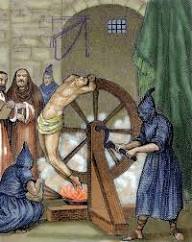
The Spirit of the Inquisition & Thought Control Lives on at the Toronto Catholic District School Board: Two Teachers Fired for “Racist” Posts
The following is the CBC’s not very newsy report on the firing to two Toronto Catholic teachers for allegedly “racist” posts over the Christmas holidays. The CBC provides no information as to what the posts said or who the teachers were or what their side of the story might be. Note that the vindictive Board seeking to cause maximum harm to their fired employees reported the matter to the Ontario College of Teachers which could take away their teaching certificates. Make no mistake about it, we live in a minority-controlled intellectual police state. “Freedom of thought” “freedom of expression” — these words from the Charter of Rights and Freedom are a sorry joke and empty promise.
A few more details did emerge from a CP24 report (March 16, 2026): “
CP24 previously reviewed a screengrab of what appears to be a series of messages on a shared social media platform in which a racist image is shared.
Another teacher reportedly responded to that image, saying “LMAO where are the chicken wings, (explicative) (N-word) are all the same.”s
“The Toronto Catholic District School Board says two high school teachers are no longer employed by the board after being accused of exchanging racist messages on a school social media page.
Advocacy group Parents of Black Children said last month that messages between two teachers at James Cardinal McGuigan Catholic High School found on a student athletics Instagram account included a racist slur and an anti-Black meme.t
The group accused school officials of not taking immediate action after a student who had access to the Instagram account screenshotted the exchange and notified the school’s principal.
The school board says the teachers were immediately placed on leave after school leadership received the images, and those teachers are no longer working for the board.
It also says it has reported the matter to the Ontario College of Teachers.
The board says it takes racism and discrimination “extremely seriously” and recognizes the impact this incident has had on the school community. (CBC News, March16, 2026)





 The Spirit of the Inquisition & Thought Control Lives on at the Toronto Catholic District School Board: Two Teachers Fired for “Racist” Posts