The Midnight Man, [1/5/2026 1:20 AM] “I am a Canadian, free to speak without fear, free to worship in my own way, free to stand for what I think right, free to oppose what I believe wrong, or free to choose those who shall govern my country. This heritage of freedom I pledge to uphold for myself and all mankind.” John Diefenbaker
Well, not any more. If you dissent, our wretched leadership and powerful minorities want to shut you up
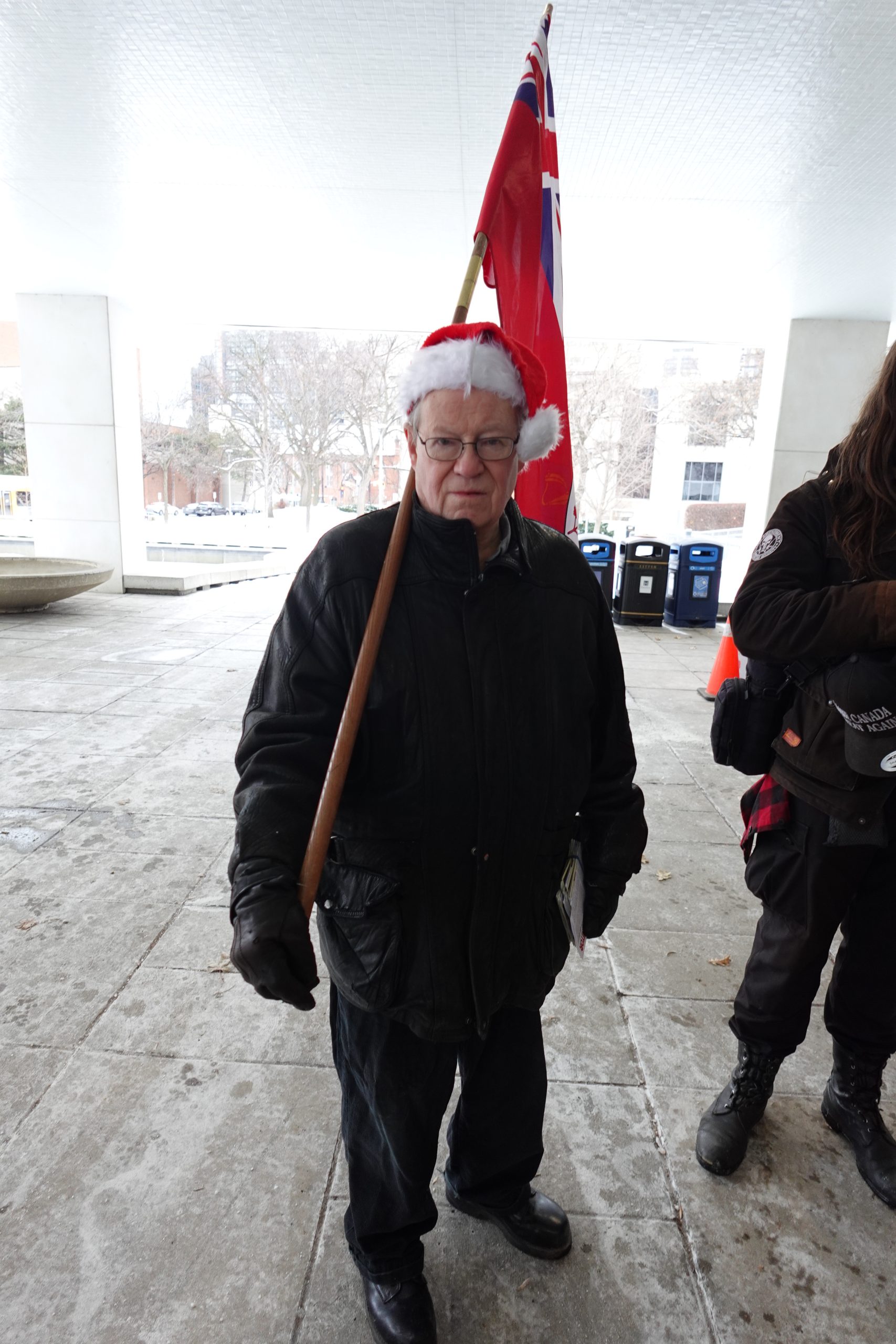
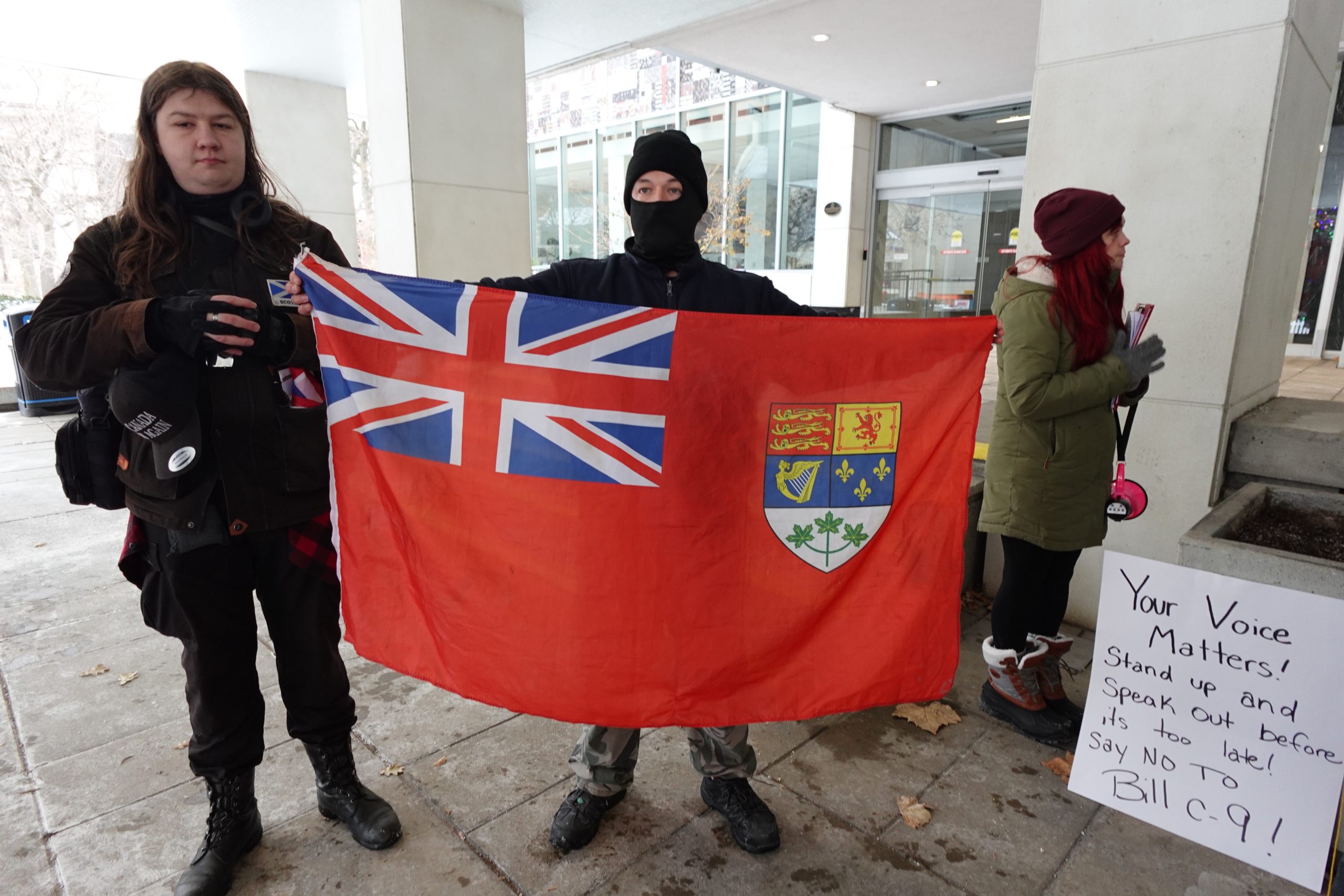
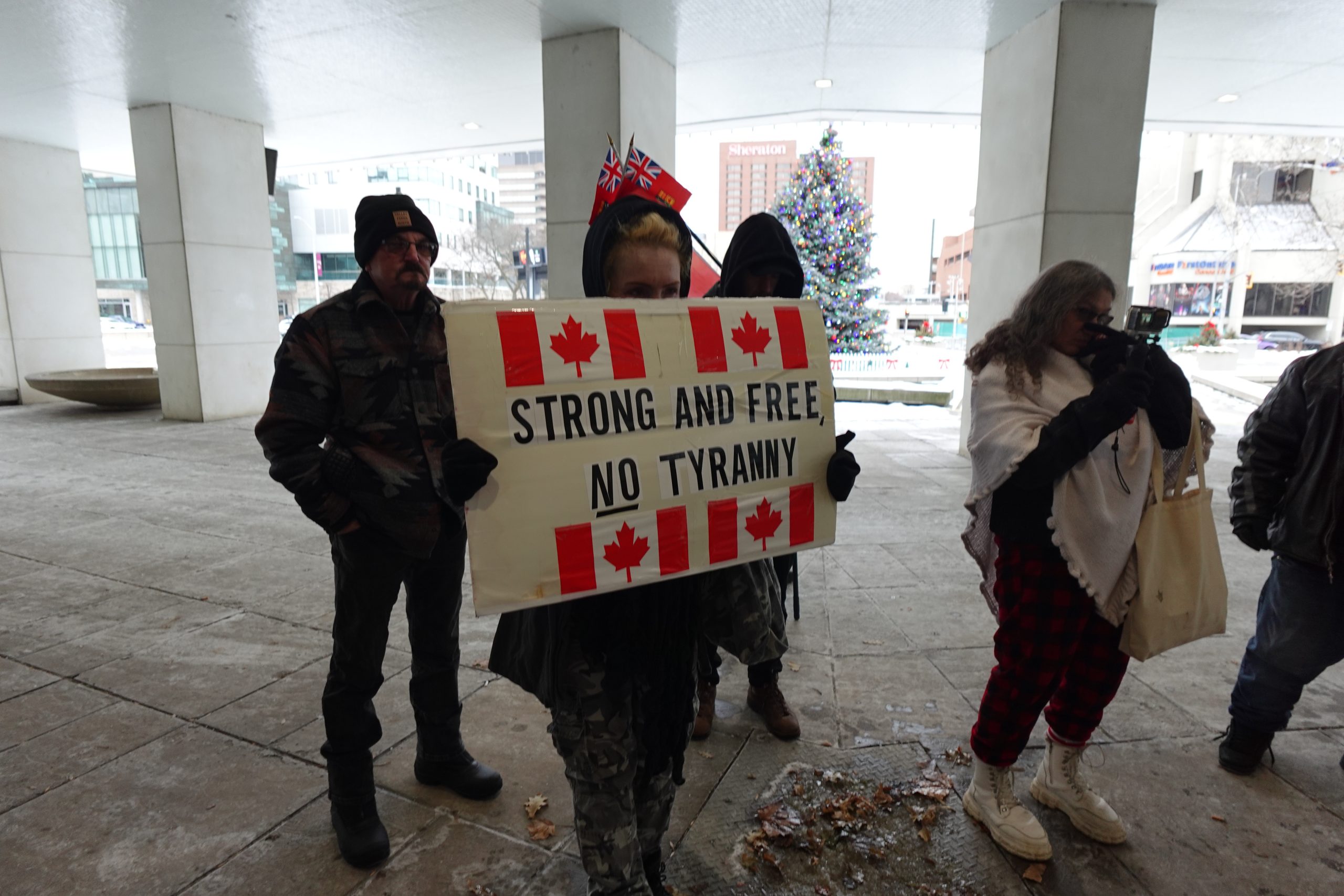
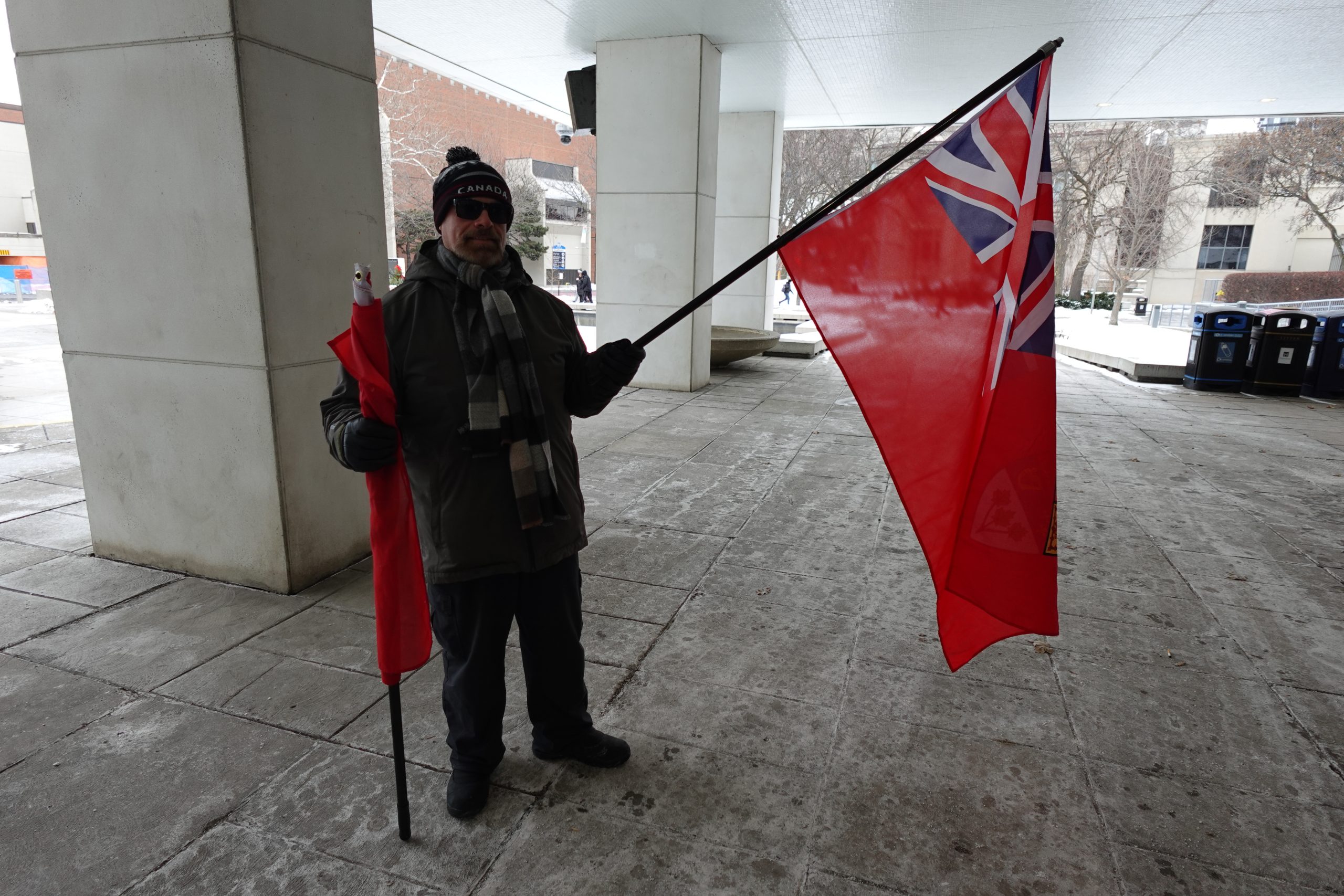
I’ve seen the Canada of my youth that cherished free speech become a crabbed, mean cancel culture, now contemplating even greater restrictions. So, on my birthday I braved bitter cold to lead about 15 CAFE associates to join a rally at Hamilton City Hall to oppose the Liberals’ latest forays into thought control on the Internet. [I fly the Red Ensign the flag of the REAL Canada.]
CAFE supporters contributed the bulk of the 30 people who gathered at Hamilton City Hall to oppose the police state censorship bills C-8 AND C-9.
A Manitoba Conservative MP is warning that the federal government’s proposed Combating Hate Act could threaten religious freedom, claiming amendments tied to Bill C-9 may allow prosecutors to “criminalize quoting the Bible.”
Brandon Leslie, the Portage–Lisgar MP, posted the warning on Facebook this week, calling the legislation “Orwellian overreach” and urging Canadians to reject it. He also promoted a petition suggesting Liberal-Bloc amendments could be used to prosecute people who share scripture from the Bible, Quran, Torah or other religious texts.
“The state has no place in the religious texts or teachings of any faith community,” the petition says, arguing that freedom of expression and religion must be protected.
Leslie repeated the accusations in Question Period, accusing the Liberals of trying to “police the thoughts of Canadians” by “making amendments to criminalize sections of sacred texts.” He linked Bill C-9 to broader cultural grievances, claiming Liberals “tacitly support tearing down statues” and are waging a war on “values, faith and heritage.”
Bill C-9 would criminalize intimidation or obstruction at religious and cultural sites, introduce tougher penalties for hate-motivated crimes, and ban public displays of Nazi or terrorist symbols except for legitimate purposes. Supplied
“Canadians do not want a government that wages war on their values, their faith, and their heritage,” he told the House.
**New criminal offences target intimidation and hate symbols**
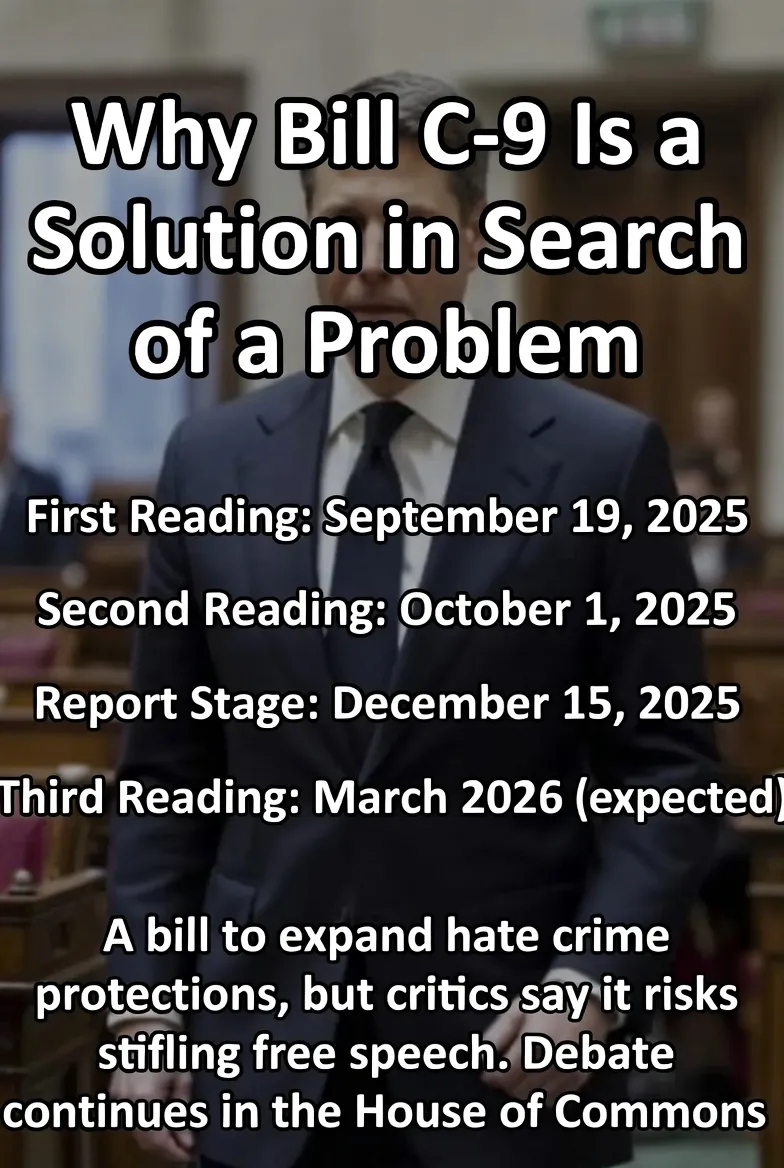
Bill C-9 was tabled in the House of Commons on October 7, and aims to update hate-crime provisions, create new offences against intimidating or blocking access to religious and cultural sites, and ban the public display of Nazi and terrorist hate symbols unless for journalism, education, religion or art.
If passed, Bill C-9 would make it a criminal offence to intimidate someone in order to stop them from entering places of worship, cultural centres, schools, seniors’ homes or cemeteries, with penalties reaching up to 10 years in prison.
The bill would also make it illegal to intentionally obstruct access to those same locations, though it includes an exception for people who are there solely to obtain or communicate information — intended to protect peaceful protest and information sharing.
Another major component of the legislation is the creation of a new hate-crime offence that increases penalties when an underlying Criminal Code offence is motivated by hatred toward an “identifiable group,” such as those defined by race, religion, gender identity, sexual orientation, age or disability.
Finally, the bill proposes a new hate-propaganda offence that would prohibit the public display of Nazi swastikas, SS bolts or symbols linked to terrorist entities. The measure includes defences to allow legitimate purposes such as journalism, education, artistic expression or religious context, ensuring those uses would not be captured by the criminal prohibition.
The law would also allow police to seek wiretap warrants and DNA orders for intimidation crimes, and judges would be able to impose bail conditions like no-contact orders or geographic restrictions, subject to judicial discretion and review.
The Charter review explicitly states that “hatred” is defined as extreme vilification, not dislike or discomfort, and that the bill would not criminalize expression that merely “discredits, humiliates, hurts or offends.”
It also clarifies that legitimate religious expression, including quoting sacred texts, does not meet the legal threshold for hate promotion unless it is used with wilful intent to encourage violence or extreme vilification.
To secure Bloc Québécois support for its censorious Bill C-9, the Liberals have reportedly agreed to a troubling trade: removing the long-standing religious defence from Canada’s hate-speech laws. This would be a mistake.
Bill C-9, the Carney government’s combating hate act, would expand criminal prohibitions on expression and increase penalties for speech offences, including online speech. Now, the bill may also gut the defence that protects good-faith religious opinion or speech rooted in religious texts.
Throughout the justice committee’s hearings, Bloc MPs fixated on this defence. Their central example, repeated to nearly every witness, was a group prayer delivered by controversial imam Adil Charkaoui at a Quebec pro-Palestinian rally in 2023. In that prayer, Charkaoui asked God to “kill the enemies of the people of Gaza” and take care of the “Zionist aggressors.”
Those comments were rightly condemned. They are grotesque. Complaints about them were investigated, and the RCMP prepared a report. It was reviewed by three Crown prosecutors, who concluded that no charges were warranted.
As Quebec’s director of criminal and penal prosecutions put it, “The evidence does not establish beyond a reasonable doubt that the words spoken constitute incitement to hatred against an identifiable group” under Sec. 319 of the Criminal Code.
One may argue that “Zionist” was just code for “Jews.” One may also believe that praying for death is morally abhorrent. But the decision not to charge Charkaoui turned on the basic threshold of incitement to hatred, not on the religious defence.
And even if it had involved the defence, one inflammatory prayer at a political rally is not a justification for dismantling a safeguard that protects millions of Canadians from state intrusion into matters of faith.
The religious defence has also been essential to the constitutionality of the hate-speech prohibition itself. In R v Keegstra, the Supreme Court wrote that the offence is a minimal impairment on the right to freedom of expression, in part because of “the presence of the Sec. 319(3) defences.” The courts upheld the law because the religious exemption exists. Remove it, and the constitutional floor collapses.
But even beyond constitutional risk, removing the defence is a profound moral and civil liberties mistake. We should not want, let alone empower, prosecutors to criminalize any form of prayer.
Religious texts across traditions contain pleas for justice against enemies, metaphors for divine retribution and expressions of anguish, symbolism and cosmic struggle. This is not the realm of the police. If the state begins parsing Psalms or Hadiths line-by-line in a courtroom, then we have forgotten why the Charter exists at all.
Advertisement 1
Trending
In practice, the defence is already exceedingly narrow. It has rarely been invoked and, based on my case law search, has never succeeded. Courts have also rejected attempts to cloak hateful speech in religious language.
In R v Harding, for example, the Court of Appeal for Ontario affirmed a lower court’s finding that the defence does not shield speech that wilfully promotes hatred merely because it is embedded with religious language, because then “religious opinion could be used with impunity as a Trojan horse to carry the intended message of hate forbidden by Sec. 319.”
Religious expression is messy, symbolic and deeply human. It concerns the nature of justice, suffering, good and evil — the most intimate dimensions of identity and conscience. These are precisely the areas where the criminal law must not tread. We do not want the government parsing religious texts, or religious speech, especially given that most of our political leaders are absolutely ignorant of religion, including, in some cases, their own religion.
For example, in a shocking display at the justice committee, Liberal committee chair Marc Miller claimed to Derek Ross, executive director of the Christian Legal Fellowship, that portions of the Bible are “hateful.” Miller then doubled down on X, writing, “I say this, in particular because I am a Christian,” which is in itself mind-boggling.
It’s dangerous for politicians to believe they can use statutes to sanitize scripture they don’t even properly understand. Criminal law is the state’s most violent instrument. It should not be swung at the human soul.
The Bible is the most banned book in history, precisely because it is powerful and points to an authority beyond the reach of government. A government that fears religious speech is not fighting extremism — it’s fighting competition.
The proposed amendment to Bill C-9 would take Canada down a dark path. We should never have criminalized belief in the first place. Strip away the religious defence, and Canada will not be combating hate, it will be criminalizing faith. The defence must be maintained. (National Post, December 4, 2025)
Christine Van Geyn Litigation Director Canadian Constitution Foundation cvangeyn@theccf.ca TO: The Standing Committee on Justice and Human Rights RE: Canadian Constitution Foundation brief on Bill C-9, An Act to amend the Criminal Code (hate propaganda, hate crime and access to religious or cultural places) November 4, 2025 The CCF The Canadian Constitution Foundation (“the CCF”) has prepared this brief to outline our concerns with Bill C-9, An Act to amend the Criminal Code (hate propaganda, hate crime and access to religious or cultural places). The CCF is a non-partisan charity dedicated to defending Canadians’ rights and freedoms through education, communications and litigation. The CCF is involved in dozens of cases per year in defence of the constitution. The CCF has been involved in landmark cases involving freedom of expression, including Saskatchewan v Whatcott, 2013 SCC 11, and Ward v Quebec, 2021 SCC 43. The CCF successfully challenged the invocation of the Emergencies Act in February 2022, where the Federal Court found the invocation was ultra vires and the regulations violated the Charter of Rights and Freedoms’ protections of expression and security against unreasonable searches and seizures. The decision remains under appeal. The CCF also offers free online courses for members of the public, including courses on the fundamentals of Canada’s constitution and a course on freedom of expression. I have co-written three books that discuss free expression: Pandemic Panic, Free Speech in Canada and Maple’s Garden. The CCF’s concerns Bill C-9 proposes major changes to Canada’s hate propaganda regime. These changes will lead to more people being investigated, charged, and prosecuted for their words. Hate against people is wrong, and our society must confront hate and condemn it. But the criminal law is not the right tool for every social scourge. The criminal law comes with a loss of liberty, and our highest level of social stigma. Expanding the possibility of putting people in prison for their words, or even being labelled hate propagandists, also risks capturing speech that may merely offend. The scope of debate on controversial topics of public importance will be limited and chilled if the threat of criminal sanction is expanded and looms over our civil discourse. The Charter right to freedom of expression guaranteed in section 2(b) protects all speech, including speech that offends, and even hate speech. The guarantee is content neutral. The question before the courts in cases involving extreme speech is always about when limits can be Page 1 of 7 Christine Van Geyn Litigation Director Canadian Constitution Foundation cvangeyn@theccf.ca imposed on speech, not whether speech is protected. To ensure the widest possible scope of debate and the search for truth, it is vital that the threshold for criminal sanction of speech is high. Bill C-9 would lower this threshold, remove safeguards against politically motivated charges, remove political accountability for charges, would create a risk of overcharging to force plea bargains, expand the availability of hate offences beyond the criminal law, and risks limiting constitutionally protected protest activity. Canadians are not safer when we do not know what people believe. The criminal law can never remove hate from an individual’s heart. Instead, the criminal law should be oriented towards doing what it can do: restricting violence and threats of violence, which includes intimidation, harassment, and blockading. The concept of hatred is subjective, and when opinion is criminalized, we make martyrs out of hatemongers and draw more attention to their vile viewpoints. Criminalizing opinion forces hateful speech underground and online, where individuals can get trapped in cycles of radicalization, and where hateful ideas are not confronted with the truth. In the end, as John Stuart Mill warned in his famous defence of free speech in On Liberty, suppressing opinions prevents the exchange of error for truth, and deprives us of the clearer and livelier perception of the truth that comes from its collision with falsehood. The primary duties of Parliament are to represent the electorate, hold the executive accountable, and uphold Canada’s constitutional democracy. Parliament has an obligation to ensure laws it passes are in keeping with our constitution, including our constitutional protection for freedom of expression. Some of the proposals in Bill C-9 are very likely unjustified violations of this protection, guaranteed by the supreme law of Canada. Others are unnecessary because they are redundant in light of Canada’s existing laws. Accordingly, the CCF’s primary recommendation is to withdraw Bill C-9. In the alternative, the CCF proposes six amendments that could reduce, though not eliminate, the risk that C-9 unjustifiably violates freedom of expression. Amendment 1: The definition of hate in Bill C-9 must exactly track the case law. The Criminal Code prohibits the public incitement of hatred in section 319(1) and the wilful promotion of hatred in section 319(2). Public incitement of hatred prohibits the communication of a statement in public that incites hatred against any identifiable group where such incitement is likely to lead to a breach of the peace. Page 2 of 7 Christine Van Geyn Litigation Director Canadian Constitution Foundation cvangeyn@theccf.ca Wilful promotion of hatred prohibits communicating statements, other than in private communication, that wilfully promote hatred against an identifiable group. If Parliament wishes to provide a statutory definition of “hatred” for offences in section 319 of the Criminal Code, this statutory definition must precisely track the definition that has been outlined by the Supreme Court as high enough to protect freedom of expression. In R v Keegstra, [1990] 3 SCR 697, the majority of the Supreme Court held that “the term ‘hatred’ connotes emotion of an intense and extreme nature that is clearly associated with vilification and detestation.” The court in Keegstra warned that there is a danger that a court may improperly infer hatred from statements he or she personally finds offensive. This is why the court recognized the need to circumscribe the definition of “hatred” in such a precise manner. In R v Andrews, [1990] 3 SCR 870, Cory J.A. stated that: “Hatred is not a word of casual connotation. To promote hatred is to instil detestation, enmity, ill-will and malevolence in another. Clearly an expression must go a long way before it qualifies within the definition in [s. 319(2)].” More recently, in Saskatchewan v Whatcott, 2013 SCC 11, the Court reiterated that: “…the legislative term “hatred” or “hatred or contempt” is to be interpreted as being restricted to those extreme manifestations of the emotion described by the words “detestation” and “vilification”.” This filters out expression which, while repugnant and offensive, does not incite the level of abhorrence, delegitimization and rejection that risks causing discrimination or other harmful effects” (emphasis added). In Whatcott, Justice Rothstein struck down a Saskatchewan provision that outlawed speech that “ridicules, belittles or otherwise affronts the dignity of” protected groups because that definition of hatred “could capture a great deal of expression which, while offensive to most people, falls short of exposing its target group to the extreme detestation and vilification which risks provoking discriminatory activities against that group” (emphasis added). The definition of hatred laid out in C-9 is a lower threshold than that set out in Keegstra. Section 319(7) of -9 defines hatred as “the emotion that involves detestation or vilification and that is stronger than disdain or dislike” (emphasis added). The proposed definition removes the requirement that the speech be the “intense and extreme”, and now merely requires that the emotion “involve” detestation or vilification rather Page 3 of 7 Christine Van Geyn Litigation Director Canadian Constitution Foundation cvangeyn@theccf.ca than be “clearly associated” with detestation and vilification. It also lowers the standard by defining hate as the emotion associated with detestation “or” vilification, rather than detestation “and” vilification. While the Minister of Justice has suggested that the intention of the bill is to reflect the case law and paraphrase the words of the court, the most important aspect of the law, if passed, that a future court will consider is the actual text. The intention of the Minister will likely be argued, but Parliament does not vote on the Minister’s statements: it votes on the text. If Parliament is to legislate the definition of hatred, it risks violating constitutional rights if it departs from the words the court has already upheld as constitutional limits on free expression. Recommendation 2: Maintain the requirement for attorney general consent for hate crime offences Currently, any prosecution for a hate propaganda offence in section 319 of the Criminal Code requires consent of the attorney general. This requirement is an important institutional safeguard on the abuse of this especially sensitive provision of the Criminal Code. Determining whether someone will face a prison sentence for the words they speak requires political accountability, and charges require a careful balancing of the public interest and the constitutional guarantee for freedom of expression. There are serious risks associated with removing the requirement of attorney general consent, including the risk of arbitrary, inconsistent, or selective enforcement based on political or ideological grounds. It also risks charges that have no chance of conviction on the basis of speech that offends the public. This risks chilling lawful political debate and dissent. There is an additional concern that removing attorney general consent will allow for the possibility of private prosecutions. While private prosecutions for criminal offences are rare in Canadian law, the subjective nature of hatred combined with the current climate of political polarization makes the risk of abuse of private prosecutions for this type of law especially concerning. Recommendation 3: Remove the standalone hate offence in proposed section 320.1001(1) The law currently treats hatred as an aggravating factor at the sentencing stage. If an offence is motivated by hatred, the sentencing judge can take that into account and impose a more serious sentence. This should not be changed. Page 4 of 7 Christine Van Geyn Litigation Director Canadian Constitution Foundation cvangeyn@theccf.ca Bill C-9 proposes the creation of new standalone hate crime offences that layer on top of another offence. And this is not confined to criminal law. Bill C-9 proposes that everyone who commits an offence contrary to any act of Parliament that is “motivated by hatred” is guilty of a separate offence. This dramatically expands criminal liability. It could make quasi-criminal or even regulatory offences criminal offences if they are “motivated” by hatred. This approach is duplicative punishment for criminal offences, and it risks transforming non-criminal offences into criminal offences that carry with them terms of imprisonment and the social stigma of the criminal law. By creating the possibility of a duplicate offence with high penalties, Bill C-9 creates a risk of overcharging. Crowns, no longer constrained by the requirement of attorney general consent, may pressure defendants to plead guilty by layering the threat of more serious hate charges on top of other criminal – or even quasi-criminal – charges. Hatred should remain a sentencing consideration. Recommendation 4: Remove the prohibition on “hate symbols” Bill C-9 makes it an offence to wilfully promote hatred by displaying listed hate symbols, including the Nazi Hakenkreuz, or hooked-cross1, the Nazi double Sig-Rune, also known as the SS bolts, as well as symbols that are “principally used by, or principally associated with” listed terrorist organizations. To be clear, the display of these symbols to wilfully promote or incite hatred are despicable. But the proposal in Bill C-9 is flawed for at least four reasons. First, Canadians are not made safer if we do not know that someone down the street from our home holds racist and evil views. We are better off knowing who holds disturbing opinions so that we can openly confront those viewpoints, or stay away from such people. Every year our newspapers feature at least one story about a local crank flying a Nazi symbol. And every year we are reminded that these symbols, though horrible, are legal. Driving these symbols underground through the criminal law grants them more power and mystique than they deserve. 1 Bill C-9 calls this symbol the Nazi swastika, which is a common misnomer. The word swastika is a Sanskrit word for an ancient and sacred symbol in Eastern religions like Hinduism, Buddhism, and Jainism. Page 5 of 7 Christine Van Geyn Litigation Director Canadian Constitution Foundation cvangeyn@theccf.ca Second, the existing hate propaganda offences can already capture the use of symbols if those symbols are used to wilfully promote or incite hatred. Under the current law, the display of these symbols alone is not sufficient for a charge. Bill C-9 could change that. While the Minister has suggested that this provision is intended to supplement the existing wilful promotion of hatred offence to place more emphasis on the use of hate symbols, the text leaves significant room for interpretation. The text could easily be read to mean that the display of these symbols on their own can now be grounds for an offence. And to reiterate, Parliament votes on the text of the Bill, not on the intentions of the minister, and a court interpreting the law will look first at the text. Prohibiting the symbols alone would also capture too much expression. While it is distasteful, foolish and inaccurate to compare any Canadian parliamentarians to Nazis or terrorists, we often see these comparisons made by some disaffected citizens exercising their freedom of expression. Some of these comparisons are made using these symbols, and this common type of political speech could now be subject to criminal sanction. There is also too much ambiguity in the text of the provision, as it would prohibit symbols that are “principally used by” or “associated with” terrorist groups, or symbols that “nearly resemble” the symbols of terrorist groups or that are “likely to be confused” with those symbols. Recommendation 5: Remove new provisions on intimidation Bill C-9 would make it an offence to engage in any conduct with the intent to provoke a state of fear in a person in order to impede their access to places of worship or cultural centres. This provision is duplicative and can lead to confusion among law enforcement. The Criminal Code already prohibits intimidation under section 423, harassment under section 264, and mischief under section 420. Provincial highway traffic statutes also prohibit blockading roads. When protests blockade roads or building entrances, police can already use these tools to remove them. The rule of law requires the enforcement of the law, not the creation of new and increasingly narrow laws when police fail to act. Recommendation 6: Keep the defences of truth and good faith religious opinion in section 319(3) Page 6 of 7 Christine Van Geyn Litigation Director Canadian Constitution Foundation cvangeyn@theccf.ca There has been some suggestion that the defences to hate propaganda offences in section 319(3) of the Criminal Code should be repealed. These defences provide that no person shall be convicted of wilful promotion of hatred if the statements were true or were a good faith expression of an opinion on a religious subject or based on a belief in a religious text. These defences must be maintained. The courts have considered the religious belief defence in 319(3), and the existence of this defence has been core in the analysis that found the offence of wilfully promoting hatred to be a justified limit, in for example, Keegstra. Removing this defence would open up the legislation to a new constitutional challenge. It is also worth noting that there has never been an instance where the defence was argued successfully. The courts have interpreted the defence as a narrow one, and found that it does not operate so as to shield speech that wilfully promotes hatred merely because it is embedded with religious language. The court in R v Harding, 2001 CanLII 21272 (ON CA) held that: “Although expression of religious opinion is strongly protected, this protection cannot be extended to shield this type of communication simply because they are contained in the same message and the one is used to bolster the other. If that were the case, religious opinion could be used with impunity as a Trojan Horse to carry the intended message of hate forbidden by s. 319.” Removing the religious defence, combined with removing the requirement for attorney general consent, would lead to investigations and charges based on good faith but misunderstood religious dialogue, and would inevitably lead to a chill on religious debate or even good faith political debate on moral topics out of fear of severe criminal sanction. Page 7 of 7
Canadian Constitution Foundation Warns: Liberal Hate Crimes Bill (C-9) Raises Free Speech Concerns
The Canadian Constitution Foundation (CCF) is concerned that key aspects of the Carney government’s proposed hate crimes legislation would unduly infringe on freedom of expression.
Among other changes to the Criminal Code, Bill C-9 would establish a standalone hate crime provision that would allow for up to life in prison for committing an act motivated by hatred, would create new intimidation and obstruction crimes related to buildings used for religious worship or primarily by identifiable groups, and would establish a new crime of wilfully promoting hatred by displaying certain symbols such as terrorist flags or Nazi swastikas in a public place. [But not the communist hammer and sickle or the Israeli flag.]
The CCF has identified the following concerns:
Overbreadth of the hate-symbol provision (s. 319(2.2)): It could chill legitimate speech in cases where it is unclear whether a symbol is “principally associated with a terrorist group” or “resembles a symbol” outlawed under the provision;
Extreme sentencing under the new hate crime offence (s. 320.1001): A person who commits mischief against property motivated by hatred could face up to seven years in prison, rather than the current two years;
Removal of Attorney General oversight: The bill would allow police to charge a person with hate speech without receiving the Attorney General’s consent, which is an important safeguard for freedom of expression that has been part of Canada’s law for decades; and
Lowering the threshold for “hatred”: The definition of “hatred” added as a new section 319(7) appears to lower the bar for hate speech set by the Supreme Court of Canada in cases like R v Keegstra and R v Whatcott, which could chill speech and public debate.
CCF Executive Director Joanna Baron questioned the need for parts of the bill considering Canada already has “robust hate propaganda laws. Creating new offences for hate-motivated crimes and lowering safeguards like Attorney General oversight is unnecessary and invites excessive prosecutions,” she said. ‘The new hate symbol offence only targets displays done with the intent to promote hatred, but without Attorney General consent as a safeguard, there is a real risk that people using these symbols in art, journalism, or protest will be charged first and vindicated later,” Baron added.
“I’m also very wary that banning hate symbols could be a slippery slope,” Dehaas said. “In free countries, we ought to criminalize violence, not speech, so this sets a worrying precedent.” (Canadian Constitution Foundation, September 19, 2025)
A Calgary casino cancelled a performance by Toronto comedian Ben Bankas after receiving two complaints about jokes he made regarding residential schools.
“They said that they got two complaint emails, and they forwarded one of them to me,” Bankas told True North. “I guess some woman saw the video on Facebook and was offended.”
The video, posted to social media by Bankas on the National Day for Truth and Reconciliation, showcases him from a previous set saying that he’d just returned from Winnipeg, and it was like “an Indigenous zombie apocalypse.”
“I was thinking it’d be nice if there’s, you know, some sort of school we could send them to,” he continued. “Unfortunately, that ship has sailed. Say what you want about the residential schools, but you know, it’s nice architecture… I’m just saying it like those schools… If you wanted to go to a residential school now, in 2025 it’d be like $40,000 a year. Those motherf**kers got it for free.”
He was scheduled to play at the Grey Eagle Casino on the Tsuut’ina Nation in Calgary on Oct. 24, but the venue cancelled after receiving two complaints.
“This comedian goes by the name of ‘Ben Bankas,’ is due to perform at your event centre on October 24 2025 as advertised on social media,” reads the complaint shared with Benkas. “I would strongly advise your team to reconsider unless some sort of public apology is made to the Indigenous people of Canada.”
The comedian had performed in Calgary several times at the Yuk Yuk’s comedy club in recent years before moving to the Deerfoot Inn & Casino for larger seating capacity.
“For two years I was doing sold out shows at Yuks and then we stepped up to Deerfoot, and then this was like the next step up,” said Benkas. “I think they still should have done the show even though they were offended,” reflected Benkas. “But with everything that’s going with Bill C-8 and C-9, it’s a…weird time.”
Bill C-8 is currently before Parliament for its second reading, which would make changes to the Telecommunications Act. Section 15.2 (1) of one of the Bill’s parts enables the federal government to “prohibit a telecommunications service provider from providing any service to any specific person, including a telecommunications service provider.”
The justification for doing so includes “any reasonable grounds to believe it is necessary to do so to secure the Canadian telecommunications system against any threat, including that of interference, manipulation, disruption, or degradation.”
Meanwhile, Bill C-9, entitled An Act to amend the Criminal Code (hate propaganda, hate crime and access to religious or cultural places), was introduced last month.
The proposed legislation would define “hatred” in the Criminal Code.
When asked whether he faced any other backlash from the video, Bankas said there were a few “death threats and weird DMs (direct messages).”
“One person said they ‘were going to hunt me down like the animal I was,’” he said.
Before the show was cancelled, roughly 1,700 of 2,300 available tickets had been sold. While those who purchased tickets have been refunded, the two parties involved are still sorting out payment.
“It’s unconfirmed if they’re going to pay me because there was a guarantee,” he said. “It wasn’t a percentage of ticket sales. So it’s up in the air whether they’re going to pay me or not. I think they should.”
When True North contacted Grey Eagle Casino, they stated the show was cancelled due to “unforeseen circumstances” but declined to comment on Bankas’ financial situation.
Outside of the recent venue cancellation, Bankas said his career is going great.
“Audiences love it. The shows are all selling out. Pretty much everything is sold out for the next two months,” he said. “I just put out a special aimed mostly towards a Canadian audience called Invasion. It’s on my YouTube channel.”
The show at Grey Eagle Casino has been relocated to Yuk Yuk’s comedy club in Calgary for seven shows between October 24 and 27.
The Canadian Constitution Foundation (CCF) is concerned that key aspects of the Carney government’s proposed hate crimes legislation would unduly infringe on freedom of expression.
Among other changes to the Criminal Code, Bill C-9 would establish a standalone hate crime provision that would allow for up to life in prison for committing an act motivated by hatred, would create new intimidation and obstruction crimes related to buildings used for religious worship or primarily by identifiable groups, and would establish a new crime of wilfully promoting hatred by displaying certain symbols such as terrorist flags or Nazi swastikas in a public place.
The CCF has identified the following concerns:
Overbreadth of the hate-symbol provision (s. 319(2.2)): It could chill legitimate speech in cases where it is unclear whether a symbol is “principally associated with a terrorist group” or “resembles a symbol” outlawed under the provision;
Extreme sentencing under the new hate crime offence (s. 320.1001): A person who commits mischief against property motivated by hatred could face up to seven years in prison, rather than the current two years;
Removal of Attorney General oversight: The bill would allow police to charge a person with hate speech without receiving the Attorney General’s consent, which is an important safeguard for freedom of expression that has been part of Canada’s law for decades; and
Lowering the threshold for “hatred”: The definition of “hatred” added as a new section 319(7) appears to lower the bar for hate speech set by the Supreme Court of Canada in cases like R v Keegstra and R v Whatcott, which could chill speech and public debate.
CCF Executive Director Joanna Baron questioned the need for parts of the bill considering Canada already has “robust hate propaganda laws.”
“Creating new offences for hate-motivated crimes and lowering safeguards like Attorney General oversight is unnecessary and invites excessive prosecutions,” she said.
“The new hate symbol offence only targets displays done with the intent to promote hatred, but without Attorney General consent as a safeguard, there is a real risk that people using these symbols in art, journalism, or protest will be charged first and vindicated later,” Baron added.
CCF Counsel Josh Dehaas said that while he’s pleased to see that the federal government has tailored its provisions on intimidation and obstruction of places of worship to capture criminal conduct rather than protected speech and protest, he is concerned that the new definition of “hatred” will chill legitimate expression.
“I’m also very wary that banning hate symbols could be a slippery slope,” Dehaas said. “In free countries, we ought to criminalize violence, not speech, so this sets a worrying precedent.”