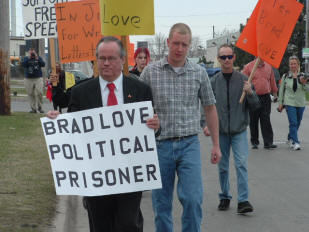
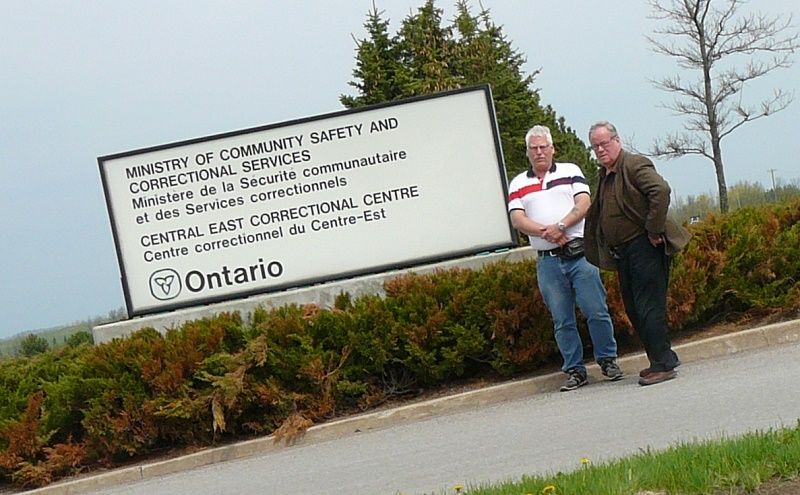
James Keegstra, Dedicated Christian, Free Speech Martyr and Free Thinker Dead at 80
James Keegstra will some day be recognized as a sincere, gentle man, whose politically incorrect views resulted in his being crushed by a media frenzy, a frightened citizenry and a judiciary sharpening the barbs of Canada’s speech repression laws. When, in 1990, the Supreme Court upheld his conviction under Canada’s notorious “hate law” (now Sec. 319 of the Criminal Code) by a narrow 5-4 margin, it became clear — and has with each passing year — that Trudeau’s Charter of Rights and Freedoms was a fraud. Far from guaranteeing traditional rights Canadians had enjoyed under Anglo-Saxon Common Law — rights like freedom of speech, — the Keegstra case helped Canadians see that they had been granted certain privileges by their government which could quickly be snatched away by government, for a good reason, of course.
The year 1985, one year after George Orwell’s year of apocalyptic horror, brought Canada into the eerie age of thought-crimes trials. Three convictions that year – Ernst Zundel in February under the archaic “false news” law, later found unconstitutional by the Supreme Court, James Keegstra in July, and Don Andrews/Robert Smith in December, under the “hate law” – saw Canadians tried, convicted, and, in two trials (Zundel’s and Andrews/Smith) sentenced to prison for nothing more than the non-violent expression of their political their or religious views which is, incidentally, how Amnesty International describes a political prisoner – a fact that puts Canada in a somewhat embarrassing situation.
Born in 1934 in Vulcan, Alberta of Dutch immigrant parents who were dairy farmers, James Keegstra earned a university degree in education. He moved to Eckville, Alberta in 1968 and began teaching high school social studies. He was also a mechanic. Jim’s quiet demeanor and shyness, seen in many of the photos of his trial, won him a following. Both in his school and the larger community, James Keegstra was well liked. His easy going informality appealed to small town Albertans who soon elected him to the Eckville council and then elected him as mayor.
The Calgary Sun (June 13, 2014) reported that, after a 13 year successful teaching career, Mr. Keegstra ran afoul of his board of education: “Keegstra remained unmoved after being ordered to stop teaching Jewish conspiracy as a fact in social studies class and was canned from his teaching position in December, 1982. While some of his students felt betrayed by the Holocaust denier, most of his pupils rallied around Keegstra, who was then Eckville’s mayor.But that was only the beginning of a 12-year courtroom odyssey that would test the country’s limits of free speech.Soon after being dumped as Eckville’s mayor, Keegstra was charged in January 1984 with willfully promoting hatred. …
While Keegstra insisted he was defending free speech and the truth, prosecutors argued his poisoning of young, captive minds couldn’t be ignored. After a 70-day trial, the ex-teacher was convicted and fined $5,000 — a decision that was to be overturned by the Alberta Court of Appeal in 1988.
That same year, an arsonist using cans of gasoline tried to torch the ex-teacher’s Eckville home, a move he called “an act of terrorism” and an attempt to muzzle his views.
In December 1990, the country’s supreme court upended the lower court’s ruling by insisting the law was constitutional and the case was sent back to the court of appeal.
A retrial was ordered in April 1991 — a decision many in Keegstra’s hometown decried. ‘I think it’s a silly waste of money … Eckville has been taking lumps for this for the past eight years,’ said the town’s then-mayor Bill Scott. …
Said Keegstra: ‘There’s no freedom of speech in the world — we’re all under Zionist and communist control.’ In the summer of 1992, Keegstra was found guilty and handed a $3,000-fine but the defendant appealed by arguing the judged erred in responding to jurors’ questions. But the Supreme Court of Canada upheld the second conviction and again sent the case back to the Alberta Court of Appeal for sentencing.
By now, Keegstra made his living in Eckville as an auto mechanic —a man his lawyer said had been punished enough, impoverished and vilified by the media. In 1996, he was given a one-year suspended sentence and ordered to perform 200 hours of community service — preferably for victims of discrimination.”
In opening his final summation in James Keegstra’s first trail, July 11, 1985, his lawyer Douglas H. Christie, the Battling Barrister, said: “Mr. JamesKeegstra is a man of 51 years of age. His life’s work and chosen vocation for 21 years was teaching. He is the man who served as Mayor of his town for several years. He was described by all but Robert David as a sincere and honest man. He served what he believed to be God, Queen and country. He was fired from his job. He has lost his career, lost his right to practice his vocation. He has been destroyed as Mayor. He has seen his reputation destroyed, and so has his family. He has suffered all this as a sincere and honest Christian.”
What was James Keegstra’s sin? In their headlines, like the Globe and Mail’s (June 14, 2014) “Holocaust denier who waged lengthy battle dies at 80”, the media flagged him as a “heretic.” The new secular religion of the West is the “holocaust.” To challenge or question it in any way is heresy and heretics must be punished with total destruction. “Holocaust denier” is a vague term that simply connotes evil or heretic. Virtually no one denies that Jews were killed in World War II. However, the term suggests the person so labelled does adopt this absurd view.
Most people accused of “holocaust denial” see the Hollywood version of WW II as a vast exaggeration and, worse, unlike most accounts of history, one that is used today to extract huge sums of money from Germany nearly 70 years after the war and to influence public policy. For instance, in 1999 when six rusting shiploads of Chinese illegals slithered into British Columbia waters, Canada’s Jewish Minister of Immigration Elinor Caplan said she was not going to be a gatekeeper and invoked the holocaust. Thus, if you want to keep out queue-jumpers and gate crashers, you’re a Nazi and want another “holocaust.”
The “holocaust” story is Jewish tribal history. It is, like all tribal histories, self-centred and self-focused. However, under huge pressure, the political elite in the West has adopted it as their own religion. Religion is, essentially, a matter of faith. Those who point to contradictions in the tenets of the “holocaust faith” — for instance, the claim that it was the greatest crime in history, in a century that saw the deliberate extermination of 8-10-million Ukrainian farmers in Stalin’s efforts to break the resistance to collectivization — are branded as “holocaust deniers” or heretics. Debate over. Fire him. Make it impossible for him to earn a living. Off to prison with him.
James Keegstra was a deeply religious man and a stubborn Dutchman. These were both his salvation and his curse. Mr. Keegstra firmly believed that there had been various conspiracies, including ones heavily influenced by Jews, that explained much of the history of the past 300 years. As a committed Christian, he felt obliged to convey these truths to his students. He did not compel them to accept his views but sought to challenge them. After some parental complaints, the school board told him to stick to the curriculum. His faith and determined nature led him to continue offering these alternative ideas to his students.
Much is made of Mr. Keegstra’s unusual curriculum. As a former teacher, eventually fired due to Jewish lobby pressure, not for my classroom behaviour but for my political views espoused on my own time outside school property, I knew of many teachers who injected a strident leftist political agenda into their English or history classes. One Catholic high school teacher. in the early 1980s, insisted that his senior religion class attend and participate in leftist “peace demonstrations.” Some English teachers I knew indoctrinated their students with White guilt and strident “anti-racism.” [What this political agenda had to do with teaching grammar, writing skills and English literature, who knows, and the authorities didn’t care.]
Once the complaints against James Keegstra went public, the media, egged on by self-interested minorities, went into a frenzy. The small town of Eckville didn’t know what hit them. Few journalists adopted a balanced perspective. Like pirhanas in a feeding frenzy, they smelled blood in the water and razor-teeth flashing raced in for the kill.
James Keegstra’s lawyer, Doug Christie, described the process that would be visited upon many of other politically incorrect dissidents — Ernst Zundel, Malcolm Ross, Terry Tremaine, to name just a few: Demonize, isolate, criminalize. First there is an orchestrated media campaign of denunciation. The victim is isolated. Friends go silent. Would-be supporters note the treatment meted out to the heretic and decide to draw back. They don’t want the same fate for themselves — friends of the heretic are as bad as the heretic himself. Now with the victim thoroughly isolated and virtually friendless, it is safe for the state to move in for the kill with criminal charges.
The people of Eckville who had liked and supported James Keegstra were appalled at the publicity and apparent vilification of their town. They began to draw back. James Keegstra retained a small but loyal following of supporters, many of them Social Crediters. Many of his former students and townspeople stood by him. But others sought a way for this whole thing to go away.
Even if one agrees that a school board could fire James Keegstra for not sticking to its curriculum, what happened next resembled a witch trial. It was not enough that Mr. Keegstra was fired, a vindictive province took away his teaching certificate, and, therefore, his ability to support his family as a teacher. Frightened townspeople voted him out as mayor.
But that was still not enough for the politically correct. A heretic must not just be exiled; he must be destroyed. As burning at the stake had gone out of fashion, a political trial under Canada’s “hate law” seemed the next best thing. By now, Mr. Keegstra was being subjected to triple jeopardy.
An amazing incident recounted by Doug Christie illustrates this point. After the guilty verdict in James Keegstra’s first trial was announced, the foreman of the jury approached Doug Christie and gave him a substantial cheque: “I want to be the first to contribute to Jim’s appeal,” he said.
Doug Christie was flabbergasted. “Why? Why?” he asked. “You had the power to acquit him.”
The foreman replied: “We liked Mr. Keegstra, but all the publicity. You know what it’s doing to this town.” So, convenience led otherwise good people to toss James Keegstra, a man they liked, under the bus.
I heard much the same thing from my district union leader during Peel Board of Education hearings into my firing. He told me: “Mr. Christie, your lawyer is brilliant. His speeches on freedom of speech are powerful and eloquent, but you’re going to lose.”
“Why?” I asked.
“Because,” he answered,” the day after they fire you, the phone calls stop.” In other words, it was not a matter of high principle but merely convenience. If the censors and thought control fanatics can raise enough noise about the heretic, convenience will dictate the sacrifice of the heretic to shut them up.
The long trials reduced James Keegstra to penury. He eked out a modest living as a mechanic and later as a custodian. He died June 2, 2014.
The Calgary Sun (June 14, 2014) reported Mr. Keegstra saying on the eve of his first trial: ““I don’t want to be a martyr, I just want justice,” Keegstra told reporters in February of that year as his case began. “He did not get his wish: He was a martyr to political correctness and he never received justice.”
James Keegstra, as even his tormenters acknowledged, remained unbroken — again his strong Christian faith and Dutch stubbornness. As the great French chanteuse Edith Piaf sang: “Je ne regretted rien.” So too, James Keegstra: “It’s been a long fight and I think it’s been worth it,” he said.
What sustained him? As one who knew James Keegstra on and off for 30 years, I can say that it was the loyal love of his lovely wife Lorraine who stood by Jim through all the abuse and punishment and his abiding faith in God. And, yes, that old quiet Dutch stubbornness and resolve.
My fervent hope is next time bossy boots Canada lectures Russia about outlawing homosexual propaganda and proclaims our attachment to freedom of speech, that President Putin scoffs and whispers in Harper’s ear: “What about James Keegstra? Free speech, ha!” — Paul Fromm
____________________________________
For a copy of Doug Christie’s brilliant summation at the first Keegstra trial, read Thought Crimes: The Keegstra Case(available from C-G\FAR Books, P.O. Box 332, Rexdale, ON., M9W 5L3, for $5.00 posdtpaid.)
Terry Long’s Appreciation of the Life of James Keegstra
Canadian patriot and school teacher Jim Keegsta was prosecuted in 1983 under Canada’s then existing Hate statute for claiming the so-called “Holocaust” was “exaggerated”. He subsequently became the first nationally vilified martyr for Canadian freedom of speech in Canada. That claim was subsequently substantiated when the world Jewish Congress in conjunction with the Auschwitz State Museum in Poland lowered the number of gassing victims at Auschwitz from 4 million to 1 million in 1990. So for any apologist who says the numbers don’t matter, it did to patriot Jim Keegstra who lost his job as a teacher and mayor of the town he lived in and was continuously vilified and slandered by the national media ever since. As a result, he was defunctionalized socially, politically and economically. Like heretics in the middle ages who denied that the earth was the center of the universe, you don’t deny the state religion of the west and get away with it. The only difference between then and now is that they’ve found a more civilized way of burning people at the stake.
There were other Canadian martyrs before Jim, people like my good friend and mentor John Ross Taylor from Toronto who spent a year in jail in the late 1970s for a telephone message talking about the Jews and their machinations, but Jim Keegstra was the first to really go national in a big way. I guess THEY figured at the time that Canadians had been dumbed down enough that it didn’t really matter what kind of outrage was perpetrated against traditional freedoms, notwithstanding that those freedoms went all the way back to the Magna Carta, and they were right. In fact the Keegstra case was the first one to my knowledge where a Canadian judge in his final address to the jury stated, “The truth is not an issue in this case”. If the truth is not an issue in a court of Law, then what the hell is? I still haven’t figured that one out and obviously Jim Keegstra hadn’t either.
The RCMP even stationed armed snipers on the roof of the Red Deer, Alberta, court house when Jim was being tried. Canada it seems must be protected against heretics at all cost.
Jim Keegstra was a friend and patriot who went out like a man. He will be sadly missed.
Terry Long