You’ve probably heard about the Assembly of First Nations passing an emergency resolution demanding that the government make residential school “denialism” a criminal offence.
Grand Chief Garrison Settee believes that demanding evidence of unmarked graves should be considered “residential school denialism” and made into a hate crime.
But here’s the problem: at sites like the one in Kamloops, ground-penetrating radar flagged anomalies that the tribe itself said it “suspects” are unmarked graves.
No excavations have been done. No bodies have been found. And yet, asking for proof could soon land you in prison.
People can lie, but we are not obliged to believe their lies. We are free to tell the truth. That is not hatred.
Section 2 of the Charter of Rights and Freedoms protects freedom of conscience, thought, belief, opinion, and expression.
These rights exist for ideas that the government finds inconvenient, wrong, or threatening.
A right that only protects approved opinions is not a right. It’s a permission slip.
Give the government the power to declare one historical interpretation criminal, and you’ve given it the power to declare any interpretation criminal.
If a historical claim is as strong as its defenders believe, it wins in open debate.
If it needs the Criminal Code to win, that says something about the confidence of the case, not the guilt of the dissenter.
The answer to an argument you hate is a better argument, not a subpoena.
The People’s Party of Canada will always fight for your freedom of speech.
Don’t let them criminalize the truth. Stand with us!
‘Denialism’ law ‘the opposite of the spirit of reconciliation’
MICHAEL HIGGINS Comment
Lawyer settles suit over ‘graves’
‘Denialism’ law ‘the opposite of the spirit of reconciliation’
[Would-be Indian cesnors want to send you to jail for questioning this gobbledegook: “
He said he recently visited the Kamloops site and that First Nations did not have to prove there were bodies by exhuming them.
“They are there and they send us messages telling us they’re there,” he said. “You can tell they’re there, right? Feel the power and the energy. For somebody that’s not from our communities, that doesn’t understand our culture, you cannot understand what that means.”]
24 Jul 2026
Making criminals out of people who merely ask questions about the residential school system is not the path to reconciliation, says B.C. lawyer Jim Heller.
Goodwill and open dialogue are needed far more than trying to imprison people under a “denialism” law, according to Heller, whose defamation suit against his own law society over potential graves at the former Kamloops Indian Residential School was recently settled.
Heller sees the Kamloops controversy as a societal sickness where facts and truth are sidelined in favour of ideology.
“As a lawyer, it is all about promoting, developing, respecting and fine-tuning a process, all in order to ask a question. That’s what it’s all about, this kind of rigorous, analytical, open, rational thinking. And that is the foundation of everything. It’s so fundamental,” he said in an interview Tuesday.
But rigour and analysis are now absent in many parts of our institutions, leaving them open to attack from outside forces, he said.
“There’s a weakening and a sickness in our society, and it’s just kind of permeated the institutions,” Heller said.
“It’s got to be cured. But maybe that won’t happen. Maybe we’re just softening so that we’ll have so little resistance for whatever’s next, whether it’s the Islamification of Canada or the CCP (Chinese Communist Party) or some sort of controls we can’t even anticipate.”
Heller found himself in a battle with the Law Society of British Columbia (LSBC) over anomalies discovered by ground-penetrating radar at the former Kamloops Residential School. He objected to mandatory law society educational materials that contained the phrase, “On May 27, 2021, the Tk’emlúps te Secwépemc Nation reported the discovery of an unmarked burial site containing the bodies of 215 children on the former Kamloops Indian Residential School grounds.”
When Heller submitted a resolution to the law society’s annual general meeting stating that no graves had been discovered and asking the LSBC to insert the word “potential” when discussing the anomalies, he suddenly found himself under attack. One critic was the BC First Nations Justice Council, which issued a statement referencing a “growing disillusioned sect” that was using “denialism” to downplay the horrors of residential schools.
Heller claimed the LSBC posted a link to the press release in an online statement knowing it was defamatory. His lawsuit alleged the LSBC refused to take down the press release and issue an apology and a retraction.
We need goodwill, the presumption of goodwill so we can have some real dialogue.
The law society denied defaming Heller as his suit moved through the courts. The case has now been settled, although the terms are confidential.
In May this year, the law society issued a clarification stating that “to the degree it was understood by some to have defamed Mr. Heller, the Law Society wishes to confirm that was not its intention.”
What is so utterly bizarre about the case is that Heller was only trying to insert the word “potential” in relation to the graves, which would have been truthful and factual. No graves and no bodies have been found at the site despite a press release in 2021 from the Tk’emlúps te Secwépemc that talked of “the remains of 215 children” at Kamloops.
As Heller pointed out, even the Tk’emlúps te Secwépemc has changed the way it discusses the matter, now opting for terms like “potential graves” and “anomalies” at Kamloops.
The danger for people like Heller is that they would almost certainly find themselves in the crosshairs of the law should “denialism” of residential schools get into the Criminal Code.
Last week, First Nations held a press conference to call for a ban on residential school denialism, echoing a recent failed attempt by a senator to make it illegal for anyone to engage in the “condoning, denying or downplaying” of residential schools, with a proposed maximum penalty of two years’ imprisonment.
During the press conference, Manitoba Keewatinowi Okimakanak Grand Chief Garrison Settee said Canada was perpetuating hate by not passing a denialism law.
He said he recently visited the Kamloops site and that First Nations did not have to prove there were bodies by exhuming them.
“They are there and they send us messages telling us they’re there,” he said. “You can tell they’re there, right? Feel the power and the energy. For somebody that’s not from our communities, that doesn’t understand our culture, you cannot understand what that means.”
Such a stance does not sit well with Heller.
“He’s saying, ‘We know this is true. The dead kids are there; they’re talking to us.’ That’s one thing for them to have that kind of outrageous belief and to make a point of doing a press conference,” said Heller, “but you combine that with, ‘And we’re going to court to make it illegal for you to even raise an eyebrow about that.’ Well that’s pretty incredible.”
Heller added that First Nations “speak in terms of potential and anomalies, but they still won’t have a discussion. That’s ridiculous. The very fact that you’re using tentative language is like an invitation to talk.
“This is the opposite of the spirit of reconciliation. It’s just crazy. We need goodwill, the presumption of goodwill so we can have some real dialogue.”
Unfortunately, constructive dialogue, discussion and discourse are sadly lacking in today’s Canada.
‘Denialism’ law ‘the opposite of the spirit of reconciliation’
National Post – (Latest Edition)
24 Jul 2026
MICHAEL HIGGINS Comment
B.C. lawyer Jim Heller, shown, sees the Kamloops graves controversy as a societal sickness where facts and truth are sidelined in favour of ideology, writes Michael Higgins.
Making criminals out of people who merely ask questions about the residential school system is not the path to reconciliation, says B.C. lawyer Jim Heller.
Goodwill and open dialogue are needed far more than trying to imprison people under a “denialism” law, according to Heller, whose defamation suit against his own law society over potential graves at the former Kamloops Indian Residential School was recently settled.
Heller sees the Kamloops controversy as a societal sickness where facts and truth are sidelined in favour of ideology.
“As a lawyer, it is all about promoting, developing, respecting and fine-tuning a process, all in order to ask a question. That’s what it’s all about, this kind of rigorous, analytical, open, rational thinking. And that is the foundation of everything. It’s so fundamental,” he said in an interview Tuesday.
But rigour and analysis are now absent in many parts of our institutions, leaving them open to attack from outside forces, he said.
“There’s a weakening and a sickness in our society, and it’s just kind of permeated the institutions,” Heller said.
“It’s got to be cured. But maybe that won’t happen. Maybe we’re just softening so that we’ll have so little resistance for whatever’s next, whether it’s the Islamification of Canada or the CCP (Chinese Communist Party) or some sort of controls we can’t even anticipate.”
Heller found himself in a battle with the Law Society of British Columbia (LSBC) over anomalies discovered by ground-penetrating radar at the former Kamloops Residential School. He objected to mandatory law society educational materials that contained the phrase, “On May 27, 2021, the Tk’emlúps te Secwépemc Nation reported the discovery of an unmarked burial site containing the bodies of 215 children on the former Kamloops Indian Residential School grounds.”
When Heller submitted a resolution to the law society’s annual general meeting stating that no graves had been discovered and asking the LSBC to insert the word “potential” when discussing the anomalies, he suddenly found himself under attack. One critic was the BC First Nations Justice Council, which issued a statement referencing a “growing disillusioned sect” that was using “denialism” to downplay the horrors of residential schools.
Heller claimed the LSBC posted a link to the press release in an online statement knowing it was defamatory. His lawsuit alleged the LSBC refused to take down the press release and issue an apology and a retraction.
We need goodwill, the presumption of goodwill so we can have some real dialogue.
The law society denied defaming Heller as his suit moved through the courts. The case has now been settled, although the terms are confidential.
In May this year, the law society issued a clarification stating that “to the degree it was understood by some to have defamed Mr. Heller, the Law Society wishes to confirm that was not its intention.”
What is so utterly bizarre about the case is that Heller was only trying to insert the word “potential” in relation to the graves, which would have been truthful and factual. No graves and no bodies have been found at the site despite a press release in 2021 from the Tk’emlúps te Secwépemc that talked of “the remains of 215 children” at Kamloops.
As Heller pointed out, even the Tk’emlúps te Secwépemc has changed the way it discusses the matter, now opting for terms like “potential graves” and “anomalies” at Kamloops.
The danger for people like Heller is that they would almost certainly find themselves in the crosshairs of the law should “denialism” of residential schools get into the Criminal Code.
Last week, First Nations held a press conference to call for a ban on residential school denialism, echoing a recent failed attempt by a senator to make it illegal for anyone to engage in the “condoning, denying or downplaying” of residential schools, with a proposed maximum penalty of two years’ imprisonment.
During the press conference, Manitoba Keewatinowi Okimakanak Grand Chief Garrison Settee said Canada was perpetuating hate by not passing a denialism law.
He said he recently visited the Kamloops site and that First Nations did not have to prove there were bodies by exhuming them.
“They are there and they send us messages telling us they’re there,” he said. “You can tell they’re there, right? Feel the power and the energy. For somebody that’s not from our communities, that doesn’t understand our culture, you cannot understand what that means.”
Such a stance does not sit well with Heller.
“He’s saying, ‘We know this is true. The dead kids are there; they’re talking to us.’ That’s one thing for them to have that kind of outrageous belief and to make a point of doing a press conference,” said Heller, “but you combine that with, ‘And we’re going to court to make it illegal for you to even raise an eyebrow about that.’ Well that’s pretty incredible.”
Heller added that First Nations “speak in terms of potential and anomalies, but they still won’t have a discussion. That’s ridiculous. The very fact that you’re using tentative language is like an invitation to talk.
“This is the opposite of the spirit of reconciliation. It’s just crazy. We need goodwill, the presumption of goodwill so we can have some real dialogue.”
Unfortunately, constructive dialogue, discussion and discourse are sadly lacking in today’s Canada.
Targetted Again: Detained for Three Hours & CBSA Steals My Laptop
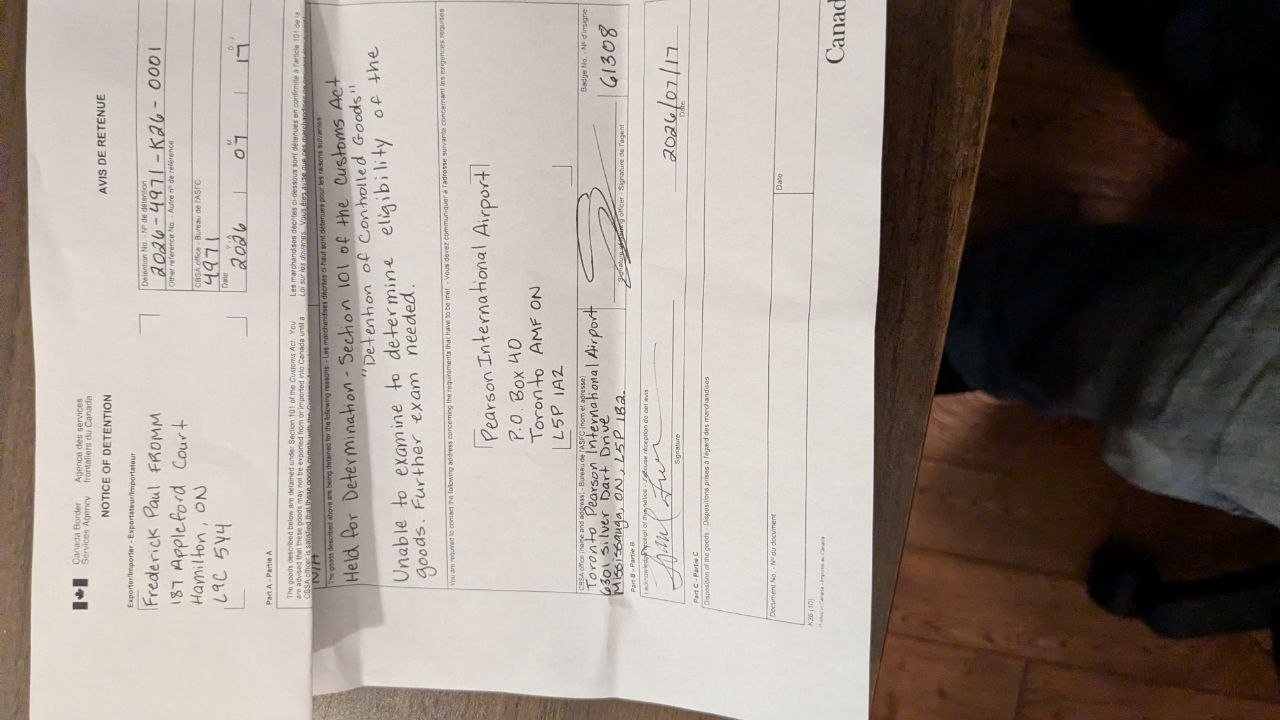
MISSISSAUGA, July 17, 2026. Late this afternoon arriving in Toronto on a flight from Tokyo, I was pulled aside for secondary inspection, the only one, I believe, on a plane carrying several hundred passengers. I was informed I was being “detained”, my cellphone, change and keys confiscated temporarily. Led by an officer named Dhaliwal, two Canada Border Service Agency agents searched my luggage, poring over newspaper clippings. They kept two cd discs I’d been given years ago, the memory chip of an old camera I had and my laptop. My laptop is being sent somewhere for “determination.”
This is not the first time I’ve been targetted. About 20 years ago, every time I returned from the U.S., I was pulled aside and my luggage searched. I was advised by a government agent after I’d spoken to the National Alliance in the U.S. that I would be subjected to such a search every time. Sometimes the results were nearly comical.One eagle-eyed border agent in Nighthawk, B.C. seized a copy of Irish Fairy Tales as potential “hate literature.” I eventually got it back. After a few years the persecution eased off. Then, in June this year, I was returning from St. Pierre. I was the only one of some 60 passengers, most of them foreigners, pulled aside for secondary inspection in Halifax. The CBSA employees laboriously pawed their way through my newspaper clippings, most, ironically, from the super-Zionist National Post. One observant officer remarked: “You must like reading.” After about 20 minutes, I was allowed to leave. At the time, I thought the search strange. Was it just my unlucky day or was it the opening round of a new pattern of persecution?
Today’s demeaning ordeal answered the question. CBSA is required to make a determination within 30 days, although in the past they often take much longer. Some years ago, a Canada Customs official, with no sense of irony, answered my question about what happens to literature that is deemed to be “hate”. The answer: “It is burned.”
Why the renewed persecution. Is it because I’m running for Mayor of Hamilton? Hard to tell.