You’ve probably heard about the Assembly of First Nations passing an emergency resolution demanding that the government make residential school “denialism” a criminal offence.
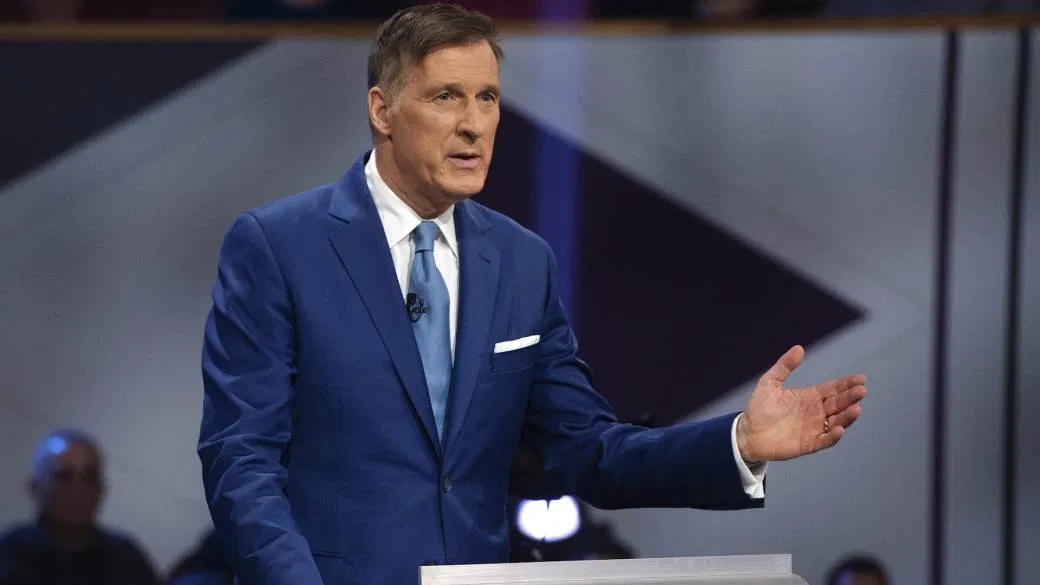
Grand Chief Garrison Settee believes that demanding evidence of unmarked graves should be considered “residential school denialism” and made into a hate crime.
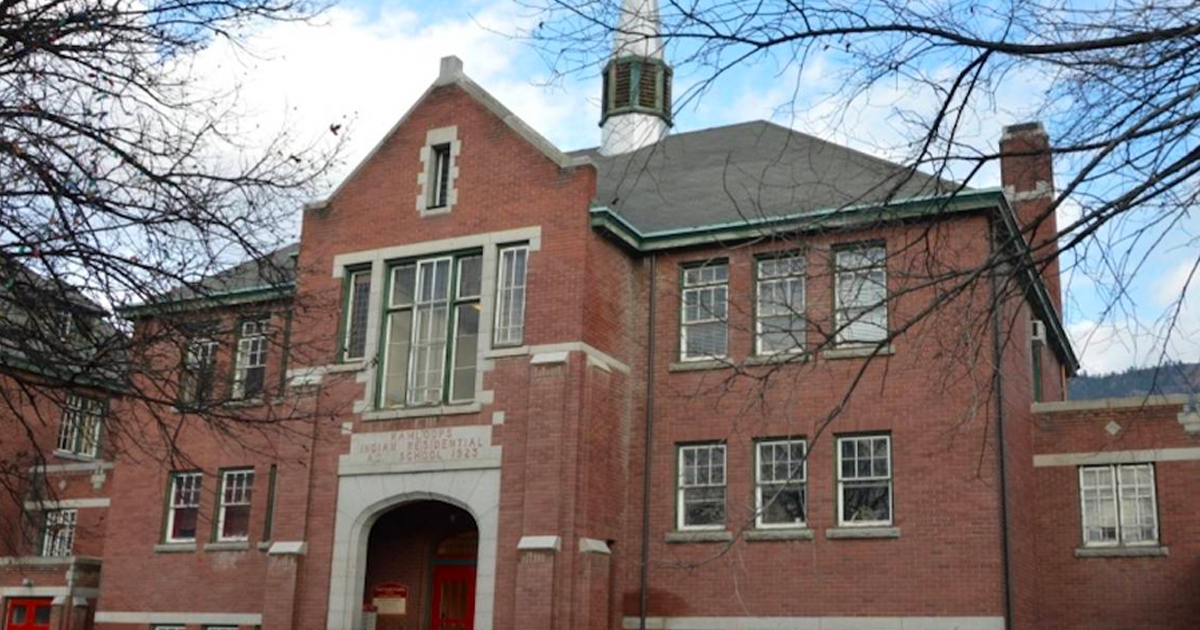
But here’s the problem: at sites like the one in Kamloops, ground-penetrating radar flagged anomalies that the tribe itself said it “suspects” are unmarked graves.
No excavations have been done. No bodies have been found. And yet, asking for proof could soon land you in prison.
People can lie, but we are not obliged to believe their lies. We are free to tell the truth. That is not hatred.
Section 2 of the Charter of Rights and Freedoms protects freedom of conscience, thought, belief, opinion, and expression.
These rights exist for ideas that the government finds inconvenient, wrong, or threatening.
A right that only protects approved opinions is not a right. It’s a permission slip.
Give the government the power to declare one historical interpretation criminal, and you’ve given it the power to declare any interpretation criminal.
If a historical claim is as strong as its defenders believe, it wins in open debate.
If it needs the Criminal Code to win, that says something about the confidence of the case, not the guilt of the dissenter.
The answer to an argument you hate is a better argument, not a subpoena.
The People’s Party of Canada will always fight for your freedom of speech.
Don’t let them criminalize the truth. Stand with us!
‘Denialism’ law ‘the opposite of the spirit of reconciliation’
MICHAEL HIGGINS Comment
Lawyer settles suit over ‘graves’
‘Denialism’ law ‘the opposite of the spirit of reconciliation’
[Would-be Indian cesnors want to send you to jail for questioning this gobbledegook: “
He said he recently visited the Kamloops site and that First Nations did not have to prove there were bodies by exhuming them.
“They are there and they send us messages telling us they’re there,” he said. “You can tell they’re there, right? Feel the power and the energy. For somebody that’s not from our communities, that doesn’t understand our culture, you cannot understand what that means.”]
24 Jul 2026
Making criminals out of people who merely ask questions about the residential school system is not the path to reconciliation, says B.C. lawyer Jim Heller.
Goodwill and open dialogue are needed far more than trying to imprison people under a “denialism” law, according to Heller, whose defamation suit against his own law society over potential graves at the former Kamloops Indian Residential School was recently settled.
Heller sees the Kamloops controversy as a societal sickness where facts and truth are sidelined in favour of ideology.
“As a lawyer, it is all about promoting, developing, respecting and fine-tuning a process, all in order to ask a question. That’s what it’s all about, this kind of rigorous, analytical, open, rational thinking. And that is the foundation of everything. It’s so fundamental,” he said in an interview Tuesday.
But rigour and analysis are now absent in many parts of our institutions, leaving them open to attack from outside forces, he said.
“There’s a weakening and a sickness in our society, and it’s just kind of permeated the institutions,” Heller said.
“It’s got to be cured. But maybe that won’t happen. Maybe we’re just softening so that we’ll have so little resistance for whatever’s next, whether it’s the Islamification of Canada or the CCP (Chinese Communist Party) or some sort of controls we can’t even anticipate.”
Heller found himself in a battle with the Law Society of British Columbia (LSBC) over anomalies discovered by ground-penetrating radar at the former Kamloops Residential School. He objected to mandatory law society educational materials that contained the phrase, “On May 27, 2021, the Tk’emlúps te Secwépemc Nation reported the discovery of an unmarked burial site containing the bodies of 215 children on the former Kamloops Indian Residential School grounds.”
When Heller submitted a resolution to the law society’s annual general meeting stating that no graves had been discovered and asking the LSBC to insert the word “potential” when discussing the anomalies, he suddenly found himself under attack. One critic was the BC First Nations Justice Council, which issued a statement referencing a “growing disillusioned sect” that was using “denialism” to downplay the horrors of residential schools.
Heller claimed the LSBC posted a link to the press release in an online statement knowing it was defamatory. His lawsuit alleged the LSBC refused to take down the press release and issue an apology and a retraction.
We need goodwill, the presumption of goodwill so we can have some real dialogue.
The law society denied defaming Heller as his suit moved through the courts. The case has now been settled, although the terms are confidential.
In May this year, the law society issued a clarification stating that “to the degree it was understood by some to have defamed Mr. Heller, the Law Society wishes to confirm that was not its intention.”
What is so utterly bizarre about the case is that Heller was only trying to insert the word “potential” in relation to the graves, which would have been truthful and factual. No graves and no bodies have been found at the site despite a press release in 2021 from the Tk’emlúps te Secwépemc that talked of “the remains of 215 children” at Kamloops.
As Heller pointed out, even the Tk’emlúps te Secwépemc has changed the way it discusses the matter, now opting for terms like “potential graves” and “anomalies” at Kamloops.
The danger for people like Heller is that they would almost certainly find themselves in the crosshairs of the law should “denialism” of residential schools get into the Criminal Code.
Last week, First Nations held a press conference to call for a ban on residential school denialism, echoing a recent failed attempt by a senator to make it illegal for anyone to engage in the “condoning, denying or downplaying” of residential schools, with a proposed maximum penalty of two years’ imprisonment.
During the press conference, Manitoba Keewatinowi Okimakanak Grand Chief Garrison Settee said Canada was perpetuating hate by not passing a denialism law.
He said he recently visited the Kamloops site and that First Nations did not have to prove there were bodies by exhuming them.
“They are there and they send us messages telling us they’re there,” he said. “You can tell they’re there, right? Feel the power and the energy. For somebody that’s not from our communities, that doesn’t understand our culture, you cannot understand what that means.”
Such a stance does not sit well with Heller.
“He’s saying, ‘We know this is true. The dead kids are there; they’re talking to us.’ That’s one thing for them to have that kind of outrageous belief and to make a point of doing a press conference,” said Heller, “but you combine that with, ‘And we’re going to court to make it illegal for you to even raise an eyebrow about that.’ Well that’s pretty incredible.”
Heller added that First Nations “speak in terms of potential and anomalies, but they still won’t have a discussion. That’s ridiculous. The very fact that you’re using tentative language is like an invitation to talk.
“This is the opposite of the spirit of reconciliation. It’s just crazy. We need goodwill, the presumption of goodwill so we can have some real dialogue.”
Unfortunately, constructive dialogue, discussion and discourse are sadly lacking in today’s Canada.
‘Denialism’ law ‘the opposite of the spirit of reconciliation’
National Post – (Latest Edition)
24 Jul 2026
MICHAEL HIGGINS Comment
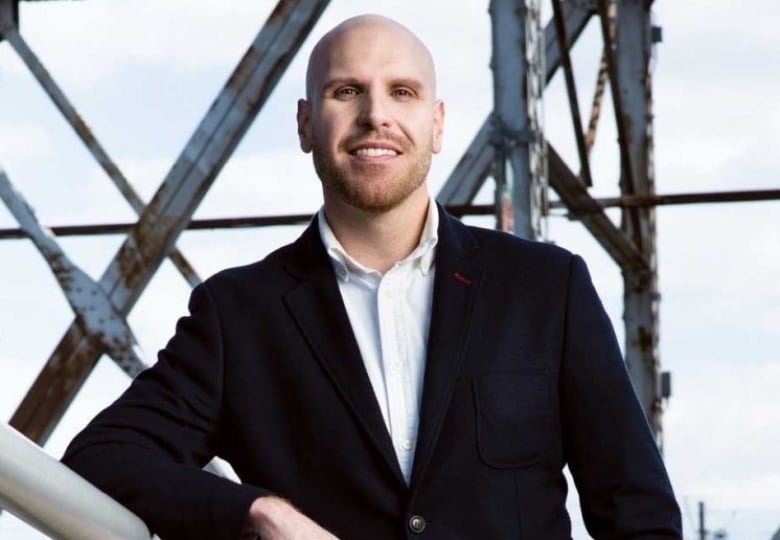
B.C. lawyer Jim Heller, shown, sees the Kamloops graves controversy as a societal sickness where facts and truth are sidelined in favour of ideology, writes Michael Higgins.
Making criminals out of people who merely ask questions about the residential school system is not the path to reconciliation, says B.C. lawyer Jim Heller.
Goodwill and open dialogue are needed far more than trying to imprison people under a “denialism” law, according to Heller, whose defamation suit against his own law society over potential graves at the former Kamloops Indian Residential School was recently settled.
Heller sees the Kamloops controversy as a societal sickness where facts and truth are sidelined in favour of ideology.
“As a lawyer, it is all about promoting, developing, respecting and fine-tuning a process, all in order to ask a question. That’s what it’s all about, this kind of rigorous, analytical, open, rational thinking. And that is the foundation of everything. It’s so fundamental,” he said in an interview Tuesday.
But rigour and analysis are now absent in many parts of our institutions, leaving them open to attack from outside forces, he said.
“There’s a weakening and a sickness in our society, and it’s just kind of permeated the institutions,” Heller said.
“It’s got to be cured. But maybe that won’t happen. Maybe we’re just softening so that we’ll have so little resistance for whatever’s next, whether it’s the Islamification of Canada or the CCP (Chinese Communist Party) or some sort of controls we can’t even anticipate.”
Heller found himself in a battle with the Law Society of British Columbia (LSBC) over anomalies discovered by ground-penetrating radar at the former Kamloops Residential School. He objected to mandatory law society educational materials that contained the phrase, “On May 27, 2021, the Tk’emlúps te Secwépemc Nation reported the discovery of an unmarked burial site containing the bodies of 215 children on the former Kamloops Indian Residential School grounds.”
When Heller submitted a resolution to the law society’s annual general meeting stating that no graves had been discovered and asking the LSBC to insert the word “potential” when discussing the anomalies, he suddenly found himself under attack. One critic was the BC First Nations Justice Council, which issued a statement referencing a “growing disillusioned sect” that was using “denialism” to downplay the horrors of residential schools.
Heller claimed the LSBC posted a link to the press release in an online statement knowing it was defamatory. His lawsuit alleged the LSBC refused to take down the press release and issue an apology and a retraction.
We need goodwill, the presumption of goodwill so we can have some real dialogue.
The law society denied defaming Heller as his suit moved through the courts. The case has now been settled, although the terms are confidential.
In May this year, the law society issued a clarification stating that “to the degree it was understood by some to have defamed Mr. Heller, the Law Society wishes to confirm that was not its intention.”
What is so utterly bizarre about the case is that Heller was only trying to insert the word “potential” in relation to the graves, which would have been truthful and factual. No graves and no bodies have been found at the site despite a press release in 2021 from the Tk’emlúps te Secwépemc that talked of “the remains of 215 children” at Kamloops.
As Heller pointed out, even the Tk’emlúps te Secwépemc has changed the way it discusses the matter, now opting for terms like “potential graves” and “anomalies” at Kamloops.
The danger for people like Heller is that they would almost certainly find themselves in the crosshairs of the law should “denialism” of residential schools get into the Criminal Code.
Last week, First Nations held a press conference to call for a ban on residential school denialism, echoing a recent failed attempt by a senator to make it illegal for anyone to engage in the “condoning, denying or downplaying” of residential schools, with a proposed maximum penalty of two years’ imprisonment.
During the press conference, Manitoba Keewatinowi Okimakanak Grand Chief Garrison Settee said Canada was perpetuating hate by not passing a denialism law.
He said he recently visited the Kamloops site and that First Nations did not have to prove there were bodies by exhuming them.
“They are there and they send us messages telling us they’re there,” he said. “You can tell they’re there, right? Feel the power and the energy. For somebody that’s not from our communities, that doesn’t understand our culture, you cannot understand what that means.”
Such a stance does not sit well with Heller.
“He’s saying, ‘We know this is true. The dead kids are there; they’re talking to us.’ That’s one thing for them to have that kind of outrageous belief and to make a point of doing a press conference,” said Heller, “but you combine that with, ‘And we’re going to court to make it illegal for you to even raise an eyebrow about that.’ Well that’s pretty incredible.”
Heller added that First Nations “speak in terms of potential and anomalies, but they still won’t have a discussion. That’s ridiculous. The very fact that you’re using tentative language is like an invitation to talk.
“This is the opposite of the spirit of reconciliation. It’s just crazy. We need goodwill, the presumption of goodwill so we can have some real dialogue.”
Unfortunately, constructive dialogue, discussion and discourse are sadly lacking in today’s Canada.
On 26 September 2024, NDP Member of Parliament Leah Gazan introduced a private member’s bill, Bill C-413, which would amend the Criminal Code to criminalize her fellow citizens, and subject them to two years’ imprisonment and forfeiture of property, for so- called residential school denialism.
Why is Leah Gazan trying to put her fellow Canadians in jail?
This private member’s bill is personal for you. Tell me why.
Gazan replied:
Well, you know, certainly, you know, my family has been impacted by residential school.
Is that true? Did residential schools impact Leah Gazan’s family?
The short answer is ‘No’.
Let’s look at Leah Gazan’s family tree.
On her father’s side, Leah Gazan is Jewish, Polish and Dutch. Her father, Abraham (Albert) Gazan , and his parents and sister found refuge in Canada after World War II.
There is obviously no residential school impact on her family on her father’s side.
On her mother’s side, she is of Chinese and Lakota descent. Her mother, Marjorie LeCaine , was the daughter of Adeline LeCaine and a Chinese father whose name is apparently unknown.
There is obviously no residential school impact on her family on her maternal grandfather’s side.
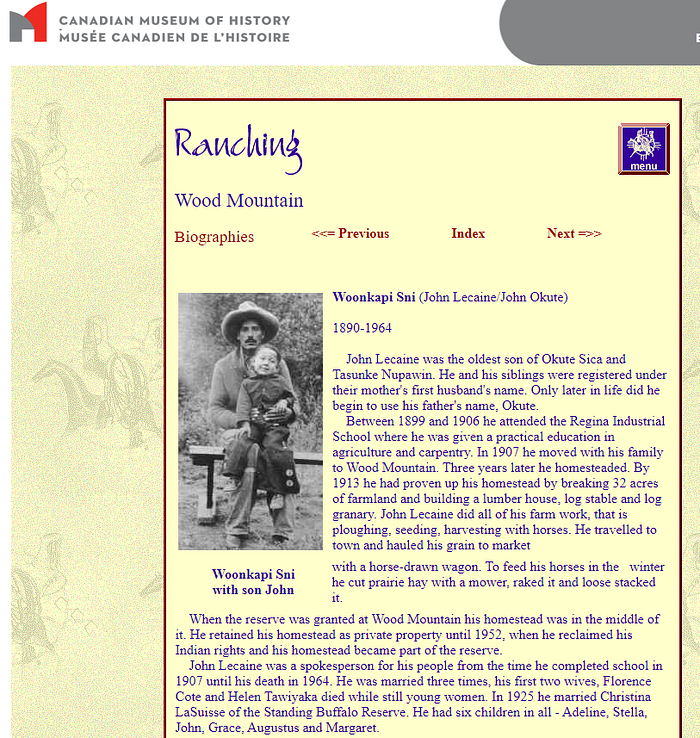
That leaves her maternal grandmother, Adeline LeCaine, who was the daughter of John LeCaine (1890–1964), who in turn was the son of a Lakota woman, Tasunka Nupawin (1868–1940), also known as Emma Loves War.
Was there residential school impact on Leah Gazan’s maternal grandmother Adeline’s side of the family?
In 1877, Chief Sitting Bull and other Lakota Indians fled to Canada to seek refuge after the massacre at the Little Big Horn . Sitting Bull returned to the US in 1881 to surrender to American authorities, but 250 Lakota remained behind at Wood Mountain in Saskatchewan, among them the family of Leah Gazan’s great-great-grandmother, Emma Loves War.
In 1888, Emma Loves War had an illegitimate daughter, Alice LeCaine (1888–1976), by a white North West Mounted Police officer from Nova Scotia, William Edward Archibald LeCain (1859–1915), who in 1881 was stationed at Wood Mountain . In 1885, LeCain was involved in putting down the Riel Rebellion . He later moved to the US, where he married, worked as an interpreter, scout, teacher and writer and died in Minnesota in 1915. Although Emma’s relationship with Lecain was brief, succeeding members of her family took his surname.
After her relationship with William Edward Archibald LeCain, and the birth of her illegitimate daughter, Alice, Leah Gazan’s great-great-grandmother, Emma Loves War, had a son, Leah Gazan’s great-grandfather, John LeCaine (1890–1964). At about that time she is said to have married a Lakota husband named Okute , although there is no known record of the marriage.
Get Michelle Stirling’s stories in your inbox
Join Medium for free to get updates from this writer.
Leah Gazan’s great-grandfather, John LeCaine (1890–1964), may have been Emma’s son by her Lakota husband Okute. The problem with that assumption is that for most of his life, Leah Gazan’s great-grandfather, John LeCaine, was considered non-status and a half-breed by the Department of Indian Affairs, which suggests that although his mother, Emma Loves War, was Indian, his father was not. As Claire Thomson says on page 338 of her thesis, Digging Roots , ‘The term “half-breed” in the Lakota context was used to signify those that had white fathers’, and Thomson is uncertain as to whether Emma married Okute before or after John LeCaine’s birth in 1890 (see page 103).
At this point, residential schools enter Leah Gazan’s family history, but in unexpected ways.
Emma’s daughter Alice and son John attended the Regina Industrial School
Despite being non-status, both Emma’s illegitimate daughter, Alice LeCaine (1888–1976), and Emma’s son, John LeCaine (1890–1964), were allowed to attend the Regina Industrial School. John attended for seven years, from 1899–1906 . Judging from his later accomplishments, he benefited greatly from the experience. He learned to read and write English and became a writer and historian of his people, and he learned carpentry and agricultural skills, which enabled him to file for a homestead (yes, Leah Gazan’s great-grandfather was a settler, as were other members of the LeCaine family). Alice also had a successful life, and died in the US as Alice Mahto in 1976.
John LeCaine’s children were not allowed to attend residential school
Leah Gazan’s great-grandfather, John LeCaine (1890–1964), married three times, and had several children, including his daughters Adeline (Leah Gazan’s grandmother) and Stella, who were half-sisters.
Having had a successful residential school experience himself, in 1930 Leah Gazan’s great-grandfather, John LeCaine, signed an application to have his daughter Stella enrolled in the Qu’ Appelle Indian Residential School, and the principal, Father Leonard, enrolled Stella pending approval from the Department of Indian Affairs. However, the Department took issue with John LeCaine’s application as well as with other applications from what the Department termed ‘halfbreeds’, as summarized by Claire Thomson on page 336 of her thesis:
Indian Commissioner WM Graham also wrote on this issue in 1930 and provided a different angle for deciding which children were Indian or not when responsibility for schooling was concerned: “You are aware that at one time (about 15 years ago) nearly half of the children in this school [Qu’Appelle Residential School] were halfbreeds. We succeeded in getting every one of them out, and made it a hard and fast rule that the only halfbreed children who could be admitted were those who were living on an Indian reserve as Indians.”9 Therefore, in 1930 HE King, overseer of the Wood Mountain Reserve, was asked about the children’s parents and supplied information showing that John Lecaine, Charles Lecaine, Albert Brown, and Jimmie Ogle, were “all white and Indian halfbreeds. Are all voters or at least entitled to vote” and all either lived off the reserve, in the town of Wood Mountain, or owned property in the area.10
As a result of Commissioner Graham’s letter (see RG10, 660–10, Part 1 ), John LeCaine’s daughter, Stella, was discharged from the Qu’ Appelle Indian Residential School on the ground that she was ineligible to attend since her father was a halfbreed , entitled to vote, and lived off reserve on his own homestead.
It goes without saying that since the Department did not permit John LeCaine to enroll his daughter Stella, the Department would not have allowed him to enroll his other daughter, Adeline, Leah Gazan’s grandmother, either.
We thus see that the impact of residential school attendance on Leah Gazan’s family was positive, not negative. Her great-grandfather, John LeCaine (1890–1964) attended the Regina Industrial School and acquired the skills to lead a very successful life as a homesteader, writer, and historian (see his obituary in the April 1964 issue of the Indian Record and the 20 March 1964 issue of the Regina Leader-Post ). His sister Alice also acquired the skills to lead a successful life.
On the other hand, Leah Gazan tells us that her grandmother Adeline, who was not allowed to attend residential school, did not experience the same success.
Leah Gazan makes her grandmother Adeline’s abandonment of her children a matter of public record
In the 1931 census , Leah Gazan’s grandmother, Adeline Lecaine, was listed as 14 years old, and living with her father, John LeCaine (1890–1964), on his homestead. However by 1941, Adeline’s life had gone off the rails, and she was in Moose Jaw with two illegitimate children, one of whom was Leah Gazan’s mother, Marjorie (1936–2007). Leah Gazan made her grandmother Adeline’s abandonment of her two children in a hotel room in Moose Jaw a matter of public record on September 18, 2023 when she told Parliament :
I want to share a story about my mother. My mother, Marjorie Gazan, was a street kid and a child welfare survivor who ended up in the system after my grandmother [Adeline] abandoned her and her younger brother in a hotel room in Moose Jaw, Saskatchewan, when she was five years old.
My grandmother [Adeline] had to leave them to earn money. There were no supports for indigenous women in the 1930s. There were no human rights. There was no one to turn to, especially for indigenous single mothers, and my grandmother was not an exception.
Since my mother was the eldest child, my grandmother left her in charge of her younger brother with specific instructions. She said, “Here is a loaf of bread, peanut butter and jam. It needs to last five days.” I remember my mother telling me how she, along with my uncle, gleefully ate the loaf of bread and ran out of their food ration in only one day. Hungry, scared and alone, my mother decided to call the Children’s Aid Society.
As mentioned earlier, Leah Gazan’s mother, Marjorie, was Adeline’s daughter by a Chinese father whose name is apparently unknown, and who took no responsibility for her upbringing. Thus, after Adeline abandoned her, Leah Gazan’s mother Marjorie was in the care of child welfare. Despite this, Marjorie made a success of her life, and eventually married Albert Gazan, who, as mentioned earlier, came to Canada with his parents as a Holocaust survivor from Holland where he had been sheltered during the war by Dutch families.
So why is Leah Gazan claiming that her family was negatively impacted by Indian residential schools to the point that she has tarred Canada with genocide , and wants to put her fellow Canadians in jail?
Why, instead of expressing gratitude to the country which gave refuge and opportunity to both sides of her family, does Leah Gazan want to criminalize her fellow citizens on the ground that residential schools harmed her family, when in fact the only person in her direct family tree who went to a residential school was her great-grandfather, John LeCaine (1890–1964), who learned skills there which enabled him to live a very fulfilling life?
Leah Gazan is the last person who should be putting forward this private member’s bill claiming that her family was harmed by Indian residential schools.
The former justice minister, a federally-appointed “special interlocutor,” an NDP MP, and now a Senate committee are all desperately trying to stop Canadians from questioning the narrative that thousands of indigenous children are missing in “unmarked graves” at former residential schools.
In May 2021, the Tk’emlúps First Nation of Kamloops, BC sensationally announced they discovered the remains of 215 children in unmarked graves.
In reality, their ground-penetrating radar found 200 soil disturbances which were possibly caused by septic field drainage tiles.
No remains have been uncovered.
Reliable evidence pointing to thousands of unmarked graves at residential schools is still lacking, yet the Standing Senate Committee on Indigenous Peoples has recommended that “the Government of Canada take every action necessary to combat the rise of residential school denialism.” https://www.youtube.com/embed/0ulTk6WZ428?feature=oembed&enablejsapi=1
The committee’s July 2023 report, “Honouring the children who never came home: Truth, education and reconciliation,” states, “Denialism serves to distract people from the horrific consequences of residential schools, and the realities of missing children, burials and unmarked graves.”
“Of real concern to the committee is the small group of vocal individuals who try to undermine Survivors’ accounts of the hardships and abuse they experienced during residential schools.”
Special Interlocutor for Missing Children and Unmarked Graves Kimberly Murray was one of the committee’s witnesses.
Murray has previously written in her own report that “Urgent consideration should be given to legal mechanisms to address denialism, including the implementation of both civil and criminal sanctions.”
In her report, Murray also claimed that grave-diggers were showing up to the Kamloops site in the night with shovels, hoping to dig up childrens’ bodies. The local RCMP detachment told True North they had no reports of such incidents. https://www.youtube.com/embed/2clXaABq7xQ?feature=oembed&enablejsapi=1
In response to Murray, Liberal MP and former Justice Minister David Lametti said he is open to “a legal solution” to “outlaw” questioning the residential school narrative.
According to Hymie Rubenstein of the Indian Residential Schools Research Group, this is an attempt to criminalize debate on important indigenous issues.
“This might be legally unprecedented if enacted and probably easily challenged as an infringement of the Charter’s free speech provision,” said Rubenstein.
“It may also be redundant given existing hate law legislation.”
The Senate committee did not respond to a request for comment.
True North also reached out to newly-appointed Justice Minister Arif Virani to ask if he would continue David Lametti’s project of outlawing “residential school denialism,” but his office offered no response.
Crown-Indigenous Relations Minister Marc Miller interested in reviewing proposed bill
Olivia Stefanovich · CBC News · Posted: Feb 18, 2023 4:00 AM EST | Last Updated: February 18
A growing memorial outside the former Kamloops Indian Residential School in B.C. following the May 2021 discovery of suspected unmarked graves. (Ben Nelms/CBC)
WARNING: This story contains distressing details.
Some Indigenous academics and activists say they’ve become the targets of a growing backlash against reports of hundreds of unmarked graves at former residential school sites — and they want Parliament to do something about it.
They say they’re being flooded with emails, letters and phone calls from people pushing back against the reports of suspected graves and skewing the history of the government-funded, church-run institutions that worked to assimilate more than 150,000 First Nations, Inuit and Métis children for more than a century.
They call it “residential school denialism” and describe it as an attempt to downplay, twist and dismiss the facts to undermine public confidence in the Indigenous reconciliation project.
CBC News: The House13:11What is residential school ‘denialism’ and should it be banned?The discovery of possible unmarked graves on the site of several former residential schools shook many Canadians, but some Indigenous academics fear it has also led to a backlash: people misrepresenting facts or dismissing the harms of residential schools. CBC’s Olivia Stefanovich has a special report on what’s being called residential school denialism — and whether anything should be done about it.
NDP MP Leah Gazan, who got the House of Commons last October to unanimously recognize that genocide occurred at residential schools, now wants to take the issue a step further by drafting legislation to outlaw attempts to deny that genocide and make false assertions about residential schools.
“Denying genocide is a form of hate speech,” said Gazan, who represents the riding of Winnipeg Centre.
“That kind of speech is violent and re-traumatizes those who attended residential school.”
Leah Gazan, the NDP MP for Winnipeg Centre, wants to craft legislation to outlaw what she calls “residential school denialism.” (Spencer Colby/The Canadian Press)
Gazan’s proposal is causing controversy, even among those who want the facts about residential schools widely known. But the Office of Crown-Indigenous Relations Minister Marc Miller said he would be interested in reviewing the proposed legislation.
“Residential school denialism attempts to hide the horrors that took place in these institutions,” Miller’s office told CBC News.
“It seeks to deny survivors and their families the truth, and distorts Canadians’ understanding of our shared history.”
‘People are responding … with fear’
More than 130 residential schools operated across the country from roughly 1883 until 1997. The Truth and Reconciliation Commission found the federal government created them for the purpose of separating Indigenous children from their families and indoctrinating them into the culture of the dominant Euro-Christian Canadian society. The goal, said the commission, was to weaken Indigenous family ties and cultural linkages.
The commission said that many children at the schools were subjected to physical and sexual abuse. It described conditions at the schools as “institutionalized child neglect.”
Michelle Good, author of the upcoming book Truth Telling: Seven Conversations about Indigenous Life in Canada, said she believes denialism is rooted in Canada’s shifting power dynamics.
“Indigenous people are experiencing a very important renaissance, a resurgence,” Good said.
“As we are returning to our strength as nations, as peoples, people are responding, I think, with fear.”
Michelle Good is the author of the 2020 Governor General’s Literary Award-winning novel Five Little Indians, which is about the residential school experience. (Silk Sellinger Photography)
Good, who also wrote the 2020 Governor General’s Literary Award-winning novel Five Little Indians, said declaring denialism hate speech would send a powerful message that the era of oppression and racism is over.
“My mother watched her friend Lily haemorrhage to death from tuberculosis at the Onion Lake Residential School,” said Good, a member of Red Pheasant Cree Nation, 153 km northwest of Saskatoon.
“To have people respond to our lived experience as though it never happened is devastating, and our country should be beyond that at this point.”
Busting myths
Crystal Gail Fraser, a Gwichyà Gwich’in assistant professor of history and Native Studies at the University of Alberta, said she would welcome the opportunity to engage in fair dialogue with denialists.
She said she receives messages every week from people arguing that residential schools were established with good intentions, or that Indigenous communities are concocting claims about unmarked graves. Some of these messages, she said, come from missionaries working overseas.
“For people who do this as a part of their jobs, their professional lives, that is very disturbing,” Fraser said.
“How is it that we can better educate everyday Canadians so we don’t have to be at the point where we’re directing efforts to bust more myths about Indigenous peoples in Canada, and we can really redirect and return our attention to the truth and reconciliation part?”
Métis archeologist Kisha Supernant taking readings using ground-penetrating radar. (Submitted by Kisha Supernant)
Kisha Supernant, director of the Institute of Prairie and Indigenous Archaeology at the University of Alberta, said she received an email challenging her own family history after she identified 169 potential graves through ground-penetrating radar in March 2022 at the former Grouard Indian Residential School in northern Alberta.
Supernant, who is Métis, also shared messages with CBC from people threatening to dig up suspected burial sites.
“I’m already dealing with the emotional toil of spending my time walking over potential graves of children who went missing, and then for that to be called into question makes the work a lot more challenging,” she said.
Supernant said expanding hate speech law to cover residential school denialism is an idea that should be explored but she doesn’t think it will silence the “denialists.”
“If nations decide to exhume, which some may, and they do find the bodies of children, they will still not be enough for denialists,” she said.
“They’ll still find ways to excuse it. Because it’s not actually about the facts.”
‘This is totalitarianism’
Some academics have experienced consequences over their stances and statements on residential schools.
She said using hate speech laws to criminalize some opinions and views on residential schools would cross a dangerous line.
“This is totalitarianism,” Widdowson said.
The announcement of 200 possible unmarked graves in Kamloops, B.C. sent shockwaves around the world. (Jeff McIntosh/The Canadian Press)
Unlike the House of Commons, Widdowson doesn’t believe the institutions were genocidal. She gained notoriety for saying the institutions gave Indigenous children an education that “normally they wouldn’t have received.”
But Widdowson said she’s not a “denialist.”
She said she acknowledges residential schools caused harm and children died, but takes issue with the reports of possible unmarked graves at the former Kamloops Indian Residential School site in B.C., which she said caused “hysteria.”
“The only way that you are going to determine whether in fact there are burials there is to do excavations on that site,” Widdowson said.
“I’m completely, you know, open to the fact that I could be misguided and wrong. But the answer to that is not to make what I’m saying illegal, which is ridiculous.”
Countering ‘denialism’ with education
Richard Moon, a law professor at the University of Windsor who specializes in freedom of expression, said any law targeting residential school denialism would invite a Charter of Rights challenge.
“We want to be very careful about regulating claims about historical events — even if we think those claims are misguided, ignorant or hurtful,” he said.
“The Supreme Court has said only a very narrow category of extreme speech is caught by hate speech laws, and that’s all they should catch in order to reconcile the regulation of hate speech with our commitment to freedom of expression under the charter.”
Eldon Yellowhorn, professor and Indigenous Studies department chair at Simon Fraser University in Burnaby, B.C., said he knows that many sceptics are demanding that suspected unmarked graves be dug up for proof.
He said that’s controversial because it crosses many taboos about the treatment of the dead in Indigenous cultures.
“People like myself are working hard on finding a resolution to this and to making the evidence stronger so that we can be more confident in the statements that we make,” said Yellowhorn, who is from the Piikani Nation, 200 km south of Calgary.
“You can’t legislate stupidity away.”
Sean Carleton, an assistant professor of history and Indigenous studies at the University of Manitoba, wants governments to educate the public about how to confront mistruths about residential schools. (Submitted by Sean Carleton)
Sean Carleton, an assistant professor in the departments of history and Indigenous studies at the University of Manitoba, said he doesn’t think hate speech legislation would be the best approach either.
“It takes the responsibility out of Canadians’ hands to challenge the people in their lives,” Carleton said.
“It risks … giving denialists more of a platform to say, you know, look at the heavy-handed approach of the government. What do they not want us, Canadians, to really understand?”
Carleton said his preference is for governments, churches, schools and community associations to counter lies and misinformation about residential schools with education.
“We need to get to that point where denialism is seen as people who deny gravity or say the earth is flat,” he said.