: B.C. human rights chief declares that it’s colonialist to stigmatize drug use
[Human Rights Commissions have long been mortal enemies of freedom of speech and often of common sense. However, recent pronouncements by the excessively paid ($351. 847) “rights” czaina, one Kasari Govender plumb new depths of madness. According to her” any return to stigmatizing illicit drug use is racist, colonialist and a violation of human rights..”],
Overdose crisis is ‘rooted in colonial approaches that prioritize individualism over community, wealth over health and power over empathy’
B.C. Human Rights Commissioner Kasari Govender speaks in Vancouver, on Tuesday, March 7, 2023. Photo by THE CANADIAN PRESS/Darryl Dyck
Just as B.C. officially acknowledges that decriminalizing drugs was a mistake, its own human rights commissioner has issued a statement saying that any return to stigmatizing illicit drug use is racist, colonialist and a violation of human rights.
The overdose crisis, which has killed more than 16,000 people in B.C. since 2016, is “rooted in colonial approaches that prioritize individualism over community, wealth over health and power over empathy,” reads a new position statement by Kasari Govender, B.C.’s human
“Using punitive tactics by criminalizing people who use drugs and doubling down on prohibition policies have proven to be ineffective and harmful for decades,” it adds.
When public policy on substance use and treatment of people who use drugs is based on stigma and morality, rather than evidence and respect for fundamental human dignity, harmful policies result. My new position statement on the toxic drug crisis response: https://t.co/ReuJbdhXh4
The 22-page document also states that it’s discriminatory to even mention that B.C. has an “overdose” crisis, as it implies that doing drugs such as meth or fentanyl is inherently unsafe.
Rather, it is the view of the human rights commissioner that the primary cause of the crisis is “illicit drug manufacturers and dealers adding unknown toxic substances.”
The “human rights” solution to all this, states the human rights commissioner, is simply for B.C. to lean even harder into policies that allow drug users to do drugs “without stigma.” More decriminalization, more low-barrier shelters and more “safer supply”; B.C.’s program of distributing free recreational opioids to drug users.
The statement was issued just as B.C.’s NDP government is acknowledging that many of its most extreme forays into harm reduction might have made the problem worse.
Article content
In February, B.C. walked back its safer supply program following reports that some drug users were simply reselling the free government opioids for cash. Now, “safer supply” can only be consumed in front of a clinician, instead of the prior system of being handed out in
B.C. Premier David Eby recently announced that the province’s experiment in decriminalizing hard drugs was “not the right policy.”
In November 2022, B.C. obtained federal permission to legalize the possession of “personal use” amounts of illicit drugs, such as heroin, fentanyl and meth, in what was initially branded as a strategy to reduce stigma and “decriminalize people who use drugs.”
But in a Vancouver speech last month, Eby said that decriminalization instead became a “permission structure” teaching drug users that “it was OK to use drugs anywhere.”
Just a week prior, in an appearance before the Union of British Columbia Municipalities, Eby also promised an increase in involuntary treatment for severe addicts, as well as tougher crackdowns on criminal drug networks.
For more than two decades, the official position of the B.C. government has been to view addiction primarily as a public health issue rather than a criminal justice issue.
But the new position statement of the human rights commissioner is notable in that it sets out almost no role for police to rein in drug dealers or for government programs to actually get drug users clean.
The document’s only mention of law enforcement in a favourable light is that it is sometimes needed because of “public safety concerns.”
Programs to get addicts off drugs are derided as “abstinence-only.” “There is no data to support the assertion that abstinence-only treatment options … are effective in addressing dependence on substances or the root causes of the toxic drug crisis,” it reads.
Govender’s report objects to every B.C. government move to rein in its various harm reduction experiments, including safer supply. “There is no evidence supporting claims that diversion is increasing overdose deaths or leading increased rates of youth to become substance dependent,” it read.
What’s more, the report states that any state drug policy must include drug addicts as collaborators in its creation. “Decision-making must include those impacted by the decisions,” it reads.
t
As for what causes people to become addicted to drugs in the first place, the report places partial blame on B.C.’s “deep-rooted history of colonialism, racism and discrimination.”
A significant portion of that goes to the commissioner herself, who is one of the highest paid civil servants in the province. As of 2024, she was collecting $351,847 per year; significantly higher than the $227,111 paid to the premier. (National Post, November 18, 2025)
On 26 September 2024, NDP Member of Parliament Leah Gazan introduced a private member’s bill, Bill C-413, which would amend the Criminal Code to criminalize her fellow citizens, and subject them to two years’ imprisonment and forfeiture of property, for so- called residential school denialism.
Why is Leah Gazan trying to put her fellow Canadians in jail?
This private member’s bill is personal for you. Tell me why.
Gazan replied:
Well, you know, certainly, you know, my family has been impacted by residential school.
Is that true? Did residential schools impact Leah Gazan’s family?
The short answer is ‘No’.
Let’s look at Leah Gazan’s family tree.
On her father’s side, Leah Gazan is Jewish, Polish and Dutch. Her father, Abraham (Albert) Gazan , and his parents and sister found refuge in Canada after World War II.
There is obviously no residential school impact on her family on her father’s side.
On her mother’s side, she is of Chinese and Lakota descent. Her mother, Marjorie LeCaine , was the daughter of Adeline LeCaine and a Chinese father whose name is apparently unknown.
There is obviously no residential school impact on her family on her maternal grandfather’s side.
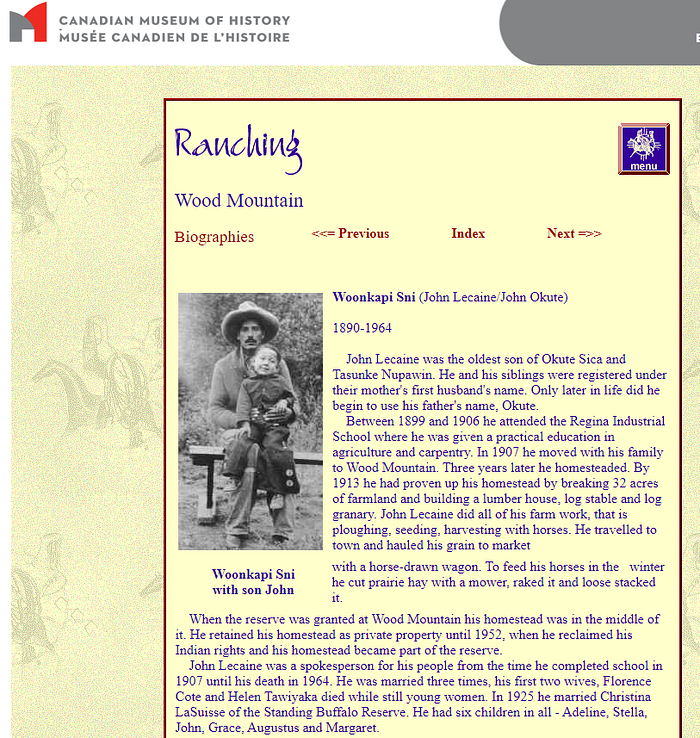
That leaves her maternal grandmother, Adeline LeCaine, who was the daughter of John LeCaine (1890–1964), who in turn was the son of a Lakota woman, Tasunka Nupawin (1868–1940), also known as Emma Loves War.
Was there residential school impact on Leah Gazan’s maternal grandmother Adeline’s side of the family?
In 1877, Chief Sitting Bull and other Lakota Indians fled to Canada to seek refuge after the massacre at the Little Big Horn . Sitting Bull returned to the US in 1881 to surrender to American authorities, but 250 Lakota remained behind at Wood Mountain in Saskatchewan, among them the family of Leah Gazan’s great-great-grandmother, Emma Loves War.
In 1888, Emma Loves War had an illegitimate daughter, Alice LeCaine (1888–1976), by a white North West Mounted Police officer from Nova Scotia, William Edward Archibald LeCain (1859–1915), who in 1881 was stationed at Wood Mountain . In 1885, LeCain was involved in putting down the Riel Rebellion . He later moved to the US, where he married, worked as an interpreter, scout, teacher and writer and died in Minnesota in 1915. Although Emma’s relationship with Lecain was brief, succeeding members of her family took his surname.
After her relationship with William Edward Archibald LeCain, and the birth of her illegitimate daughter, Alice, Leah Gazan’s great-great-grandmother, Emma Loves War, had a son, Leah Gazan’s great-grandfather, John LeCaine (1890–1964). At about that time she is said to have married a Lakota husband named Okute , although there is no known record of the marriage.
Get Michelle Stirling’s stories in your inbox
Join Medium for free to get updates from this writer.
Leah Gazan’s great-grandfather, John LeCaine (1890–1964), may have been Emma’s son by her Lakota husband Okute. The problem with that assumption is that for most of his life, Leah Gazan’s great-grandfather, John LeCaine, was considered non-status and a half-breed by the Department of Indian Affairs, which suggests that although his mother, Emma Loves War, was Indian, his father was not. As Claire Thomson says on page 338 of her thesis, Digging Roots , ‘The term “half-breed” in the Lakota context was used to signify those that had white fathers’, and Thomson is uncertain as to whether Emma married Okute before or after John LeCaine’s birth in 1890 (see page 103).
At this point, residential schools enter Leah Gazan’s family history, but in unexpected ways.
Emma’s daughter Alice and son John attended the Regina Industrial School
Despite being non-status, both Emma’s illegitimate daughter, Alice LeCaine (1888–1976), and Emma’s son, John LeCaine (1890–1964), were allowed to attend the Regina Industrial School. John attended for seven years, from 1899–1906 . Judging from his later accomplishments, he benefited greatly from the experience. He learned to read and write English and became a writer and historian of his people, and he learned carpentry and agricultural skills, which enabled him to file for a homestead (yes, Leah Gazan’s great-grandfather was a settler, as were other members of the LeCaine family). Alice also had a successful life, and died in the US as Alice Mahto in 1976.
John LeCaine’s children were not allowed to attend residential school
Leah Gazan’s great-grandfather, John LeCaine (1890–1964), married three times, and had several children, including his daughters Adeline (Leah Gazan’s grandmother) and Stella, who were half-sisters.
Having had a successful residential school experience himself, in 1930 Leah Gazan’s great-grandfather, John LeCaine, signed an application to have his daughter Stella enrolled in the Qu’ Appelle Indian Residential School, and the principal, Father Leonard, enrolled Stella pending approval from the Department of Indian Affairs. However, the Department took issue with John LeCaine’s application as well as with other applications from what the Department termed ‘halfbreeds’, as summarized by Claire Thomson on page 336 of her thesis:
Indian Commissioner WM Graham also wrote on this issue in 1930 and provided a different angle for deciding which children were Indian or not when responsibility for schooling was concerned: “You are aware that at one time (about 15 years ago) nearly half of the children in this school [Qu’Appelle Residential School] were halfbreeds. We succeeded in getting every one of them out, and made it a hard and fast rule that the only halfbreed children who could be admitted were those who were living on an Indian reserve as Indians.”9 Therefore, in 1930 HE King, overseer of the Wood Mountain Reserve, was asked about the children’s parents and supplied information showing that John Lecaine, Charles Lecaine, Albert Brown, and Jimmie Ogle, were “all white and Indian halfbreeds. Are all voters or at least entitled to vote” and all either lived off the reserve, in the town of Wood Mountain, or owned property in the area.10
As a result of Commissioner Graham’s letter (see RG10, 660–10, Part 1 ), John LeCaine’s daughter, Stella, was discharged from the Qu’ Appelle Indian Residential School on the ground that she was ineligible to attend since her father was a halfbreed , entitled to vote, and lived off reserve on his own homestead.
It goes without saying that since the Department did not permit John LeCaine to enroll his daughter Stella, the Department would not have allowed him to enroll his other daughter, Adeline, Leah Gazan’s grandmother, either.
We thus see that the impact of residential school attendance on Leah Gazan’s family was positive, not negative. Her great-grandfather, John LeCaine (1890–1964) attended the Regina Industrial School and acquired the skills to lead a very successful life as a homesteader, writer, and historian (see his obituary in the April 1964 issue of the Indian Record and the 20 March 1964 issue of the Regina Leader-Post ). His sister Alice also acquired the skills to lead a successful life.
On the other hand, Leah Gazan tells us that her grandmother Adeline, who was not allowed to attend residential school, did not experience the same success.
Leah Gazan makes her grandmother Adeline’s abandonment of her children a matter of public record
In the 1931 census , Leah Gazan’s grandmother, Adeline Lecaine, was listed as 14 years old, and living with her father, John LeCaine (1890–1964), on his homestead. However by 1941, Adeline’s life had gone off the rails, and she was in Moose Jaw with two illegitimate children, one of whom was Leah Gazan’s mother, Marjorie (1936–2007). Leah Gazan made her grandmother Adeline’s abandonment of her two children in a hotel room in Moose Jaw a matter of public record on September 18, 2023 when she told Parliament :
I want to share a story about my mother. My mother, Marjorie Gazan, was a street kid and a child welfare survivor who ended up in the system after my grandmother [Adeline] abandoned her and her younger brother in a hotel room in Moose Jaw, Saskatchewan, when she was five years old.
My grandmother [Adeline] had to leave them to earn money. There were no supports for indigenous women in the 1930s. There were no human rights. There was no one to turn to, especially for indigenous single mothers, and my grandmother was not an exception.
Since my mother was the eldest child, my grandmother left her in charge of her younger brother with specific instructions. She said, “Here is a loaf of bread, peanut butter and jam. It needs to last five days.” I remember my mother telling me how she, along with my uncle, gleefully ate the loaf of bread and ran out of their food ration in only one day. Hungry, scared and alone, my mother decided to call the Children’s Aid Society.
As mentioned earlier, Leah Gazan’s mother, Marjorie, was Adeline’s daughter by a Chinese father whose name is apparently unknown, and who took no responsibility for her upbringing. Thus, after Adeline abandoned her, Leah Gazan’s mother Marjorie was in the care of child welfare. Despite this, Marjorie made a success of her life, and eventually married Albert Gazan, who, as mentioned earlier, came to Canada with his parents as a Holocaust survivor from Holland where he had been sheltered during the war by Dutch families.
So why is Leah Gazan claiming that her family was negatively impacted by Indian residential schools to the point that she has tarred Canada with genocide , and wants to put her fellow Canadians in jail?
Why, instead of expressing gratitude to the country which gave refuge and opportunity to both sides of her family, does Leah Gazan want to criminalize her fellow citizens on the ground that residential schools harmed her family, when in fact the only person in her direct family tree who went to a residential school was her great-grandfather, John LeCaine (1890–1964), who learned skills there which enabled him to live a very fulfilling life?
Leah Gazan is the last person who should be putting forward this private member’s bill claiming that her family was harmed by Indian residential schools.
This article was originally published by the Public Sector Digest in its November 2017 issue
Introduction
Municipalities and other public bodies are charged with making decisions which have wide-reaching impacts across broad swaths of society. They are often mandated to do so, explicitly or implicitly, in the public interest, and in a free, open, and democratic manner. Frequently, such decisions involve matters of some controversy among the constituents who will be affected by or interested in the outcome. As a result, Council and Board deliberations, debates, and decisions are subject to considerable public scrutiny and, often, criticism. Concerned citizens sometimes lobby councillors or board members by letter or email; attend open meetings to make representations or pose difficult questions; even take to protest. Councillors, board members, or staff sometimes find these actions by citizens to be disruptive or even intimidating. While some individuals and their actions may be viewed as a nuisance, others can come across as threatening. When the actions give rise to concerns about safety or disruption of the decision making process the public body must complete, the question arises what public bodies should and should not do to manage perceived “troublemakers” or threats.
In a decision released on August 25, 2017, Bracken v. Fort Erie (Town), 2017 ONCA 668 (“Bracken”), the Court of Appeal for Ontario, the province’s top court, explained how issuing a “Trespass Notice” under the Trespass to Property Act, R.S.O. 1990, c. T.21 may not be an appropriate solution. The difficulty, the Court held, is that such a drastic action by the public body may be an unconstitutional breach of an individual’s freedom of expression. Using the Bracken decision as a reference point, this article considers the constitutional and administrative law issues that arise when a municipality or public body considers removing or banning an individual from public spaces, including open council or board meetings. This article also discusses alternatives suggested in Bracken and in other court decisions on dealing with these challenges posed by vocal constituents, as well as precautionary measures that municipalities and other public entities might consider in the interests of transparency and free, open, democratic governance.
Background – The Legal Landscape
In order to understand the decision in the Bracken case and its implications, it is important to set out the legal landscape within which the case unfolded.
The Trespass to Property Act
In Ontario, the Trespass to Property Act, like similar legislation in other provinces, sets out the governing laws regarding trespassing. The purposes of this legislation is to provide greater control over entry and use of an occupier’s premises (i.e. lands or structures), to set out penalties and remedies for violations of the legislation, and to establish clear terms for recreational use of private lands. An “occupier” is defined in the Trespass to Property Act as: “(a) a person who is in physical possession of premises, or (b) a person who has responsibility for and control over the condition of premises or the activities there carried on, or control over persons allowed to enter the premises, even if there is more than one occupier of the same premises.” Section 2(1) of the Trespass to Property Act makes it an offence for any person, not acting under a right or authority conferred by law, who
(a) without the express permission of the occupier, the proof of which rests on the defendant,
(i) enters on premises when entry is prohibited under this Act, or
(ii) engages in an activity on premises when the activity is prohibited under this Act; or
(b) does not leave the premises immediately after he or she is directed to do so by the occupier of the premises or a person authorized by the occupier.
An occupier may issue a notice prohibiting entry on premises pursuant to section 3(1), and, according to section 5(1), such notice may be given orally or in writing, by means of clearly visible signs, or by a marking system described in section 7 of the Trespass to Property Act.
The Canadian Charter of Rights and Freedoms
Whenever a premises in Ontario is public land or when the occupier is a government body, any action taken by that public entity is subject to compliance with the Canadian Charter of Rights and Freedoms (the “Charter”). The Charter guarantees certain rights and freedoms, which cannot be infringed unless it is by some “reasonable limits prescribed by law as can be demonstrably justified in a free and democratic society” (section 1). For example, and specifically relevant to the issue of prohibitions against trespass under the Trespass to Property Act, everyone has fundamental freedoms under section 2 of the Charter to freedom of thought, belief, opinion and expression, including freedom of the press and other media of communication, and freedom of peaceful assembly. Additionally, every citizen has the right to vote in federal and provincial elections protected by section 3 of the Charter. And, everyone has certain legal rights including: to life, liberty and security of the person (section 7); to be secure against unreasonable search and seizure (section 8); not to be arbitrarily detained or imprisoned (section 9). The Charter also provides, in section 24(1), the ability of citizens to seek a remedy from the courts for any violation of their rights or freedoms. The interplay between a public body’s ability to make use of the Trespass to Property Act and the protections afforded to individuals by the Charter was squarely at issue in the Bracken case.
The Open Meetings Principle
Before moving on to the specifics of the Bracken decision, it is important to understand one more important element of the legal landscape: the “open meetings principle”. In Ontario, the Municipal Act, 2001, S.O. 2001, c. 25, enshrines the open meetings principle at section 239, which states: “Except as provided in this section, all meetings shall be open to the public.”
The open meeting principle ensures that citizens have the right to a transparent, open decision-making process of local governments, committees and boards. A corollary of this principle is that concerned citizens will be free to observe the meetings of municipalities and other public entities and participate in the manner prescribed by the applicable rules, regulations, and by-laws.
Fredrick Bracken and the Town of Fort Erie
With this legal landscape in mind, it is now appropriate to turn to the Bracken case and the lessons that it holds regarding the use of trespass notices by municipalities or other public bodies. Facts
Fredrick Bracken is a self-described citizen journalist. He challenges and protests government decisions with which he does not agree through various means, including marching with a megaphone, loudly exclaiming his concerns and demands. He also video records his protests and interactions with members of the public and government officials.
On June 16, 2014, Town Council for the Town of Fort Erie was scheduled to discuss a by-law which would permit a medical marijuana facility to be built across the street from Mr. Bracken’s house. Mr. Bracken opposed the by-law, and decided, on the evening of the scheduled Council meeting, to protest the proposed by-law.
Mr. Bracken attended at Town Hall about an hour before the Council meeting began to set up his protest. He entered the unlocked Council chamber and left a note on each councillor’s desk expressing displeasure with the proposed by-law. He also ensured that his megaphone siren could not be heard inside of the Council chamber so as to not disrupt the meeting. Mr. Bracken returned to the Town Square outside Town Hall and began marching back and forth, shouting into his megaphone “kill the bill” and other things, including demands that a senior Town staff was a liar and should be fired.
Mr. Bracken’s protest was peaceful, but loud and apparently disturbing to some municipal staff who observed his marching and chanting. The municipality’s interim Chief Administrative Officer called the police, had the appellant arrested, and issued a Trespass Notice preventing the appellant from entering certain municipal properties for one year, which included preventing him from attending council and other committee meetings, which are open to the public and he otherwise would have been entitled to attend.
Charter Application Dismissed
Mr. Bracken brought an application in the Superior Court of Justice, challenging the constitutionality of the Trespass Notice under sections 2(b) (freedom of expression) and 7 (right to life, liberty and security of the person) of the Charter. In a decision released as Bracken v. Fort Erie (Town), 2016 ONSC 1122, the application judge dismissed Mr. Bracken’s application, stating at paragraph 98 that Mr. Bracken “crossed the line of peaceful assembly and protest” and was engaged in acts of violence such that his expression was not protected under section 2(b) of the Charter. The application judge also commented at paragraphs 95 and 101 that Mr. Bracken’s language was incomprehensible shouting and his behaviour was erratic and intimidating, and therefore the use of a Trespass Notice was a legitimate effort to protect the public and Town staff and not a violation of Mr. Bracken’s freedom of expression. The application judge declined to rule on Mr. Bracken’s challenge to the Trespass Notice under section 7 of the Charter.
Appeal to the Court of Appeal Allowed
Mr. Bracken appealed the dismissal of his application to the Court of Appeal for Ontario. In a unanimous decision by Justices Feldman, Lauwers, and Miller, the Court of Appeal allowed Mr. Bracken’s appeal, found that the Town’s Trespass Notice violated Mr. Bracken’s freedom of expression under section 2(b) of the Charter, and quashed the Trespass Notice. Given the result under section 2(b), the Court of Appeal found it unnecessary to consider section 7. As an aside, the Court of Appeal also noted that the application ought to have been framed not as a Charter application, but as an application for judicial review under the Judicial Review Procedure Act, R.S.O. 1990, c. J.1, to determine: “whether the Town’s expulsion of Mr. Bracken from the premises and the issuance of the trespass notice was lawful in the circumstances.” This would have “brought to the fore the issue of the implied limits on the common law authority of government actors to exclude persons from public property.” Since the application was not framed in that manner, that issue remains to be determined another day. The Court of Appeal decision provides some helpful guidance regarding the protections of freedom of expression provided by section 2(b) and the interplay between the Charter and the Trespass to Property Act. A full discussion of the Court’s analysis is beyond the scope of this article, but certain highlights are worth noting. Justice Miller, writing for the Court of Appeal, concluded that:
Mr. Bracken’s protest was a form of expression protected by section 2(b) of the Charter;
Mr. Bracken’s protest was not violent, nor did it threaten violence – “A person’s subjective feelings of disquiet, unease, and even fear, are not in themselves capable of ousting expression categorically from the protection of s. 2(b)” (paragraph 49);
The location of Mr. Bracken’s protest in front of Town Hall, in the literal “town square”, “is a place where free expression not only has traditionally occurred, but can be expected to occur in a free and democratic society” (paragraph 54);
The Trespass Notice had the effect of limiting Mr. Bracken’s section 2(b) rights to freedom of expression by preventing him from conveying his message to his intended audience, both on that day and for one entire year thereafter;
The “statutory obligation to promote workplace safety, and the “safe space” policies enacted pursuant to them, cannot be used to swallow whole Charter rights. In a free and democratic society, citizens are not to be handcuffed and removed from public space traditionally used for the expression of dissent because of the discomfort their protest causes” (paragraph 82); and
The limit on Mr. Bracken’s section 2(b) freedom of expression was not a reasonable one that could be demonstrably justified in a free and democratic society under section 1 of the Charter, as it failed to meet the proportionality analysis set out in R. v. Oakes, [1986] 1 S.C.R. 103. Specifically, the Town could not establish it was acting for a sufficiently important public purpose, nor could the Town demonstrate that the Trespass Notice was minimally impairing of Mr. Bracken’s Charter rights or that the benefits of expelling Mr. Bracken were proportionate to the deleterious effects on his rights.
In quashing the Trespass Notice, the Court of Appeal cautioned against the type of blanket prohibition and commented that the one year ban employed by the municipality in Bracken as being overbroad and arbitrary. In light of the decision in Bracken, municipalities and other public bodies would be prudent to consider taking precautionary measures to ensure the validity of any prohibitions against attendance on public lands issued to a concerned citizen, and to canvass alternatives to the type of outright ban implemented by the Trespass Notice issued to Mr. Bracken.
Precautionary Measures
The Court of Appeal’s judgment in Bracken provides examples of precautionary measures a government body might take to ensure the validity of any notices of prohibition against trespass issued. At paragraph 72, Justice Miller comments: “Unlike other municipalities, the Town has no by-law regulating its use of trespass notices, or even a trespass policy. I observe that the risk of arbitrary action is higher in the absence of a well-crafted by-law, and there are greater opportunities for uncertainty as to what sorts of actions will be permitted.” A first step, therefore, might be for municipalities and other public bodies to ensure that they have such a by-law or policy, or review existing by-laws or policies with reference to Bracken. Justice Miller also observed, at paragraph 75 of the Bracken decision, a government actor’s exercise of the common law power to expel persons from public property is “subject to implied limits.” Such limits include that the trespass notice “cannot be issued capriciously, that is, it cannot be issued, in the circumstances of a public protest in the town square, without a valid public purpose.” Some examples of valid public purposes would include: “the prevention of unlawful activity, securing the safety of persons, preventing the appropriation of public space for private use, and preventing the obstructing of the operation of government and the provision of government services.” Additionally, in a separate case involving Mr. Bracken, Bracken v. Regional Municipality of Niagara Corporation, 2015 ONSC 6934, Justice Nightingale noted at paragraph 65, that another valid public purpose could be “to preserve order at Regional Council meetings”. Municipalities and public bodies might want to take the precautionary second step of considering the validity and importance of the purpose for prohibiting an individual from entry on public premises prior to issuing a trespass notice.
Alternatives to Trespass Prohibitions
Finally, in Bracken, the Court of Appeal suggested alternative approaches that would have had less impact on Mr. Bracken’s freedom of expression. To justify any limit imposed on an individual’s rights or freedoms under the Charter, a government entity must show that its actions impair the right or freedom as little as possible, and only to the extent necessary to promote the valid public purpose. Justice Miller explained at paragraph 79 that the Town had a number of more minimally impairing options available to it in dealing with Mr. Bracken. Examples suggested include “actually talking with Mr. Bracken and cautioning him not to use the megaphone in the building, asking him to lower the volume if it was disruptive to those working inside, and asking him to keep a respectful distance from people entering Town Hall.” In the Bracken v. Regional Municipality of Niagara Corporation case, Justice Nightingale similarly suggested, at paragraphs 67-70, more minimally impairing alternatives to an outright ban such as trespass notices that would:
restrict the citizen’s ability to ask questions and make presentations during future Council meetings regarding Council business in accordance with the rules and procedural bylaws;
restrict the citizen’s communication in a non-disruptive manner with Council members to the confines of Council chambers before Council meetings;
restrict the citizen’s communication with Council members or staff by email or written correspondence;
make the citizen’s attendance at Council meetings conditional on not disrupting or attempting to disrupt the proceedings;
make it clear to the citizen that his or her right to attend future meetings would be in jeopardy and potentially taken away because of any improper conduct that would warrant expulsion from the meeting by the Chair under the Municipal Act, 2001;
be for a much shorter period of time (than one full year) at which point, the government body could then determine if the citizen’s alleged disruptive behaviour was no longer an issue; or
confirm that staff except the CAO would not be required to communicate or interact with the citizen thereby restricting his or her communication and contact with staff altogether and requiring the citizen to deal directly with the CAO including at Council meetings.
The Court of Appeal made similar observations in Bracken, especially about the length and geographic scope of the prohibition. At paragraph 80, Justice Miller observed: “the trespass notice took on a punitive nature, banning Mr. Bracken from all town property for a full year, terms which were far in excess of whatever immediate threat, real or imagined, the notice was intended to ameliorate.” Justice Miller also commented, that the geographic scope of the notice was overbroad as there was no evidence or suggestion that Mr. Bracken ever set foot in two of the three properties from which he was banned, let alone caused problems there. Accordingly, even when use of a prohibition against trespass might be warranted, its terms should be carefully circumscribed to what is necessary in the circumstances including time frame, portions of the occupier’s lands, and conduct on those lands.
Conclusion
Municipalities and other public, decision-making bodies are charged with a difficult task and a number of competing obligations. First and foremost, these government entities are mandated to govern, in the public interest, for the best interest of the public. In carrying out this mandate, some decisions will inevitably stir up controversy and dissent amongst constituents with diverse and diverging views. In some cases, those with dissenting voices may decide to take steps to have their voices heard in any number of ways – which will run the spectrum from passive and docile to loud, angry, and violent. In those circumstances, government actors will need to find a balance between preserving order and ensuring the safety and security of staff, other constituents and members of Committees or Councils on one hand, and respecting individual rights and freedoms enshrined in the Charter on the other hand. The balancing of rights as between two groups of individuals is not an easy one as reflected by 35 years of disputes under the Canadian Charter of Rights and Freedoms since its inception in 1982. However, the Court of Appeal for Ontario’s recent decision in Bracken v. Fort Erie (Town), provides some useful guidance to municipalities, other public bodies, and individuals alike regarding the delicate interplay between the Trespass to Property Act, the Charter, and the principles of free, open, and democratic debate on which our society is founded.
Are Canada’s New Laws a Risk to Free Speech? Growing Concerns About Bill C-11, C-8, and C-9 In recent years, the Canadian government has passed or introduced several new bills that critics say could limit basic rights like freedom of speech, freedom of expression, and even freedom of association. These rights are protected under the Canadian Charter of Rights and Freedoms, but new laws may be putting them at risk. The most talked-about of these is Bill C-11, also known as the Online Streaming Act. It became law in April 2023. But now, two newer bills, Bill C-8 (focused on cybersecurity) and Bill C-9 (focused on hate crimes), are raising even more concerns about what these laws mean for ordinary Canadians, especially those who use the internet to share opinions, create content, or take part in peaceful protests.
What Is Bill C-11? Bill C-11 gives the federal government, through the Canadian Radio-television and Telecommunications Commission (CRTC), new powers to regulate online streaming services like YouTube, TikTok, and Netflix. The government says the bill is about making sure Canadian content is promoted online. But many people worry that it gives the CRTC too much control over what people can see, hear, and say on the internet. For example: The CRTC can influence the algorithms that decide what videos show up on your feed. It may prioritize certain voices while hiding others, especially those that don’t match the government’s definition of “Canadian content.” Although user content is said to be “mostly exempt,” platforms like YouTube could still be forced to adjust or limit what content is promoted or allowed. Many creators in Alberta, like comedian Spencer Streichert and YouTuber J.J. McCullough, have spoken out. They say the bill risks silencing diverse voices, especially immigrants and independent creators who don’t meet the government’s narrow content rules.
What’s in Bill C-8?Bill C-8, introduced in June 2025, is Canada’s newest cybersecurity law. It aims to protect important systems like banking, electricity, and telecom networks from cyberattacks. It creates a new law called the Critical Cyber Systems Protection Act (CCPSA). Here’s what it does: Forces certain companies (like internet providers) to have strong cybersecurity plans. Requires companies to report cyberattacks to the government. Gives the federal Industry Minister the power to order companies to take action, including possibly cutting off internet or phone services to protect security. Supporters say this is necessary for national safety. But critics, including civil liberties groups, warn that it could be used to limit people’s access to the internet – possibly without a warrant, court approval, or even telling the person involved – and force the topic of Digital ID. The bill also allows for strict secrecy. That means companies may not be allowed to tell you why your service was cut or how to challenge the decision. “A digital ID tied to access and services risks becoming a tool of control rather than convenience. We must ensure that technology serves freedom—not replaces it.” — Dr. Leslyn Lewis, speaking on digital governance issues, 2023 This raises serious questions about transparency, due process, and even freedom of association—especially if online groups or communities are suddenly blocked or restricted without clear reason.
What Is Bill C-9?Bill C-9, introduced in September 2025, is called the Combatting Hate Act. It changes the Criminal Code to add tougher rules around hate crimes and hate symbols. Here’s what the bill does: Makes it a crime to intimidate or block access to places like churches, community centers, or cemeteries. Bans the public display of hate symbols, like Nazi swastikas or symbols from known terrorist groups. Creates a new hate crime offense that adds extra punishment if someone commits a crime with “hateful intent.” Changes the legal definition of hatred, now described as strong feelings of “detestation or vilification.” Removes the rule that required the Attorney General’s permission to start hate speech prosecutions. “We have seen the rise in hate-fueled actions across this country. Communities need to know that the law protects them from intimidation and vilification.” — Peter Julian, public statement, September 2025 The goal is to protect communities from hate, but some groups worry that the bill may go too far. The Canadian Civil Liberties Association and Egale Canada have warned that peaceful protests could be misunderstood or criminalized under the new rules.
But HOW does one define the emotion “hate” into a legal context? This becomes subjective by nature and now our justice system is responding to individual levels of mental toughness rather than demonstrably justified or unjust. For example, if someone protests near a public building or church and is seen as too loud or emotional, they could be accused of intimidation. Even if their goal was simply to express an opinion. This raises concerns about freedom of expression and peaceful assembly. How These Laws Work Together Each bill focuses on something different—streaming content, cybersecurity, and hate speech. But taken together, they show a bigger trend: more government control over what Canadians say, share, and access, especially online. Critics argue that: Bill C-11 affects what content people can find and share online. Bill C-8 could allow the government to cut off someone’s internet without warning. Bill C-9 could make it easier to criminalize protests and controversial opinions. All three bills give more power to federal officials and create rules that limit transparency and public debate.
This could lead to situations where people are punished or silenced without knowing why or how to defend themselves. “Freedom of speech is not just the right to say things people agree with—it’s the right to say things others may not want to hear. Government cannot be the gatekeeper of acceptable opinion.” — Dr. Leslyn Lewis, remarks shared on her official website and social media platforms,
2023Alberta’s Growing Frustration In Alberta, these laws have added fuel to long-standing concerns about Ottawa’s growing control over areas like media, energy, and individual rights. Dr. Dennis Modry, founder and CEO of the Alberta Prosperity Project, says these laws are part of a larger problem. “This is not how democracy is supposed to work,” he said. “Canadians should not be afraid to speak, associate, or create content that doesn’t match the federal government’s viewpoint.” According to an Angus Reid poll, nearly three-quarters of Albertans feel that their interests are not fairly represented in Ottawa. That feeling is now growing stronger, especially as more people see these bills as threats to basic freedoms. Why It Matters Canada has long been seen as a country that respects free speech, open debate, and democratic rights. But with these new laws, many are asking whether that is still true. While protecting people from hate, cyberattacks, and misinformation is important, it’s also important to protect the rights and freedoms that make Canada a democratic country. When the government gains new powers to control content, limit access to services, or silence protests, it must be held accountable. These bills are not just about policy—they are about how much control the federal government should have over what Canadians can say, see, and do. For many, especially in Alberta, the answer is clear: less control, more freedom.
Christine Van Geyn Litigation Director Canadian Constitution Foundation cvangeyn@theccf.ca TO: The Standing Committee on Justice and Human Rights RE: Canadian Constitution Foundation brief on Bill C-9, An Act to amend the Criminal Code (hate propaganda, hate crime and access to religious or cultural places) November 4, 2025 The CCF The Canadian Constitution Foundation (“the CCF”) has prepared this brief to outline our concerns with Bill C-9, An Act to amend the Criminal Code (hate propaganda, hate crime and access to religious or cultural places). The CCF is a non-partisan charity dedicated to defending Canadians’ rights and freedoms through education, communications and litigation. The CCF is involved in dozens of cases per year in defence of the constitution. The CCF has been involved in landmark cases involving freedom of expression, including Saskatchewan v Whatcott, 2013 SCC 11, and Ward v Quebec, 2021 SCC 43. The CCF successfully challenged the invocation of the Emergencies Act in February 2022, where the Federal Court found the invocation was ultra vires and the regulations violated the Charter of Rights and Freedoms’ protections of expression and security against unreasonable searches and seizures. The decision remains under appeal. The CCF also offers free online courses for members of the public, including courses on the fundamentals of Canada’s constitution and a course on freedom of expression. I have co-written three books that discuss free expression: Pandemic Panic, Free Speech in Canada and Maple’s Garden. The CCF’s concerns Bill C-9 proposes major changes to Canada’s hate propaganda regime. These changes will lead to more people being investigated, charged, and prosecuted for their words. Hate against people is wrong, and our society must confront hate and condemn it. But the criminal law is not the right tool for every social scourge. The criminal law comes with a loss of liberty, and our highest level of social stigma. Expanding the possibility of putting people in prison for their words, or even being labelled hate propagandists, also risks capturing speech that may merely offend. The scope of debate on controversial topics of public importance will be limited and chilled if the threat of criminal sanction is expanded and looms over our civil discourse. The Charter right to freedom of expression guaranteed in section 2(b) protects all speech, including speech that offends, and even hate speech. The guarantee is content neutral. The question before the courts in cases involving extreme speech is always about when limits can be Page 1 of 7 Christine Van Geyn Litigation Director Canadian Constitution Foundation cvangeyn@theccf.ca imposed on speech, not whether speech is protected. To ensure the widest possible scope of debate and the search for truth, it is vital that the threshold for criminal sanction of speech is high. Bill C-9 would lower this threshold, remove safeguards against politically motivated charges, remove political accountability for charges, would create a risk of overcharging to force plea bargains, expand the availability of hate offences beyond the criminal law, and risks limiting constitutionally protected protest activity. Canadians are not safer when we do not know what people believe. The criminal law can never remove hate from an individual’s heart. Instead, the criminal law should be oriented towards doing what it can do: restricting violence and threats of violence, which includes intimidation, harassment, and blockading. The concept of hatred is subjective, and when opinion is criminalized, we make martyrs out of hatemongers and draw more attention to their vile viewpoints. Criminalizing opinion forces hateful speech underground and online, where individuals can get trapped in cycles of radicalization, and where hateful ideas are not confronted with the truth. In the end, as John Stuart Mill warned in his famous defence of free speech in On Liberty, suppressing opinions prevents the exchange of error for truth, and deprives us of the clearer and livelier perception of the truth that comes from its collision with falsehood. The primary duties of Parliament are to represent the electorate, hold the executive accountable, and uphold Canada’s constitutional democracy. Parliament has an obligation to ensure laws it passes are in keeping with our constitution, including our constitutional protection for freedom of expression. Some of the proposals in Bill C-9 are very likely unjustified violations of this protection, guaranteed by the supreme law of Canada. Others are unnecessary because they are redundant in light of Canada’s existing laws. Accordingly, the CCF’s primary recommendation is to withdraw Bill C-9. In the alternative, the CCF proposes six amendments that could reduce, though not eliminate, the risk that C-9 unjustifiably violates freedom of expression. Amendment 1: The definition of hate in Bill C-9 must exactly track the case law. The Criminal Code prohibits the public incitement of hatred in section 319(1) and the wilful promotion of hatred in section 319(2). Public incitement of hatred prohibits the communication of a statement in public that incites hatred against any identifiable group where such incitement is likely to lead to a breach of the peace. Page 2 of 7 Christine Van Geyn Litigation Director Canadian Constitution Foundation cvangeyn@theccf.ca Wilful promotion of hatred prohibits communicating statements, other than in private communication, that wilfully promote hatred against an identifiable group. If Parliament wishes to provide a statutory definition of “hatred” for offences in section 319 of the Criminal Code, this statutory definition must precisely track the definition that has been outlined by the Supreme Court as high enough to protect freedom of expression. In R v Keegstra, [1990] 3 SCR 697, the majority of the Supreme Court held that “the term ‘hatred’ connotes emotion of an intense and extreme nature that is clearly associated with vilification and detestation.” The court in Keegstra warned that there is a danger that a court may improperly infer hatred from statements he or she personally finds offensive. This is why the court recognized the need to circumscribe the definition of “hatred” in such a precise manner. In R v Andrews, [1990] 3 SCR 870, Cory J.A. stated that: “Hatred is not a word of casual connotation. To promote hatred is to instil detestation, enmity, ill-will and malevolence in another. Clearly an expression must go a long way before it qualifies within the definition in [s. 319(2)].” More recently, in Saskatchewan v Whatcott, 2013 SCC 11, the Court reiterated that: “…the legislative term “hatred” or “hatred or contempt” is to be interpreted as being restricted to those extreme manifestations of the emotion described by the words “detestation” and “vilification”.” This filters out expression which, while repugnant and offensive, does not incite the level of abhorrence, delegitimization and rejection that risks causing discrimination or other harmful effects” (emphasis added). In Whatcott, Justice Rothstein struck down a Saskatchewan provision that outlawed speech that “ridicules, belittles or otherwise affronts the dignity of” protected groups because that definition of hatred “could capture a great deal of expression which, while offensive to most people, falls short of exposing its target group to the extreme detestation and vilification which risks provoking discriminatory activities against that group” (emphasis added). The definition of hatred laid out in C-9 is a lower threshold than that set out in Keegstra. Section 319(7) of -9 defines hatred as “the emotion that involves detestation or vilification and that is stronger than disdain or dislike” (emphasis added). The proposed definition removes the requirement that the speech be the “intense and extreme”, and now merely requires that the emotion “involve” detestation or vilification rather Page 3 of 7 Christine Van Geyn Litigation Director Canadian Constitution Foundation cvangeyn@theccf.ca than be “clearly associated” with detestation and vilification. It also lowers the standard by defining hate as the emotion associated with detestation “or” vilification, rather than detestation “and” vilification. While the Minister of Justice has suggested that the intention of the bill is to reflect the case law and paraphrase the words of the court, the most important aspect of the law, if passed, that a future court will consider is the actual text. The intention of the Minister will likely be argued, but Parliament does not vote on the Minister’s statements: it votes on the text. If Parliament is to legislate the definition of hatred, it risks violating constitutional rights if it departs from the words the court has already upheld as constitutional limits on free expression. Recommendation 2: Maintain the requirement for attorney general consent for hate crime offences Currently, any prosecution for a hate propaganda offence in section 319 of the Criminal Code requires consent of the attorney general. This requirement is an important institutional safeguard on the abuse of this especially sensitive provision of the Criminal Code. Determining whether someone will face a prison sentence for the words they speak requires political accountability, and charges require a careful balancing of the public interest and the constitutional guarantee for freedom of expression. There are serious risks associated with removing the requirement of attorney general consent, including the risk of arbitrary, inconsistent, or selective enforcement based on political or ideological grounds. It also risks charges that have no chance of conviction on the basis of speech that offends the public. This risks chilling lawful political debate and dissent. There is an additional concern that removing attorney general consent will allow for the possibility of private prosecutions. While private prosecutions for criminal offences are rare in Canadian law, the subjective nature of hatred combined with the current climate of political polarization makes the risk of abuse of private prosecutions for this type of law especially concerning. Recommendation 3: Remove the standalone hate offence in proposed section 320.1001(1) The law currently treats hatred as an aggravating factor at the sentencing stage. If an offence is motivated by hatred, the sentencing judge can take that into account and impose a more serious sentence. This should not be changed. Page 4 of 7 Christine Van Geyn Litigation Director Canadian Constitution Foundation cvangeyn@theccf.ca Bill C-9 proposes the creation of new standalone hate crime offences that layer on top of another offence. And this is not confined to criminal law. Bill C-9 proposes that everyone who commits an offence contrary to any act of Parliament that is “motivated by hatred” is guilty of a separate offence. This dramatically expands criminal liability. It could make quasi-criminal or even regulatory offences criminal offences if they are “motivated” by hatred. This approach is duplicative punishment for criminal offences, and it risks transforming non-criminal offences into criminal offences that carry with them terms of imprisonment and the social stigma of the criminal law. By creating the possibility of a duplicate offence with high penalties, Bill C-9 creates a risk of overcharging. Crowns, no longer constrained by the requirement of attorney general consent, may pressure defendants to plead guilty by layering the threat of more serious hate charges on top of other criminal – or even quasi-criminal – charges. Hatred should remain a sentencing consideration. Recommendation 4: Remove the prohibition on “hate symbols” Bill C-9 makes it an offence to wilfully promote hatred by displaying listed hate symbols, including the Nazi Hakenkreuz, or hooked-cross1, the Nazi double Sig-Rune, also known as the SS bolts, as well as symbols that are “principally used by, or principally associated with” listed terrorist organizations. To be clear, the display of these symbols to wilfully promote or incite hatred are despicable. But the proposal in Bill C-9 is flawed for at least four reasons. First, Canadians are not made safer if we do not know that someone down the street from our home holds racist and evil views. We are better off knowing who holds disturbing opinions so that we can openly confront those viewpoints, or stay away from such people. Every year our newspapers feature at least one story about a local crank flying a Nazi symbol. And every year we are reminded that these symbols, though horrible, are legal. Driving these symbols underground through the criminal law grants them more power and mystique than they deserve. 1 Bill C-9 calls this symbol the Nazi swastika, which is a common misnomer. The word swastika is a Sanskrit word for an ancient and sacred symbol in Eastern religions like Hinduism, Buddhism, and Jainism. Page 5 of 7 Christine Van Geyn Litigation Director Canadian Constitution Foundation cvangeyn@theccf.ca Second, the existing hate propaganda offences can already capture the use of symbols if those symbols are used to wilfully promote or incite hatred. Under the current law, the display of these symbols alone is not sufficient for a charge. Bill C-9 could change that. While the Minister has suggested that this provision is intended to supplement the existing wilful promotion of hatred offence to place more emphasis on the use of hate symbols, the text leaves significant room for interpretation. The text could easily be read to mean that the display of these symbols on their own can now be grounds for an offence. And to reiterate, Parliament votes on the text of the Bill, not on the intentions of the minister, and a court interpreting the law will look first at the text. Prohibiting the symbols alone would also capture too much expression. While it is distasteful, foolish and inaccurate to compare any Canadian parliamentarians to Nazis or terrorists, we often see these comparisons made by some disaffected citizens exercising their freedom of expression. Some of these comparisons are made using these symbols, and this common type of political speech could now be subject to criminal sanction. There is also too much ambiguity in the text of the provision, as it would prohibit symbols that are “principally used by” or “associated with” terrorist groups, or symbols that “nearly resemble” the symbols of terrorist groups or that are “likely to be confused” with those symbols. Recommendation 5: Remove new provisions on intimidation Bill C-9 would make it an offence to engage in any conduct with the intent to provoke a state of fear in a person in order to impede their access to places of worship or cultural centres. This provision is duplicative and can lead to confusion among law enforcement. The Criminal Code already prohibits intimidation under section 423, harassment under section 264, and mischief under section 420. Provincial highway traffic statutes also prohibit blockading roads. When protests blockade roads or building entrances, police can already use these tools to remove them. The rule of law requires the enforcement of the law, not the creation of new and increasingly narrow laws when police fail to act. Recommendation 6: Keep the defences of truth and good faith religious opinion in section 319(3) Page 6 of 7 Christine Van Geyn Litigation Director Canadian Constitution Foundation cvangeyn@theccf.ca There has been some suggestion that the defences to hate propaganda offences in section 319(3) of the Criminal Code should be repealed. These defences provide that no person shall be convicted of wilful promotion of hatred if the statements were true or were a good faith expression of an opinion on a religious subject or based on a belief in a religious text. These defences must be maintained. The courts have considered the religious belief defence in 319(3), and the existence of this defence has been core in the analysis that found the offence of wilfully promoting hatred to be a justified limit, in for example, Keegstra. Removing this defence would open up the legislation to a new constitutional challenge. It is also worth noting that there has never been an instance where the defence was argued successfully. The courts have interpreted the defence as a narrow one, and found that it does not operate so as to shield speech that wilfully promotes hatred merely because it is embedded with religious language. The court in R v Harding, 2001 CanLII 21272 (ON CA) held that: “Although expression of religious opinion is strongly protected, this protection cannot be extended to shield this type of communication simply because they are contained in the same message and the one is used to bolster the other. If that were the case, religious opinion could be used with impunity as a Trojan Horse to carry the intended message of hate forbidden by s. 319.” Removing the religious defence, combined with removing the requirement for attorney general consent, would lead to investigations and charges based on good faith but misunderstood religious dialogue, and would inevitably lead to a chill on religious debate or even good faith political debate on moral topics out of fear of severe criminal sanction. Page 7 of 7
FIRST READING: Another NDP bill threatens to jail Canadians for speech
Two years in jail for any Canadian caught ‘condoning, denying, downplaying or justifying’ Indian residential schools
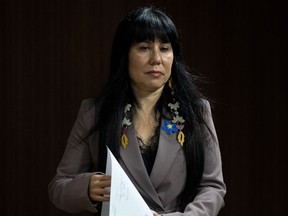
NDP MP for Winnipeg Centre Leah Gazan steps up to the podium at a news conference, Wednesday, Sept. 25, 2024 in Ottawa. Photo by Adrian Wyld /THE CANADIAN PRESS
First Reading is a Canadian politics newsletter curated by the National Post’s own Tristin Hopper. To get an early version sent directly to your inbox, sign up here.
Article content
T
For the third time in two years, a member of the NDP has introduced a private members’ bill
Last week, the House of Commons completed its first reading of Bill C-254, a private members’ bill introduced by the NDP’s Leah Gazan that would criminalize “residential school denialism.”
As the bill’s text states, any Canadian found to be “condoning, denying, downplaying or justifying the Indian residential school system” could be punished with up to two years in jail.
Article content
B
A judge would also be able to order the forfeiture of “anything by means of or in relation to” the speech offence.
“Since the discovery of unmarked graves (we have seen) an increase in denialism about what occurred in the residential schools. This is horrific,” said Gazan in a Friday statement on Parliament Hill.
Article content
This is the second time Gazan, the MP for Winnipeg Centre, has put forward a bill to jail who she’s called “residential school denialists.” She introduced an identical bill in the 44th Parliament.
Article content
Bill C-254 also comes just 16 months after a private member’s bill by the NDP’s Charlie Angus that proposed to jail Canadians for speaking well of fossil fuels.
The Fossil Fuel Advertising Act, which died on the order paper with the dissolution of Parliament in March, would have prescribed strict punishments for any Canadian caught in the act of “promoting” a “fossil fuel, a fossil fuel-related brand element or the production of a fossil fuel.”
Article content
If a normal citizen had been caught perpetrating such a promotion, the punishment could be as severe as a $500,000 fine. If done as a representative of an oil company, it would have prescribed a two-year jail term.
Gazan’s reintroduced bill comes just as an upstart B.C. political party, OneBC, is campaigning hard against the notion that the summer of 2021 had yielded a wave of previously undiscovered graves at the sites of former Indian residential schools.
“No graves in Kamloops. No genocide. No wrongs left to reconcile. No land, cash, or power grabs. No looking back,” read a social media post by OneBC leader Dallas Brodie responding to Bill C-254.
The “unmarked graves” phenomenon began in May 2021 when Tk’emlúps te Secwépemc First Nation in B.C. garnered international headlines by announcing that a ground-penetrating radar survey had found “the remains of 215 children” at the former site of the Kamloops Indian Residential School.
A
The statement would prompt then prime minister Justin Trudeau to lower the flags on federal buildings to half-mast for an unprecedented five months.
Four years later, none of the 215 have been confirmed as graves, and Tk’emlúps te Secwépemc is now referring to the 215 as “anomalies.”
In August, a poll by the Angus Reid Institute found that Canadians still generally believed that Indian residential schools constituted a form of “cultural genocide” against Canadian Indigenous people (68 per cent agree vs. 23 per cent disagree).
Nevertheless, that same poll found that both Indigenous and non-Indigenous respondents were doubtful that the 215 anomalies were actually children’s graves
A majority of Canadians (Indigenous respondents 56 per cent, all respondents 63 per cent) said Canada should “only accept the claim if further information is publicly available to verify through excavation.”
Article content
Article content
In 2021, Gazan twice referred to the 215 as lying in a “mass grave” — a claim that went beyond Tk’emlúps te Secwépemc’s initial statements, which had said simply that the 215 were unmarked burials.
Gazan changed this to “unmarked graves” in a June 1, 2021 House of Commons statement, and has not mentioned the alleged Kamloops Indian Residential School burials in her Parliamentary statements ever since.
Private members’ bills very seldom become law, and Bill C-254 does include multiple caveats under which a charge of “denialism” can be dismissed. Defences of Indian residential schools are allowed if it’s an “opinion based on a belief in a religious text” or if the accused is able to establish that “the statements communicated were true.”
The bill also specifies that Canadians are allowed to say whatever they want in “private conversation.”
Long before Tk’emlúps te Secwépemc ever commissioned a ground-penetrating radar survey at the Kamloops Indian Residential School, the seven-year-long Truth and Reconciliation Commission inquiry concluded that Canada’s system of Indian residential schools had featured outsized rates of student mortality, particularly in the pre-First World War era.
Article content
As per the Commission’s 2015 final report, an estimated 3,200 children had died while attending Indian residential schools, predominantly from outbreaks of tuberculosis. Many of those were buried in on-site graveyards that were subsequently abandoned.
Liberal MP Marc Miller is defending his remarks about limiting religious defences in hate speech cases, stating freedom of worship is not threatened, but public incitement of hatred should not be shielded by citing scripture.
Miller, who chairs the House Justice Committee, made headlines Thursday after questioning if Canada’s Criminal Code allows too much leeway for individuals to defend hate speech by referencing religious texts.
“There are religious texts that say [hateful things],” he told committee witnesses, specifically referencing Leviticus, Deuteronomy and Romans. “Clearly, there are situations in these texts where these statements are hateful. They should not be used to invoke or be a defence.”
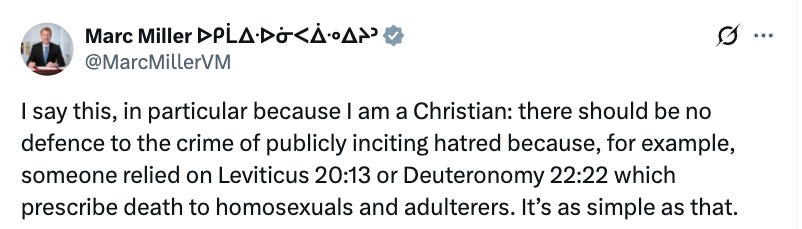
On Friday, he reinforced the message online, writing: “There should be no defence to the crime of publicly inciting hatred because, for example, someone relied on Leviticus 20:13 or Deuteronomy 22:22, which prescribe death to homosexuals and adulterers.”
The remarks sparked criticism from conservative commentators and faith advocates, who accused Miller of targeting scripture and religious speech.
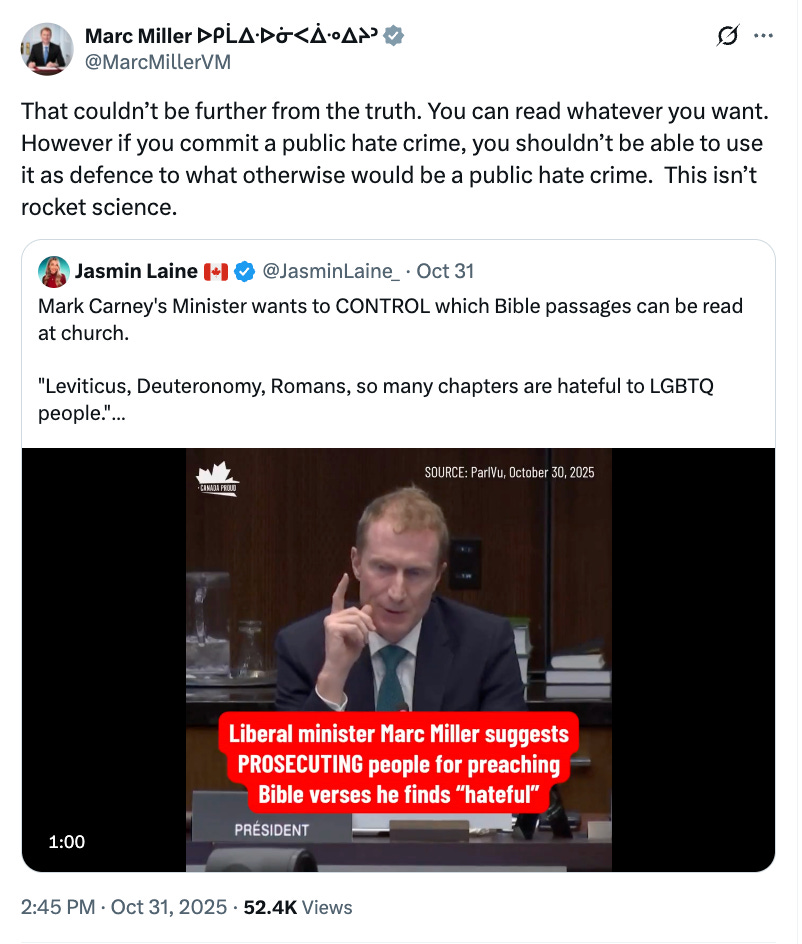
“Mark Carney’s Minister wants to CONTROL which Bible passages can be read at church,” political commentator Jasmin Laine posted on X, citing Miller’s reference to Biblical chapters “hateful to LGBTQ people.”
Miller responded on the platform: “That couldn’t be further from the truth. You can read whatever you want. However, if you commit a public hate crime, you shouldn’t be able to use it as defence to what otherwise would be a public hate crime. This isn’t rocket science.”
The debate centres on Section 319 of the Criminal Code, which criminalizes the willful promotion or public incitement of hatred against identifiable groups.
Miller did not propose immediate amendments to the law, but questioned whether current exemptions reflect the government’s intent.
“We have to be honest about what is being said, how it’s being justified, and whether our laws are working the way we say they are,” Miller told the committee.
Help arrested pro-lifer cover legal expenses: LifeFunder
(LifeSiteNews) – Alexander Kissiakov of Montreal, who was arrested and charged for standing in front of an abortion clinic handing out pamphlets to pregnant women to tell them about the psychological consequences of abortion, is asking the pro-life community to help him cover the legal costs he incurred for promoting a pro-life message.
On October 31, Kissiakov launched a LifeFunder to raise $15,000 to help cover legal expenses. It is only now that he can tell his story, as the court had issued a peace bond that prevented him from speaking publicly about his case until now.
“If you find my cause honorable and have the means to contribute, your support would be deeply appreciated,” Kissiakov said.
In September 2022, Kissiakov was arrested after protesting in front of an abortion clinic, where he gave a pamphlet to a person he thought was a patient but later turned out to be a nurse at the clinic who was offended by what he was doing.
“Following a renewed desire to ‘live by faith’ after watching Pastor Chuck Baldwin’s sermon, I stood on September 13, 2022, in front of an abortion clinic to distribute informational pamphlets to pregnant women about the psychological consequences of abortion — because I believed they had the right to know,” he said.
“Most declined to take one, and I respected their choice as they respected my right to be there.”
Kissiakov said that after the nurse said “no” to taking a pamphlet, the police were later called. He was wearing a shirt that quoted Psalm 22:10 on the front: “From my mother’s womb you have been my God.”
When police arrived, he was told to leave right away by the security guard, and that if he did not, the police would remove him. He made it a point to ask the police if he was under suspicion of committing a crime, and he was told he was not.
He said that he asked many times if he was being charged and was told he was not. Eventually, Kissiakov said, “police became agitated. They grabbed me violently, my phone fell, and the recording stopped.”
“They searched me while I was against the wall without informing me what crime I had committed or whether I was under arrest. After repeated demands for clarification, the police finally said that I was under arrest,” he said.
He was told by one officer that he had done “mischief.” He later learned that he was charged with two counts of criminal harassment, one toward the nurse and one toward the users of the clinic.
He was also charged with one count of mischief for allegedly having “prevented, interrupted, or interfered with the lawful use, enjoyment, or operation of property exceeding $5,000 (the abortion clinic).”
“In other words, what began with the police assuring me I had committed no crime ended in three criminal charges,” he said.
After the trial, with the help of his video evidence, all charges against him were dropped after it became clear to the judge that he was told by police that he was not being charged, with him saying, “one officer even submitted a written confession to that effect.”
“The nurse claimed that I had followed her and tried to enter the clinic, but her account contradicted both my video evidence and the Crown’s own submissions,” he noted.
“She further alleged that I told her, ‘According to God’s law, one cannot have an abortion.’ I believe she confused the biblical verse on my T-shirt for words I had spoken, as I made no such statement. The judge found the nurse’s testimony unreliable and dismissed that charge.”
Kissiakov said the court determined that he was not in the wrong, with him saying, “neither security nor the police witnessed any interaction between me and the patients. Video evidence showed that I approached women briefly and always politely.”
“The court ruled that none of this behavior met the threshold for intimidation required under section 264(2)(d) of the Criminal Code, and that there was no evidence any patient actually feared for her safety. Filming women’s faces while expressing opposition to abortion did not constitute harassment. I was acquitted on this charge as well,” he noted.
Surveillance footage confirmed that he has never blocked access to the clinic.
Kissiakov noted that although he was acquitted on all charges “due to insufficient evidence,” the judge expressed “serious concern about statements I made during my testimony.”
He paraphrased her remark below:
“He claimed to act under the supremacy of God, above human law; believed he had a duty to inform only women, expecting less violent reactions from them; wished to position his camera lower to better film women seeking abortions; continued filming one woman after she refused his pamphlet; defied repeated police orders because he believed his conscience overrode them; admitted lying to men to reach women with his message; and acknowledged his actions were politically incorrect and unwelcome but necessary to follow his conscience. The court warned that if the prosecution pursued a peace bond under section 810, it would be inclined to consider it.”
Kissiakov agreed to the peace bond, which is said to be “why I have been unable to speak publicly about this matter until now.”
“I am now seeking $15,000 to help cover my legal expenses. If you find my cause honorable and have the means to contribute, your support would be deeply appreciated,” he said.
German political prisoner Alfred Schaefer has been moved, without explanation, to a new prison. Here’s his address. You might want to drop a letter of encouragement to this “man behind the wire.”
Alfred Schaefer JVA Bernau Baumannstr. 81 83233 Bernau Germany







 LifeFunder