
: B.C. human rights chief declares that it’s colonialist to stigmatize drug use
[Human Rights Commissions have long been mortal enemies of freedom of speech and often of common sense. However, recent pronouncements by the excessively paid ($351. 847) “rights” czaina, one Kasari Govender plumb new depths of madness. According to her” any return to stigmatizing illicit drug use is racist, colonialist and a violation of human rights..”],
Overdose crisis is ‘rooted in colonial approaches that prioritize individualism over community, wealth over health and power over empathy’
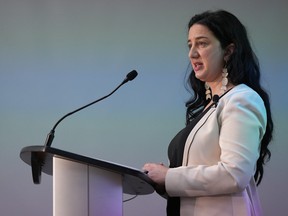
Just as B.C. officially acknowledges that decriminalizing drugs was a mistake, its own human rights commissioner has issued a statement saying that any return to stigmatizing illicit drug use is racist, colonialist and a violation of human rights.
The overdose crisis, which has killed more than 16,000 people in B.C. since 2016, is “rooted in colonial approaches that prioritize individualism over community, wealth over health and power over empathy,” reads a new position statement by Kasari Govender, B.C.’s human
“Using punitive tactics by criminalizing people who use drugs and doubling down on prohibition policies have proven to be ineffective and harmful for decades,” it adds.
t
The 22-page document also states that it’s discriminatory to even mention that B.C. has an “overdose” crisis, as it implies that doing drugs such as meth or fentanyl is inherently unsafe.
Rather, it is the view of the human rights commissioner that the primary cause of the crisis is “illicit drug manufacturers and dealers adding unknown toxic substances.”
Just last month, the B.C. Coroners Service confirmed that the province continues to see an average of five overdose deaths per day.
The “human rights” solution to all this, states the human rights commissioner, is simply for B.C. to lean even harder into policies that allow drug users to do drugs “without stigma.” More decriminalization, more low-barrier shelters and more “safer supply”; B.C.’s program of distributing free recreational opioids to drug users.
The statement was issued just as B.C.’s NDP government is acknowledging that many of its most extreme forays into harm reduction might have made the problem worse.
Article content
In February, B.C. walked back its safer supply program following reports that some drug users were simply reselling the free government opioids for cash. Now, “safer supply” can only be consumed in front of a clinician, instead of the prior system of being handed out in
B.C. Premier David Eby recently announced that the province’s experiment in decriminalizing hard drugs was “not the right policy.”
In November 2022, B.C. obtained federal permission to legalize the possession of “personal use” amounts of illicit drugs, such as heroin, fentanyl and meth, in what was initially branded as a strategy to reduce stigma and “decriminalize people who use drugs.”
But in a Vancouver speech last month, Eby said that decriminalization instead became a “permission structure” teaching drug users that “it was OK to use drugs anywhere.”
Just a week prior, in an appearance before the Union of British Columbia Municipalities, Eby also promised an increase in involuntary treatment for severe addicts, as well as tougher crackdowns on criminal drug networks.
For more than two decades, the official position of the B.C. government has been to view addiction primarily as a public health issue rather than a criminal justice issue.
But the new position statement of the human rights commissioner is notable in that it sets out almost no role for police to rein in drug dealers or for government programs to actually get drug users clean.
The document’s only mention of law enforcement in a favourable light is that it is sometimes needed because of “public safety concerns.”
Programs to get addicts off drugs are derided as “abstinence-only.” “There is no data to support the assertion that abstinence-only treatment options … are effective in addressing dependence on substances or the root causes of the toxic drug crisis,” it reads.
Govender’s report objects to every B.C. government move to rein in its various harm reduction experiments, including safer supply. “There is no evidence supporting claims that diversion is increasing overdose deaths or leading increased rates of youth to become substance dependent,” it read.
What’s more, the report states that any state drug policy must include drug addicts as collaborators in its creation. “Decision-making must include those impacted by the decisions,” it reads.
t
As for what causes people to become addicted to drugs in the first place, the report places partial blame on B.C.’s “deep-rooted history of colonialism, racism and discrimination.”
The Office of the B.C. Human Rights Commissioner is an arms-length agency of the B.C. government, costing around $8 million per year.
A significant portion of that goes to the commissioner herself, who is one of the highest paid civil servants in the province. As of 2024, she was collecting $351,847 per year; significantly higher than the $227,111 paid to the premier. (National Post, November 18, 2025)