
Dostoyevski & The Problems With “Tolerance” — Says A Lot About Our World

Latest Victim of Politically Correct Cancel Culture: Jamie Cudmore, Assistant Rugby Coach Fired
Canada’s poisonous cancel culture of speech control has claimed another victim. Jamie Cudmore is a former player and was assistant coach for the men’s national XVs team. After the women’s team rugby team imploded at the Olympics, losing to France and Fiji, he criticized their political stands — social justice warrior stuff about Indians and racial inclusion. He suggested that maybe more concentration on their game and less of political preaching might have served them better.
He tweeted: “
“Karma is a bitch! #Survivorsmyass,. I think someone could decolonize 9th place tomorrow.”His references to “survivors” and “decolonize” echoed statements the women’s team have made in the past.
The shameless Rugby Canada promptly fired Jamie Cudmore but had the gall to say they wished “to promote a healthy, inclusive culture” — just not inclusive or Mr. Cudmore or any political dissent.
On the other hand, Charity Williams of the women’s team relieved herself of such mawkish statements as: ““But as we know, we are more than athletes. This is what it looks like when you decolonize your space.” What does that even mean? And then: “we will be playing for us, the 1794 Indigenous children and counting, all the Black athletes who are only seen as valuable when they are successful and all survivors of abuse whose stories are not trusted 🧡” And, ““My hope is our team continues a legacy of creating safe and empowering spaces and organizations across Turtle Island and the world,” For the uninitiated, “Turtle Island” is what some Indians call Canada.
This self-styled victim couldn’t even gag out “Canada”. The only victim here is dissident Jamie Cudmore. — Paul Fromm

Jamie Cudmore, a former player and now an assistant coach for the men’s national XVs team, wrote the tweets after the women’s team crashed out of medal contention at Tokyo 2020

A veteran of the Canadian men’s rugby team, who faced a stampede of criticism after he wrote a series of tweets criticizing the political stances taken by the national women’s rugby sevens team, has been fired by Rugby Canada.
Jamie Cudmore, a former player who was serving an assistant coach for the men’s national XVs team, as well as running the national development academy in Langford, B.C., was terminated Friday afternoon, Rugby Canada confirmed in an email.
After the women’s team crashed out of medal contention at Tokyo 2020, rather than criticizing the poor play of the team — they suffered heavy defeats against Fiji and France — Cudmore took aim at the team’s politics.
“Karma is a bitch! #Survivorsmyass,” he initially tweeted before sharing an image — not seen by Postmedia — that Twitter flagged as “potentially sensitive content.” He then tweeted “I think someone could decolonize 9th place tomorrow.”
His references to “survivors” and “decolonize” echoed statements the women’s team have made in the past.
“LFG China,” he also tweeted, in support of the Chinese women’s team, who needed a big win over Japan to qualify ahead of Canada. (China beat Japan 29-0 to leap ahead of the Canadians in the overall standings.)
Cudmore later deleted the tweets.
Rugby Canada reacted swiftly, sending out a response early Friday morning via social media.
“Rugby Canada stands with our women’s 7s athletes. We support the team in their efforts both on and off the rugby pitch and are proud of the way they have represented our country. Rugby Canada is aware of recent social media comments made about the team and worked to ensure they were removed as quickly as possible,” the national organization said.
“Our organizational values include solidarity and respect, and everyone on our staff is expected to help create an inclusive environment for all.”
Story continues below https://bf25fc2e7035d6d0418b9f5f2ff189e5.safeframe.googlesyndication.com/safeframe/1-0-38/html/container.html
Rugby Canada’s senior management team decided Friday afternoon to terminate Cudmore’s employment, effective immediately.
“This decision comes as a result of a review of recent social media postings which were unacceptable and in breach of organization policy,” Rugby Canada said in a statement.
“Rugby Canada’s core values, including integrity and respect, must be exemplified in all our rugby programs and we are determined to promote a healthy, inclusive culture now and in future,” Rugby Canada board chair Sally Dennis added.
Last winter, the women’s team filed a series of complaints against former head coach John Tait, which were investigated under Rugby Canada’s harassment and bullying policies. Tait was cleared by the investigation but his position was untenable and he stepped down after more than a decade in charge of the women’s program.
Before these games began, the women spoke up about human rights issues, especially around racial and cultural inclusion and the historical treatment of Indigenous peoples in Canada, as well as the structure of their own program.
“A year ago, our team would be sitting here solely talking about the game — and the game is important to us and we are ready for that,” Charity Williams said in a pre-Games press conference. “But as we know, we are more than athletes. This is what it looks like when you decolonize your space.”
“I’ve been on this team for eight years and from my experience, I’ve never felt like there is a true place for me here. But sitting here today, I can say I trust my teammates are open to listening and learning,” she added. “My hope is our team continues a legacy of creating safe and empowering spaces and organizations across Turtle Island and the world,” she added.
Early Friday morning, ahead of Canada’s placing round game vs. Brazil — the Canadians won 45-0 — Williams responded on social media to Cudmore.
“I wanted to take this moment to talk about our performance and how proud I am of this team beyond any result. Because I am, and what we accomplished this year is far greater than one weekend. What this team stands for and who we have become means that young female athletes across Canada can play their sport and feel safe. I’m proud of that,” Williams said.
“But instead I have to sit here once again and share what we’ve been going through as a team. The consistent hatred we have received from people in our own organization. I’m only sharing because this is what we have been dealing with for months. From private texts, to public stalking online and in person. The bullying and harassment that we have received for coming forward is outrageous & scary at times. This is the reason we called for an internal investigation because we haven’t been safe,” she added. “But still, with everything, we have pushed through tears, pain, & joy, all of it to get us here. It’s not the result we wanted but we worked f—ing hard.
“Beyond all of that I want to thank those of you who have supported us thus far..we have heard you and we love you. We don’t regret a single moment and the team’s heads are all held high right now. 2 more games that we will be playing for us, the 1794 Indigenous children and counting, all the Black athletes who are only seen as valuable when they are successful and all survivors of abuse whose stories are not trusted 🧡”
By Raymond Ibrahim Jul 30, 2021 11:45 AM ET

A Coptic Christian church was recently burned to the ground—not in Egypt, where the torching of Coptic churches is not an uncommon occurrence, but in Canada, also known as “the church-burning centre of the Western world.”
In the early morning hours of July 19, St. George Coptic Orthodox Church in Surrey, which served 500 families and provided food for the homeless, was set aflame and completely destroyed. Only one charred wall remains standing.
According to the report, “The cause of the fire is still under investigation, but Surrey RCMP [police] said it is being treated as ‘suspicious.’ The St. George Coptic Orthodox Church was also the target of an attempted arson just last Wednesday, although authorities do not know if the two incidents are connected.”
What, exactly, do Canadian mounted police find “suspicious”? The church was clearly targeted for arson, as evidenced by the fact that it was targeted for arson a few days earlier, and at the very same time (between 2:30-4:00 a.m.). On July 14, surveillance video captured a woman lighting a fire, one that failed to catch, at the church door. That the “authorities do not know if the two incidents are connected” seems like wishful thinking.
What is deserving of the term “suspicious” is that, days after the church reported the first failed arson attempt to police—which should have led to better awareness and security for the church—another successful arson attempt took place.
After expressing its “immense sadness and pain” at the loss of the church, a statement from the Coptic Orthodox Diocese of Mississauga called on Premier John Horgan and the authorities to expedite the investigation, correctly observing that “The timing of this fire … raises many questions about what the authorities did to protect our church, especially considering the attempt on the same church this past Wednesday.”
Related: Vandals Burn Churches TO THE GROUND in Canada Amid ‘Truth and Reconciliation Report
Similarly, congregant Nancy Khalil, whose family helped build the now destroyed sanctuary, as well as dozens of “priceless” hand-painted icons, also expressed disappointment that “neither provincial nor federal leaders had yet spoken out about the fire.” “It hurts,” she said, “to see no word from the government. I’m very, very much hoping for at least a statement from the premier to condemn what is happening.”
She shouldn’t hold her breath. Canada’s leaders couldn’t care less about yet another church burning to the ground. Before this Coptic church was burned, at least 50 other churches, mostly Catholic, a few Anglican, were also vandalized or torched in Canada. Here’s how Canada’s leading voices responded:
So attacks on Christian churches are “unacceptable”—but they’re also “understandable.” Considering that these two words neutralize each other, Trudeau’s stance is impotent, his words meaningless.
But why are they “understandable” in the first place? According to Canadian “mainstream” media—all of which are left of Left—unmarked graves of Natives were recently discovered by boarding schools, and the Catholic Church is being accused of killing them and trying to cover it up. The problem, however, is that this widely shared narrative appears to be inherently false (see here and here): These graves were once marked and therefore known, and most of those buried in them died of natural causes.
More specifically, the deaths mostly took place in the early 1800s. Apparently, some plague—epidemics were especially common back then—broke out in these church-sponsored boarding schools for natives, in part due to the prevailing hygiene and lack of proper medical treatment (in comparison to modern standards and technology).
At any rate, that the current accusation against the Catholic Church was always a pretext to justify anti-Christianism in general is amply demonstrated by this most recent torching of a Coptic Orthodox church: What on earth do the Copts, Egypt’s native Christians, who began migrating to Canada over a century after these graves were first dug, have to do with this issue?
Nothing, they just happen to be Christian—and that’s apparently all that matters, all that warrants hate crimes and indifference to them in Leftist Canada. Evil, after all, never needs an excuse to manifest itself, though a pretext always offers good cover.
Senator Rand Paul Stands for Sexual Common Sense & Against Forced Masking
.png) |
| Dear Friend, You can find my latest below! Dr. Rand Paul Meets with Athletes Fighting to Save Girls’ and Women’s Sports This week my wife Kelley and I met with a group of women who have experienced the unfairness of biological males competing in women’s sports. During the meeting, which was organized by the Independent Women’s Forum, we heard from world champion track athlete Cynthia Monteleone and her daughter Margaret O’Neal, both who have faced the difficulties associated with competing against males in track meets and competitions. 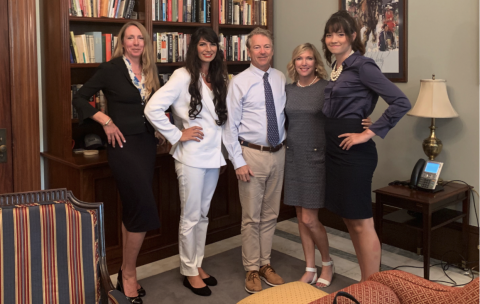 |
Like her mother Cynthia, Margaret, who is a high school sophomore, has also run against biological males. She probably would have won her first and only pre-COVID track meet of last season (instead of placing second) had she not been competing against a biological male, who predictably took first place. We also heard from three-time Olympian Inga Thompson, a retired road bicycle racer, who has raced with men when there were no women’s events, and she explained first-hand how much stronger and faster men are than women when competing in athletics.
I think the majority of Kentuckians and Americans would agree that boys should not be competing in girls’ sports. Thank you to these brave women for standing up and sharing their stories.
For more of Margaret and Cynthia’s stories, you can check this video out HERE.
Dr. Rand Paul Speaks on Foreign Spending and the Need to Prioritize America
It has always been my priority to put America’s and Kentucky’s interests first. This means focusing on funding critical infrastructure projects at home, rather than sending tax dollars abroad to fund infrastructure in Afghanistan.
On Wednesday during a U.S. Senate Foreign Relations Committee hearing, I spoke on the need to prioritize our country’s needs over those overseas. I explained that during my time in the Senate, I have seen our national debt grow to over $28 trillion, while the U.S. has continued to increase foreign aid by 70 percent over the last decade.
Following my remarks, I introduced an amendment that would have cut foreign aid across the board and allowed for those funds to be saved or redirected back to the taxpayers and instead spent on projects in their own communities.
Kentucky’s needs should always come first, and I promise to keep fighting to fund your roads and bridges instead of ones overseas.
You can watch my full remarks HERE and to read my amendment click HERE.
Dr. Rand Paul Pens Op-ed on Funding Infrastructure Projects by Cutting Wasteful Programs
This week, I penned an op-ed in the Cincinnati Enquirer on cutting wasteful spending and redirecting those funds toward our country’s critical infrastructure projects.
As I wrote in the op-ed:
I have long been a champion on the issue of prioritizing Kentucky’s critical infrastructure projects. Year after year, I’ve introduced legislation that would redirect one percent of non-infrastructure spending to domestic projects, and ensure more of Kentuckians’ hard-earned tax dollars are spent on important projects in your own backyards and communities. In addition, I’ve forced votes on cutting foreign aid welfare and using that money for roads and bridges here at home.
Despite my persistent efforts, Congress has continued to fail the American people on this issue. Democrats and some Republicans apparently care more about building roads and bridges in Afghanistan than those here at home.
Soon, the U.S. Senate will take up what we hope is a bipartisan infrastructure bill – I won’t hold my breath on that – but it could fund some of our nation’s most critical infrastructure projects, like the Brent Spence Bridge. America needs to invest in infrastructure, but with our national debt growing by the trillions, we must find a way to pay for needed projects without incurring additional debt.
Democrats are proposing a $3.5 trillion reckless tax and spending spree under the guise of infrastructure by including pet projects that have nothing to do with infrastructure. Did you know reparations for slavery, free child care, free health care, free cars, free college, free you-name-it, are now considered infrastructure by Democrats?
Certainly, a 60-year-old bridge that serves as a critical element of our nation’s infrastructure, carrying both I-75 and I-71 traffic through the Greater Cincinnati and Northern Kentucky areas, and serves as a connection point for 10 different states, would be higher priority.
To read my entire op-ed click HERE.
Dr. Rand Paul Reintroduces Legislation to Defend Farmers and Landowners from Government Overreach
On Wednesday, I reintroduced my legislation to get government off the backs of farmers and landowners. The Defense of Environment and Property Act of 2021 restores common sense to federal water policy by redefining “navigable waters,” excluding ephemeral or intermittent streams from federal jurisdiction, and restraining the power the Environmental Protection Agency and the Army Corps of Engineers hold over American landowners.
While some would have us believe we can only protect the environment by giving the federal government more control over Americans’ lives, my bill shows we can act while still respecting Americans’ private property rights and the Constitution’s limits on federal power.
Kentucky’s farmers and coal industry suffered when the Obama administration implemented its burdensome WOTUS rule. Though the Trump administration replaced that rule, we know the new Biden administration will certainly try to return us to an unworkable scenario again. That’s why it’s now more important than ever to make an actual change to the law to fix the problem, and protect our land and invaluable industries.
“We offer our thanks to Senator Rand Paul for introducing the Defense of Environment and Property Act of 2021 as we look forward to the clarity such legislation would bring to the Waters of the U.S. issue,” said Mark Haney, President of Kentucky Farm Bureau. “Farm families have always been on the forefront of good stewardship when it comes to natural resources, but we need to have some clear direction on the definition of navigable waterways that are defined in statue, not by regulations that are subject to change with every new administration. We believe this bill will do just that.”
To learn more about the Defense of Environment and Property Act click HERE.
Dr. Rand Paul Recognizes Bird Dogs Coffee of Owenton, Kentucky, as Senate Small Business of the Week
As Ranking Member of the Senate Committee on Small Business and Entrepreneurship, each week I recognize an outstanding Kentucky small business that exemplifies the American entrepreneurial spirit.
This week, it is my privilege to recognize Bird Dogs Coffee, a family-owned small business in Owenton, Kentucky, as the Senate Small Business of the Week.
Located in the heart of Owenton, Kasey Craigmyle Towles opened Bird Dogs Coffee in 2015. Kasey, who grew up in Owenton, and was the founder and operator of “Kasey’s Corner,” a successful gift shop, decided to pursue a different business venture that would uplift her hometown and foster a sense of community.
When Bird Dogs Coffee opened its door, Kasey and her husband, Randy, were seizing the opportunity to fill a gap in the Owenton market since there was not a coffee shop in town.
Like many small business owners, Kasey and Randy are actively involved in their community. Bird Dogs Coffee is a member of the Owen County Chamber of Commerce, and is an enthusiastic supporter of the Owen County Tourism Commission.
For several years, Bird Dogs Coffee has sponsored Owen County School District sports teams and contributed to multiple fundraisers for local organizations. Additionally, Kasey and Randy regularly donate to Owen County Project Graduation, which provides an alcohol- and drug-free graduation celebration for local high school seniors.
With Owen County High being close to their hearts, Kasey and Randy are also actively involved with the Owen County High School Alumni Association.
Bird Dogs Coffee is a remarkable example of how hard work, ingenuity, and discipline can turn a dream into reality. Small businesses, like Bird Dogs Coffee, form the heart of towns across Kentucky, regularly stepping up to support their communities.
To learn more about Bird Dogs Coffee you can visit their website HERE.
Dr. Rand Paul Hosts Final Meeting of the Intern Lecture Series with Guest Randy Barnett
This week I, alongside the Fund for American Studies, held the final installment of our intern lecture series, hosting over 250 interns from across the Hill.

These free educational opportunities allow Washington, D.C., interns to learn from prominent speakers on topics surrounding freedom, civil liberties, and free enterprise. Our lecture series is open to all D.C. interns and is a great platform to network with other students interested in economic freedom and limited government.
Our final guest this week was Mr. Randy Barnett, the Patrick Hotung Professor of Constitutional Law at Georgetown University who spoke on combating the radical left’s agenda promoting social justice and what we can do to stand up to it, as well as the important role that the 14th and 15th amendments play in today’s America. He also talked about the need for more judicial activism among our youth, teaching them to stand up for our rights and defend the Constitution against those who wish to change it. It is up to the young people of today and future generations to shape a future that cancels cancel culture itself and says no to the growing ideology of group-think.
As the series comes to an end, I am excited to continue my work with TFAS in the fall, working to bring great speakers from around the country to touch on the issues facing our nation and highlight the importance of freedom and civil liberties.
Media Wrap-Up
This week, I joined Tucker Carlson Tonight on Fox News, Newsmax, Nextstar Media Group, Larry Glover with WVLK, and Jessica Rosenthal with Fox News Radio.

Have an Issue or Concern?
If you are a Kentucky resident and need assistance with a federal agency or with navigating the federal response and ongoing community needs related to COVID-19, please feel free to contact my Bowling Green office at 270-782-8303. One of my staff members will be more than happy to assist you.
Kentucky has also set up a COVID-19 Hotline at 1-800-722-5725.
Stay in Touch with Dr. Paul
You can stay up to date on my latest news and activities by visiting my Senate website, www.paul.senate.gov, or my official Facebook and Twitter pages.
You can watch my Senate floor speeches and press interviews on Rumble HERE and my YouTube channel HERE. You can also sign up to be notified about my telephone townhall events HERE.
Warm Regards,

| Freedom of Worship Rally, Vancouver, August 8, 2021 |
| IMPORTANT NOTICE: There is no Freedom Worship Rally this Sunday, July 25th, 2021. We were not guaranteed availability at this time, so we unfortunately have had to cancel the event; however, we do have a Worship Freedom Rally event planned for August 8th (see blow for details)! We are also requesting prayers as we cross the border for a safe return to Canada without drama! Warmest Regards, Laura-Lynn |
| Vancouver Freedom Worship Rally |
| August 8th, 2021 – 11:00am- Jack Poole Plaza, Vancouver |

| We welcome you to come and join us for a powerful worship experience and an incredible message from the Word of God. |
New York Dems Seek to Block Chick-fil-A From State’s Rest Stops
– Newsmax
Dr. Seuss? Canceled.
Old Glory? Canceled.
4th of July? Canceled.
And now…Cancel Culture’s latest victim? CHICK-FIL-A!
That’s right. New York Democrats are trying to CANCEL Chick-Fil-A and BLOCK America’s beloved chicken sandwich from New York’s rest stops — all because the fast-food company is run by conservatives.
This cancel culture nonsense needs to END. Do you agree? Then stand with Chick-Fil-A NOW!
| STAND WITH CHICK-FIL-A ADD YOUR NAME TO THE OFFICIAL HOUSE GOP PETITION Your response is MISSING! ADD YOUR NAME |
We wouldn’t be coming to you if we didn’t think we could count on your response. PLEASE stand with conservative values and STAND WITH CHICK-FIL-A!
Sincerely,
Izzy
House Republicans STAND WITH CHICK-FIL-A
Important Legal Documents & Mail Being Kept from Political Prisoner Dr. James Sears
The Canadian Association for Free Expression learned today that information is being kept from political prisoner Dr. James Sears. A judge’s July 16 refusal to grant leave to appeal had not been given to him 13 days later.
He has received NONE of the many cards & letters sent to him. Did the censors get them or did the COVID eat them?
Dr. Sears was jailed for a year for satirical writing about privileged minorities, Jews and women, in the tabloid YOUR WARD NEWS, which he edited from 2016-2019. He was convicted under Canada’s notorious censorship law, Sec. 319 of the Criminal Code — the “hate law”.
He is being held in the Toronto South Detention Centre in Etobicoke.

FREE POLITICAL PRISONER, DR. JAMES SEARS
PLEASE SEND POSTCARDS OR LETTERS OF SUPPORT TO ONE OF OUR MEN BEHIND THE WIRE.
Dr. James Sears, Political Prisoner,
Toronto South Detention Center,
160 Horner Ave,
Toronto, ON
M8Z 0C2
CANADA
Disappointing — Political Prisoner Dr. James Sears Will Remain in Jail for Writing Politically Incorrect Satire in YOUR WARD NEWS: Court of Appeal for Ontario Won’t Grant Him Leave to Appeal
It took Motions Judge David Brown a full month to peruse Dr. James Sears’ Application for Leave to Appeal his conviction and maximum sentence of one year’s imprisonment under Canada’s notorious “hate law”, Sec. 319 of the Criminal Code for satirical writings about privileged minorities (Jews and women) in the tabloid YOUR WARD NEWS. Judge Brown in his July 16 ruling denied leave (permission) for the Court to hear Dr. Sears’ appeal.
So, a Canadian writer and newspaperman will remain in jail as a political prisoner, a non-violent prisoner of conscience in a Cultural Marxist ruled country that praises “diversity” but detests “diversity” of opinion.
Dr. Sears is being held in the South Toronto Detention Centre and is considering his legal options.
What follows is the text of Judge Brown’s ruling.

Paul Fromm
Director
Canadian Association for Free Expression
COURT OF APPEAL FOR ONTARIO
CITATION: R. v. Sears, 2021 ONCA 522
DATE: 20210716
DOCKET: M52559 & M52561
Brown J.A. (Motions Judge)
BETWEEN
Her Majesty the Queen
Responding Party
and
James Sears
Applicant
James Sears, acting in person
Ian McCuaig, assisting the applicant
Michael Bernstein, for the responding party
Heard: June 18, 2021 by video conference
ENDORSEMENT
[1] The applicant, James Sears, applies for leave to appeal from the order of the Summary Conviction Appeal Judge, Cavanagh J. (the “Appeal Judge”), and, if leave is granted, bail pending appeal.
[2] On January 24, 2019, the applicant and his co-accused, LeRoy (Lawrence) St. Germaine, were found guilty on two counts of willfully promoting hatred against identifiable groups – Jews and women – contrary to s. 319(2) of the Criminal Code. Neither accused testified at trial. The trial judge sentenced the applicant to a term of imprisonment of six months on each count, to be served consecutively.
[3] The convictions stemmed from statements written and published by the applicant and his co-accused in 22 issues of a newspaper called “Your Ward News” distributed in Toronto and online between January 2015 and June 2018.
[4] The applicant appealed his conviction and sentence to the Superior Court of Justice. The Appeal Judge dismissed the appeal: R. v. Sears, 2021 ONSC 4272 (“Appeal Reasons”).
[5] The applicant then applied before this court for leave to appeal his conviction and sentence pursuant to Criminal Code s. 839(1). As well, the applicant sought bail pending his appeal.
[6] The applications came before me on Monday, June 14, 2021. I advised the applicant that his application for bail pending appeal would necessarily entail a consideration of the merits of his leave to appeal application. Although I had jurisdiction to hear his application for leave to appeal[1], the practice of this court is for a panel to consider such applications in writing: Criminal Code, s. 839(1); “Practice Direction Concerning Criminal Appeals at the Court of Appeal for Ontario”, (March 1, 2017), at 7.3.6. The applicant advised that he wished to proceed before a single judge. I adjourned the hearing until Friday, June 18, 2021 to permit the applicant to file further materials.
[7] An appeal to the Court of Appeal in summary conviction matters lies, with leave, “on any ground that involves a question of law alone”: Criminal Code, s. 839(1). The principles governing such applications for leave were summarized by this court in R. v. Lam, 2016 ONCA 850, at paras. 9 and 10, leave to appeal refused, [2017] S.C.C.A. No. 2:
Section 839(1) of the Criminal Code limits appeals to this court from decisions of summary conviction appeal courts to grounds involving questions of law alone and requires that leave to appeal be granted by this court. This second level of appeal in summary conviction proceedings is an appeal from the decision of the summary conviction appeal court, not a second appeal from the decision of the trial court. The appeal is limited to questions of law alone and does not extend to questions of fact alone or of mixed fact and law, as do appeals to the summary conviction appeal court from decisions made at trial. Second appeals in summary conviction proceedings are the exception, not the rule: R. v. R.(R), 2008 ONCA 497, 90 O.R. (3d) 641, at para. 25.
Two key variables influence the leave decision:
• The significance of the legal issue(s) raised to the general administration of criminal justice
• The merits of the proposed ground(s) of appeal.
Issues that have significance to the administration of criminal justice beyond the particular case may warrant leave to appeal, provided the grounds are at least arguable, even if not especially strong. And leave to appeal may also be granted even if the issues lack general importance, provided the merits appear very strong, especially if the conviction is serious and an applicant is facing a significant deprivation of his or her liberty: R.(R.), at para. 37.
[8] To those principles I would add two others. First, since an appeal pursuant to s. 839(1) is an appeal against the judgment of the summary conviction appeal court, not a second appeal of the trial judgment, the leave to appeal judge should determine whether the summary conviction appeal judge properly applied the principles governing appellate review of the trial decision: John Sopinka, Mark Gelowitz & W. David Rankin, Sopinka and Gelowitz on the Conduct of an Appeal, 4th ed. (Toronto: LexisNexis, 2018), at §3.119; R. v. McCammon, 2013 MBCA 68, 294 Man. R. (2d) 194, at paras. 21, 36; R. v. C.S.M., 2004 NSCA 60, 223 N.S.R. (2d) 311, at para. 26.
[9] Second, the leave to appeal test should be relaxed where the summary conviction appeal decision is, in effect, a decision of first instance, for example where the appeal court reverses a decision of the trial court by substituting an acquittal for a conviction: R. v. O’Meara, 2012 ONCA 420, 292 O.A.C. 358, at para. 25. That a new issue arose for the first time on the summary conviction appeal is an important contextual factor within which to address the R. v. R.R., 2008 ONCA 497, 90 O.R. (3d) 641, test: R. v. MacKay, 2012 ONCA 671, 112 O.R. (3d) 561, at paras. 21-22.
[10] The applicant acts in person. As a former medical doctor, the applicant is very articulate. However, his written materials at times lack focus or sufficient legal particularity.
[11] The applicant’s Notice of Appeal identifies six grounds of appeal, which really amount to five as the fourth and sixth grounds essentially relate to the same sentencing issue concerning the imposition of consecutive sentences. The applicant’s Notice of Application for Release Pending Appeal and Leave to Appeal repeats three of the grounds contained in the Notice of Appeal.
[12] At the hearing on June 14, the applicant was assisted by Mr. Ian McCuaig, who was counsel at trial and on appeal for the applicant’s co-accused. In response to my inquiry for a more focused statement of the questions of law alone on which the applicant seeks leave, Mr. McCuaig sent the court an email identifying three issues that the applicant considers his strongest grounds of appeal. They are:
i. A new issue arising from the conduct of the summary conviction appeal: specifically, that the mode of hearing for the appeal was changed from in-person to Zoom videoconference over the applicant’s objections, resulting in an unfair process for the appeal hearing;
ii. The Appeal Judge erred in treating the direct evidence of the actus reus – the 22 editions of Your Ward News – as direct evidence for proving the mens rea of the offences. In the applicant’s view, the newspapers were only circumstantial evidence of mens rea and the trial judge did not satisfy the requirements of R. v. Villaroman, 2016 SCC 33, [2016] 1 S.C.R. 1000, when he inferred the applicant’s intent from the contents of the newspapers he edited and wrote; and
iii. The Appeal Judge failed to address the applicant’s sentence ground of appeal that Criminal Code s. 718.2(a)(i) – treating evidence that the offence was motivated by hatred based on race or sex as an aggravating factor – did not apply to offences under s. 319(2).
[13] On these applications, I will examine those three grounds of appeal, as well as whether the Appeal Judge erred by letting the applicant’s consecutive sentences stand. Although the applicant raised a number of other complaints with the trial decision during oral argument, these four grounds of appeal were the only ones advanced with particularity in the Notice of Appeal and Notice of Application for Release Pending Appeal and Leave to Appeal.
The events
[14] The appeal hearing was scheduled to be heard in mid-October 2020. One issue on the appeal concerned the applicant’s allegation of ineffective assistance by trial counsel; the trial judge had dismissed an application for a mistrial by reason of ineffective assistance. Cross-examination on the affidavits relating to that issue would take place at the appeal hearing. The applicant anticipated that the hearing would be in-person as that was the default mode of hearing for self-represented persons at that point of time in the Toronto Region.
[15] A case management conference was held before Akhtar J. on October 9, 2020, who advised that because of increasing COVID-19 infection rates in Toronto the appeal would be heard by Zoom videoconference. The applicant objected, arguing that he was entitled “to see the eyes of the person that is judging me.” A discussion ensued about whether the applicant had to comply with the general rule to wear a mask when entering the courthouse and the ability of supporters of the applicant to watch the appeal. At the end of the discussion Akhtar J. ruled:
[L]isten, I apologize for the miscommunication. There’s clearly been miscommunication [indiscernible] with the court what, what happened. The means of infection is a game changer. They are surging. But I understand that there’d be over a hundred people, potentially, coming into the court and they would not be allowed in the courtroom. And who knows what they’re going to be doing, whether they’re going to be wearing masks or not, I don’t know. Mr. Sears says he won’t wear a mask because he’s exempt. He won’t be allowed into the courthouse, I can assure you of that, because that’s the rule. Mr. Sears, I’ve done my best to accommodate you, and you know that, in every single day here, to try and get this on, on the rails and keep it on the rails. But, you have no entitlement to an in-person hearing. You don’t decide the procedure here. The court does. And based on all the circumstances I’ve heard, including the fact that, as I say, there’s going to be a large crowd coming, there’s going – you’re not going to be wearing a mask, and the fact that these figures today on the COVID I’m hearing, they are going to the Zooms and it is to be a Zoom hearing, and it will be a Zoom hearing.
[16] A Zoom hearing of the appeal commenced before the Appeal Judge on October 13, 2020. The applicant again raised his objection to the appeal proceeding by way of Zoom. He also submitted, by way of a “key takeaway”, that he required additional time to prepare properly for a Zoom hearing: he had planned to use large display boards at the in-person hearing but now would have to prepare a PowerPoint slide presentation. The Appeal Judge granted the applicant’s request for a short adjournment until November 10, 2020.
[17] On November 5, a few days before the scheduled start of the hearing, the Appeal Judge heard a motion by the applicant to adjourn the appeal until it could be conducted in-person. The applicant argued that the order to proceed by Zoom conflicted with information on the court’s website stating that self-represented persons must appear in person and violated his rights under the Canadian Charter of Rights and Freedoms.
[18] The Appeal Judge dismissed the motion, ruling in part:
This was raised again before me on October 13, 2020 when the applicant appeared by audio conference only, and I granted the requested adjournment on that occasion on the basis that it would not be fair for Mr. Sears to participate in the appeal by audio conference only. And at that time Mr. Sears agreed to secure an Internet link in order to proceed by Zoom, and new dates were scheduled.
Section 715.23 of the Criminal Code provides that the court may order an accused to appear by audio conference or video conference if the court is of the opinion that it would be appropriate, having regard to all the circumstances including the five specified circumstances set out in section 715.23.
In this case the order of Justice Akhtar as the case management judge is an interlocutory order and I lack jurisdiction to hear an appeal from that order.
…
And so in my view the order of Justice Akhtar order is – [indiscernible] the order as stands and I am not allowed to interfere with it on this application. If it turns out that there was a problem with a reasonable apprehension of bias, as Mr. Sears suggests, or any other issue with respect to that interlocutory order, that is properly a matter to be addressed through appeal proceedings, if the summary conviction appeal is dismissed.
[19] Although the applicant informed the Appeal Judge that he might not appear on the first two days of the appeal hearing when the evidence on the ineffective assistance of counsel issue was scheduled, in fact he participated throughout the Zoom appeal hearing.
Positions of the parties
[20] In his Notice of Application for Release Pending Appeal and Leave to Appeal and his Notice of Appeal, the applicant states that the decision of Akhtar J. to change the mode of hearing without notice was procedurally unfair because it contravened “the stated policy of the Court that self-represented appeals would be heard in person.” The decision prejudiced the applicant “as the appeal included cross examination as part of an ineffective assistance claim, the appeal record was voluminous and the number of issues argued was significant.”
[21] The applicant submits that Akhtar J. lost jurisdiction by overruling the “stated policy of the Court”, which was the September 28, 2020 iteration of the Superior Court of Justice, Toronto Region, “Notice to Profession: Toronto Expansion Protocol for Court Hearings During COVID-19 Pandemic.” Section A.4 dealt with “matters that will continue to be heard remotely.” Subsection (viii) concerned Summary Conviction Appeals. In the section dealing with hearings, para. 4 stated:
All out of custody appellants required to attend the hearings in person are no longer required to do so, unless self-represented. Hearings for self-represented appellants/applicants shall be conducted in person, unless in custody, in which case they will be conducted remotely.
[22] In his Enhanced Book of Authorities and Unfiltered Oral Argument Notes for Summary Conviction Appeal (“Unfiltered Argument”), which the applicant filed at the appeal hearing and on these applications, he describes his objection to a Zoom appeal hearing in the following terms:
I am being denied my constitutional right to an in-person hearing, and instead, under threat of imprisonment, I have been ordered to stare into a video screen at a cluster of pixels being transmitted from the Ministry of Truth. I am told that the image formed on the screen represents the Arbitrator of Truth who I must refer to as “His Honour” and who may be a real human or an A.I. virtual image.
…
And the reason I am forbidden to meet my arbitrator in person is that the Ministry of Truth is an arm of a fascist government which conveniently claims that an invisible virus could strike dead the Ministry of Truth’s aged prosecutor. And my suggestion that he alone appear by ZOOM is rejected without a reason.
[23] The Crown submits that this ground of appeal does not involve a question of law alone. Sections 683(2.1) and 822(1) of the Criminal Code provide a summary conviction appeal judge with the statutory power to order an appeal hearing to proceed by videoconference. Akhtar J.’s exercise of that statutory power does not give rise to a question of law alone. In any event, the applicant’s particular complaints about the mode of hearing do not have significance to the administration of justice beyond the four corners of the case.
Analysis
[24] I do not understand the applicant to be taking the position that Akhtar J. lacked the power to direct a videoconference appeal hearing. That is understandable given that s. 683(2.1) of the Criminal Code, which applies to summary conviction appeals by reason of s. 822(1), states: “In proceedings under this section, the court of appeal may order that a party appear by audioconference or videoconference, if the technological means is satisfactory to the court.”[2]
[25] Instead, I understand the applicant to be arguing that Akhtar J. improperly exercised his power to order a videoconference hearing because the Notice to Profession then in force contemplated in-person hearings for summary conviction appeals where the appellant was self-represented.
[26] I am not persuaded that a challenge to a procedural decision made within the jurisdiction of a summary conviction appeal judge raises “a question of law alone” within the meaning of s. 839(1) of the Criminal Code: R. v. Bresnark, 2013 ONCA 110, at para. 7.
[27] Even if the ruling could be characterized as a breach of procedural fairness giving rise to a question of law alone, the merits of this ground are very weak for two reasons. First, as disclosed in his reasons, Akhtar J. exercised his discretion to direct a Zoom hearing at a time of increasing public health concerns with the start of the COVID-19 “second wave” in Ontario, which resulted in the cancellation of most in-person attendances. Second, the prejudice the applicant sought to avoid – namely, impediments to adducing viva voce evidence and cross-examining on the issue of ineffective assistance of counsel – evidently did not materialize for he has not sought leave to appeal the Appeal Judge’s dismissal of his ineffective assistance of counsel claim.
[28] Nor does this ground of appeal involve a matter of significance to the general administration of criminal justice: it concerns the exercise of judicial discretion on a specific set of facts at a point of time when there were unique public health concerns.
[29] Accordingly, treating this ground of appeal as a new issue arising from the appeal hearing, I do not see it satisfying even a relaxed application of the R.R. principles regarding s. 839(1) leaves to appeal.
[30] The 22 issues of Your Ward News were marked as Exhibit 2 at trial. The trial judge wrote:
After considering the entirety of Exhibit 2, a consistent and obvious theme that radiated from this publication was hatred. It was at times contradictory in that love was professed to Jews and some women. It was at times satirical in that humour and exaggeration were employed to make the point. But hatred of Jews and women was overwhelmingly the message.
[31] The trial judge went on to find that: (i) “both men intended to publish hate. No other intent can be inferred from a complete reading of this newspaper”; (ii) “there exists significant evidence of the promotion of that hatred which undeniably illustrates their intent to pass on to others the message of hate towards Jews and women”; and (iii) “both men were fully aware of the unrelenting promotion of hate in YWN and intended that hatred to be delivered to others.”
[32] The applicant appealed those findings, advancing his objections under several discrete grounds of appeal, contending that the trial judge: provided insufficient reasons; failed to read the publications as a whole and failed to consider the published words in their context; wrongly treated the 22 issues of Your Ward News as direct evidence from which he could infer intent; failed to consider alternate, non-criminal meanings for the published words; and misapprehended the evidence thereby rendering the verdict unreasonable. The Appeal Judge rejected the applicant’s objections.
[33] On these applications, the applicant repeats his challenge to the trial judge’s findings, organizing his complaints under two grounds of appeal contained in his Notice of Appeal and Notice of Application for Release Pending Appeal and Leave to Appeal: (i) the Appeal Judge improperly applied the test for promotion of hatred and erred in concluding that statements made by the applicant constituted promotion of hatred; and (ii) the Appeal Judge improperly applied the law relating to circumstantial evidence with respect to the issue of wilfulness.
[34] In comprehensive reasons, the Appeal Judge dealt with each submission. His reasons disclose that he:
i. correctly identified the applicable scope of appellate review: Appeal Reasons, at paras. 15-19; 23; 39-42; 49-50; 55; 57; 61; and 67;
ii. correctly identified the governing legal principles set out in R. v. Keegstra, [1990] 3 S.C.R. 697, and found that the trial judge had given himself the direction recommended in that case: Appeal Reasons, at paras. 31-33;
iii. accurately summarized the facts and principles in Villaroman, seeing no error in the trial judge’s finding that the contents of the 22 issues of Your Ward News constituted direct evidence of the statements made by the applicant from which the intention of the applicant could be inferred: Appeal Reasons, at paras. 34-37;
iv. on the latter point, properly referred to and applied the observation in Keegstra, at p. 778, that “[t]o determine if the promotion of hatred was intended, the trier will usually make an inference as to the necessary mens rea based upon the statements made”: Appeal Reasons, at para. 65;
v. Accurately read the trial judge’s reasons as stating that he had read the entirety of all 22 issues of Your Ward News, had assessed the statements made in context, and understood the distinction between hate speech and merely offensive or distasteful statements: Appeal Reasons, at paras. 33, 46, 58-61; and
vi. As part of the process of appellate review, reviewed the evidence of the issues of Your Ward News marked as Exhibit 2 at trial: Appeal Reasons, at paras. 56-61.
[35] That process of appellate review led the Appeal Judge to conclude, at paras. 58 and 61:
In his reasons, the trial judge found that “[w]hen all 22 issues are examined, one is left with unfocused and absurd opinions, contradictory messages, and scattershot ramblings. Except for its stated claims of being the world’s largest anti-Marxist publication, YWN exhibits no unifying concept.” This finding is reasonably supported by the evidence.
…
Based on my review of the published issues of YWN marked at trial as Exhibit 2, I am satisfied that there was ample evidence upon which the trial judge could reasonably make these findings and reach these conclusions. Statements described by the trial judge in paragraphs 11 and 12 of his reasons as communicating hatred, within the meaning of that term in Keegstra, against women and Jews are found in the issues of YWN received in evidence. The trial judge’s reasons show why he decided as he did, and they show a logical connection between why he decided as he did and the evidence that was the basis for his decision. The 22 issues of YWN received in evidence provide the basis for public accountability of the trial judge’s reasons. The trial judge’s reasons, read in the context of the evidence at trial and the submissions made by counsel, do not foreclose appellate review.
[36] The applicant has not identified any error of law that tainted the Appeal Judge’s analysis. As I understand his submissions, the applicant simply repeats his disagreements with how the trial judge applied the law to the specific facts of his case and complains that the Appeal Judge did not apply the law to the facts in a different way. This ground of appeal is fact-focused and does not engage a question of law alone.
[37] In his reasons for sentence, the trial judge identified, as an aggravating factor, that Criminal Code s. 718.2(a)(i) provides that “where offences are motivated by hate, the sentences ought to be increased.” That section deems to be an aggravating circumstance “evidence that the offence was motivated by bias, prejudice or hate based on race, national or ethnic origin, language, colour, religion, sex, age, mental or physical disability, sexual orientation, or gender identity or expression, or on any other similar factor.”
[38] In his factum on appeal, the applicant enumerated 10 errors committed by the trial judge in his sentence, including “misapplying Section 718.2(a)(i), as Parliament never meant it to redundify Section 319.” In his “Unfiltered Argument”, the applicant contended that since some speakers during the Parliamentary debate over the enactment of s. 718.2 gave examples of hate motivated crimes causing physical harm to people and the then Minister of Justice, Allan Rock, stated the proposed amendment had “nothing to do with policing or punishing the way people think or the views they hold”, it follows that s. 718.2(a)(i) applies only to violent crime against an individual. Since the applicant did not commit such a crime, he contends that the trial judge erred by relying on s. 718.2(a)(i) as part of his determination of sentence.
[39] In oral submissions, the applicant complained that the Appeal Judge failed to deal with his ground of appeal involving s. 718.2(a)(i). He contends that s. 718.2(a)(i) applies only to cases other than hate speech under Criminal Code s. 319.
[40] No doubt the proper interpretation of a provision of the Criminal Code involves a question of law. So, too, the proper interpretation of a provision of the Criminal Code is an issue of significance to the administration of criminal justice beyond the particular case. Yet, the applicant offers no arguable grounds for his position outlined above. On its face, s. 718.2(a)(i) applies to all offences in the Criminal Code; it identifies no exception. The applicant advances no plausible argument based on the principles of statutory interpretation that would create an exception where none exists.
[41] However, I have considered the applicant’s submission from a different angle. Perhaps the applicant is attempting to argue that by taking into account the statutory aggravating factors in s. 718.2(a)(i) the trial judge, in effect, impermissibly considered elements of the offence under s. 319(2) as aggravating factors. Characterizing an element of the offence as an aggravating factor is a reviewable error: R. v. Lacasse, 2015 SCC 64, [2015] 3 S.C.R. 1089, at para. 42; R. v. Adan, 2019 ONCA 709, at para. 106. Nevertheless, numerous cases have found no such error where a sentencing judge has taken into account statutory aggravating factors that are themselves elements of the offence: R. v. Tejeda-Rosario, 2010 ONCA 367, 262 O.A.C. 228, at paras. 12-13; R. v. B.S., 2019 ONCA 72, at para. 12; R. v. S.C.W., 2019 BCCA 405, at paras. 27-36; R. v. JAS., 2019 ABCA 376, at paras. 18-19. In any event, even where a sentencing judge errs, appellate intervention requires demonstrating that the error had an impact on the sentence. In the present case, the Appeal Judge considered whether the trial judge had erred by imposing a demonstrably unfit sentence. He concluded, at para. 136, that the applicant had not shown that the trial judge imposed a demonstrably unfit sentence. The applicant has not identified any arguable error of law in the Appeal Judge’s review of this aspect of the sentence.
[42] Consequently, this ground of appeal does not satisfy the principles in R.R.
[43] The trial judge sentenced the applicant to the maximum sentence of six months on each of the two counts, to be served consecutively. In determining that the sentences should be consecutive, the trial judge applied the decision of this court in R. v. Gummer (1983), 1 O.A.C. 141, [1983] O.J. No. 181 (C.A).
[44] Gummer involved convictions for dangerous driving and failing to stop. In setting aside the imposition of concurrent sentences and making them consecutive, this court stated at para. 13:
We do not consider the rule that sentences for offences arising out of the same transaction or incident should normally be concurrent necessarily applies where the offences constitute invasions of different legally-protected interests, although the principle of totality must be kept in mind. The offences of dangerous driving and “failing to remain” protect different social interests. The offence of dangerous driving is to protect the public from driving of the proscribed kind. The offence of failing to remain under s. 233(2) of the Code imposes a duty on the person having the care of a motor vehicle which has been involved in an accident, whether or not fault is attributable to him in respect of the accident, to remain and discharge the duties imposed upon him in such circumstances.
[45] The trial judge stated, at para. 12:
In this case, identifiable groups, those being women and Jews, have separate, legally-protected interests. The defendant could promote hatred against one and not the other, or vice versa. He promoted hatred against both. In addition, the hate was promoted against both groups not from one incident, but many, and consistently over a period of three years.
[46] On his appeal from sentence, the applicant submitted that the trial judge committed an error in principle by deciding that the sentence for each count should be served consecutively rather than concurrently. The Appeal Judge did not accept that submission. The Appeal Judge properly recited the deference owed to a sentencing decision absent an error in principle or demonstrably unfit sentence. In the case before him, the Appeal Judge concluded that the trial judge did not err in principle by ordering that the sentence on each count be served consecutively, stating at paras. 129-130:
Counsel for Mr. St. Germaine submits that the only relevant interest for a sentencing judge to consider is society’s interest, and that the trial judge erred by identifying two separate interests. I disagree with this submission. Society has an interest in discouraging hate crimes against different groups and, just as in Gummer, the trial judge concluded in respect of the charges against the appellants, that there were two separate societal interests, discouraging hatred against women and discouraging hatred against Jews.
The Crown proceeded with a two-count information against each appellant and it acted within its discretion to do so. The trial judge had reviewed the collection of the 22 issues of YWN that were introduced into evidence, and he was well situated to decide whether the communications against women and against Jews in those issues should properly be treated as part of the same conduct against two groups who do not not enjoy separate protected interests, such that concurrent sentences would be proper. The trial judge, having reviewed the 22 issues, concluded that the communications promoting hatred were directed against separate identifiable groups, women and Jews, and each has a separate legally protected interest.
[47] On this application, the applicant submits that the Appeal Judge erred in law in allowing the order for consecutive sentences to stand.
[48] I am not persuaded that this ground of appeal amounts to a “question of law alone”. The Appeal Judge properly identified the principles governing his appellate review of the trial judge’s sentence. The applicant does not identify any conflict within the jurisprudence relevant to the circumstances of his sentence. Finally, as pointed out in Clayton C. Ruby, Sentencing, 10th ed. (Toronto: LexisNexis, 2020), at §14.18, “it becomes a fact-specific inquiry of whether the nexus between offences is sufficiently or insufficiently close to merit either consecutive or concurrent sentences.” [Emphasis added.]
[49] For the reasons set out above, I am not satisfied that the applicant’s proposed appeal meets the requirements of Criminal Code s. 839(1), as interpreted by R.R. Accordingly, the application for leave to appeal is dismissed. It follows that the application for bail pending appeal is also dismissed.
“David Brown J.A.”
[1] Section 839(1) of the Criminal Code states, in part: “Subject to subsection (1.1), an appeal to the court of appeal as defined in section 673 may, with leave of that court or a judge thereof, be taken on any ground that involves a question of law alone …” [Emphasis added.]
[2] The decision of this court in Woods (Re), 2021 ONCA 190, 154 O.R. (3d) 481, to which the applicant directed my attention, has no application to the present case. Woods involved proceedings under Part XX.1 of the Criminal Code. This court held, at para. 33, that Part XX.1 of the Criminal Code did not provide the Ontario Review Board with the authority to conduct its hearing by videoconference without the consent of the NCR accused. Part XX.1 has no application to the present case, which concerns the powers of judges on summary conviction appeals.
Australia’s Medico-Stalinist Police State Intensifies — Troops Called Out to Enforce Lockdown in Sydney
Issued on: 29/07/2021 – 09:36Modified: 29/07/2021 – 09:34

1 min Advertising
Sydney (AFP)
Police in Australia’s largest city have requested military help to enforce a coronavirus lockdown as infections in Sydney reached a new record Thursday.
Commissioner Mick Fuller said New South Wales police had asked for 300 Australian Defence Force personnel to be deployed “to boost its operational footprint”.
The city of five million people is in its fifth week of a lockdown that is set to run until the end of August.
Stay-at-home orders have failed to reduce new infections to zero, and compliance has been patchy.
Sydney residents are only allowed to leave their homes for exercise, essential work, medical reasons, and to shop for necessities such as food.
But for weeks, parks and beach promenades have been filled with Sydneysiders drinking coffee and chatting with friends.
Police have increasingly been doling out fines to those violating the restrictions and Fuller said those efforts would be stepped up in the coming days.
Last weekend thousands of people gathered in central Sydney to protest against the measures, and further demonstrations have been mooted.
Police have also requested more powers to shut down businesses that they say are not abiding by rules on social distancing.
On Thursday state premier Gladys Berejiklian warned that the outbreak — which began mid-June when a driver for an international flight crew contracted the virus — is “likely to get worse”.
Officials announced 239 new infections in Sydney, a record for this outbreak, which now totals 2,810 cases.
With under 14 percent of the Australian population vaccinated, many experts have warned that Sydney’s lockdown could run for months more.
Supplies of Pfizer-BioNTech shots are low and there has been widespread scepticism about the AstraZeneca jab, slowing the vaccine rollout.

PAUL FROMM ON BLOOD RIVER RADIO, SATURDAY JULY 31 — 5:00-7:00 p.m. E.S.T.


Tune in this Saturday, July 31, to BLOOD RIVER RADIO at bloodriverradio.com, 5:00-7:00 p.m. E.S.T. Special Guest Paul Fromm. Charlottesville Changed Everything: Charlottesville’s Importance in White Nationalist History.