Forced Out of His Job for Opposing City Name Change
It was supposed to be all about reconciliation with First Nations.
But that’s not how it turned out for Powell River born and raised paramedic Ted Vizzutti, forced out of his job based on unsubstantiated allegations of racism.
The Tla’amin First Nation took umbrage with the town’s namesake, Israel Wood Powell, and asked that the City change its name.
Like thousands of other townsfolk, Ted Vizzutti pushed back.
Disapproving of the name change cost Vizzutti his job.
BC Emergency Health Services (“BCEHS”) forced the 38-year veteran out of his beloved career, accusing him of racism.
Vizzutti, as described in some detail below, spent 38 years doing often life-saving work for people in his community, regardless of their background.
Like a lot of paramedics, Vizzutti fits the profile of the heroic first responder.
How and why did Ted Vizzutti get drummed out of his job?
The name change discussions date to the City of Powell River’s formation of a “Joint Working Group” in 2021, which led to an ultimately inconclusive city-wide consultation process in 2022.
A detailed, July 2022 report, summarizing the consultations revealed broad-based community opposition to the name change leading the working group to stand down and call for a “time of reflection.”
As illustrated in the below graphic, survey data included in the Working Group report revealed that a majority of both “racialized” and “white” residents were either “strongly opposed” to or “leaning no” on the proposed name change.

Despite the “time of reflection,” proponents and opponents of the name change continued to advocate for their positions.
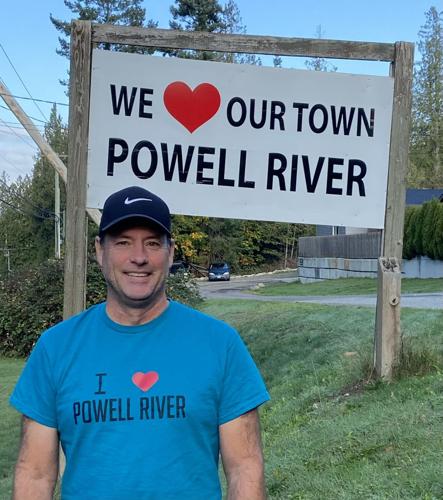
According to news reports, on May 4th, 2023, Vizzutti appeared with a group of other residents at Powell River City Hall to voice opposition to a proposal to change the City’s name, some wearing “I (heart) Powell River” t-shirts.
Vizzutti had made a post to his personal Facebook page inviting people to the City Hall gathering. The post was entitled “Say no to the name change of Powell River.”
Vizzutti’s Facebook post about the event seemed entirely benign.
“We, the citizens of Powell River,” wrote Vizzutti, “are coming together to tell elected officials that we are not in favour of a name change for our city. Please come out in support with your signs and voices. Two wrongs don’t make a right.”
According to Vizzutti, a group of protesters in favour of the name change gathered outside Powell River City Hall for the May 4th council meeting. Vizzutti says one of the protesters, threatened to have him fired from his job.
The next day, May 5th, Vizzutti received a severe Code of Conduct violation letter from Sheree Haydu, Manager, Clinical Operations, Sunshine Coast for BCEHS, demanding he appear at a meeting to address alleged “racism.”
According to Haydu, “On May 4, 2023, the Employer was made aware of your involvement in the following allegations: Circulating racist, anti-indigenous, and defamatory content on social media and door to door.”
According to Vizzutti, counter-protestor approached him and yelled close to his face “We’re going to get you fired!”
Sure enough, the next day, Vizzutti was summoned to the disciplinary meeting.
A series of meetings and correspondence ensued, resulting in Vizzutti leaving the employ of BCEHS.
A May 30th letter from Haydu included an expanded list of new vague and inflammatory allegations against the 58-year-old Mr. Vizzutti, including:
“You have impacted community members and made them feel unsafe.”
“Your comments and actions have impacted the Tla’amin First Nations community wherein they do not feel safe to call 911.”
“You have directly impacted your colleagues where they feel unsafe.”
Vizzutti says, upon reading the allegation that Tla’amin members felt “unsafe” calling 911, he phoned a friend within that community. The community member, according to Vizzutti, said that he was unaware of anyone declining to call 911 due to feeling “unsafe.”
The New Westminster Times spoke to Sheree Haydu by phone to ask questions and seek comment. Haydu declined to comment and referred the New Westminster Times to BCEHS media relations.
A series of questions were sent to Haydu by email seeking evidence that would substantiate the serious allegations leveled at Vizzutti.
Those questions were forwarded to BCEHS Manager, Media and Issue Communications Bowen Osoko, who responded via email: “We are unable to comment on confidential human resources matters as per privacy legislation, including any of the personal information you provided.”
Prior to a scheduled meeting with BCEHS, Vizzutti’s union representatives told him that he was going to be fired at the meeting. The union reps told Vizzutti that if he retired before they fired him, he could avoid loss of income and a lengthy fight.
In the face of the total loss of his income, the prospect of a lengthy dispute, Vizzutti decided to retire.
In response to Vizzutti’s retirement, the investigation was put in abeyance, but to Vizzutti’s great surprise, the BCEHS letter from Haydu included new threats, restrictions and insults.
“Should you choose to pursue employment with BC Emergency Health Services or Provincial Health Services Authority in the future, we reserve the right to re-commence and conclude the investigative process,” wrote Haydu, effectively cutting off any future BCEHS employment prospects for Vizzutti indefinitely.
“Often when paramedics retire, they work part-time or move to other locations where they offer their services if needed,” said Vizzutti in an interview. “With this threat of reopening the investigation, they have blackballed me across the entire province.”
Another Haydu directive was particularly humiliating to Vizzutti.
“Furthermore, as indicated in the initial 11.04 notice, you are prohibited from visiting any BCEHS property, including all stations and offices. I will arrange for any personal items currently stored at Station 229 to be returned to you as well as for you to return any BCEHS property including, but not limited to keys, ID Badge, and uniforms.”
“I was made persona non grata in a field where I had performed admirably and enjoyed a great deal of respect and seniority,” said Vizzutti. “I never did anything wrong but I am being treated like dirt.”
Based on our investigation, Ted Vizzutti was just one of thousands of Powell River residents voicing concern over the name change proposal.
Powell River Mayor Ron Woznow, elected in 2022, spoke candidly about the name change, which he said suffered from “a very flawed process.”
“The challenge with that was the majority of people in Powell River felt it was not a meaningful consultation,” said Woznow. “So what the city did was, rather than just going to talk to the residents of Powell River about this request, they put together a consultation process where the people from Powell River couldn’t go and ask a question.”
“So I think basically, where we’re at now, it’s been my position since I ran, is we have a request from the Nation, and it’s important that each member of Powell River has an opportunity to learn about the significance of this and then cast a vote as to whether or not they would like to do this or not,” said Woznow. “And if 50.1% want to do it, then council would take that to the provincial government and ask, if 50.1% or more don’t want to do it, then we’ll politely say to our neighbours, with regard to your request, the majority of people in Powell River would not like to do that.”
Despite the fact that City of Powell River’s public engagement process on the name change was by its own admission inconclusive and, as Woznow put it, “flawed,” the issue has suddenly been put back on the agenda.
At its January 16, 2024 Committee of the Whole meeting, a draft of the City’s “Strategic Priorities” was tabled that included this bombshell priority: “Take real steps towards a name change.”
The surprise inclusion of the name change as a “priority” brought out a large crowd to City Hall, some holding signs. It was evident at the January 16th meeting that the strategic plan was not unanimously supported.
At the meeting, councillors voted 6:1 to bring forward the plan for debate and possible adoption at the City’s February 15th, 2024 meeting.
Vizzutti, whose opposition to the name change seems very common in the town, feels that he has been unfairly singled out by BCEHS.
“The BCEHS is not only trying to take away my right to freedom of expression, their discriminatory actions are robbing me of my right to work,” said Vizzutti. “I’m at a time in my career where I can be helping new recruits learn the ropes, but they are blocking me from saving lives in the community like I used to.”
“I love my job,” said Vizzutti. “I wanted to keep serving my community, but they didn’t want me. It’s not fair.”
Who is Ted Vizzutti?
The bustling lunch crowd at popular Powell River Julie’s Airport Café seemed more like a family reunion for Ted Vizzutti. The hugs, high-fives, and “hey-how-are-ya’s” evoked a warm sense of community connection that people often associate with a small town.
When the New Westminster Times met with Vizzutti, he said he had told no one in town why he was not at work. The truth is BCEHS had muzzled him.
When asked about his stand-out paramedic stories, Vizzutti recounted the kind of harrowing tails that regularly lead people to describe first responders as heroes.
“One thing about being a paramedic in a small town is that you often end up on calls where you know the people you are trying to help,” explained Ted. “It can make the job more emotional.”
A vivid memory Vizzutti shared was his first car accident.
“It turned out two of my high school friends went off the road at high-speed on their way back from Lund,” explained Vizzutti. “The car was going so fast when it hit the tree that the engine flew out and was found hundreds of feet away. The vehicle was suspended six feet in the air. When I managed to climb up to the wreckage, I found my young friend dead at the scene, impaled on a branch.”
Then there was the radio call from an injured logger, miles from nowhere, in a mountain up Powell Lake during a snowstorm, in the middle of the dense, slippery, and dangerous coastal forest.
“There were no roads in, so me and my partner commandeered a boat to head up Powell Lake to get closer to the guy,” explained Ted. “The boat malfunctioned, so we had to turn around and get ourselves another boat. We ended up at a trail head into the logger’s location and embarked on a multi-hour hike. Having no spiked boots, I almost broke my leg when I slipped on a log, but managed to free my pinned foot and carry on. The person had been struck by a fallen tree to his back and had been spitting up blood. We packaged him up and slid him down on the snow. This call lasted 6 hours. At that time I was making a call out wage of approximately $10 an hour.”
It was the kind of story that makes you ask yourself “why would anyone want to do this job?”
“I’m like everyone else who does my job. We don’t think of ourselves heroes,” says Ted, humbly. “We’re just doing our jobs.”
Vizzutti’s undeserved ouster from his job as a paramedic comes at a time of extreme staffing shortages across the entire BC healthcare system.
After several calls to the Tla’amin First Nation for comment, Director of Communications Davis McKensie called back. McKensie said that he was “new” and didn’t know much about the name-change topic, and said that he needed time to speak with others and back to us with possible comments.
As it turns out, contrary to what McKenzie told the New Westminster Times on the phone, McKensie appears in fact to be very knowledgeable about the Powell River name change process.
McKensie was a member of the above noted Working Group, formed in 2021.
Also, as disclosed and discussed at Powell Rivers’ January 16, 2024 Committee of the Whole meeting at City Hall (archived on video), McKenzie is in the midst of producing a documentary on behalf of the Tla’amin First Nation about the Powell River name-change process.
In an email, McKenzie stated: “I checked around and it looks like the Nation would decline to comment on this.”
The Ted Vizzutti story epitomizes the now common overreach of zealous Canadian bureaucrats seeking to rob citizens of their constitutionally protected right to freedom of expression.
Across Canada indigenous calls for geographic place name changes are put forward in the name of reconciliation with First Nations and “decolonization.”
As the story of Ted Vizzutti illustrates, “decolonization” could turn out to be the opposite of reconciliation.