Ontario dad demands answers after his bank accounts are frozen in case that could strengthen the Charter rights of all Canadians Dear friend of freedom,Every day, Canadians rely on access to their bank accounts to pay bills, manage expenses, and support their families.But imagine discovering that your bank accounts had been frozen, with no explanation and no warning.Your online banking access denied. Your ATM cash withdrawal requests denied. Your pre-authorized payments blocked, jeopardizing your vehicle, mortgage, or insurance payments. Evan Blackman experienced this, along with hundreds of other Canadians.
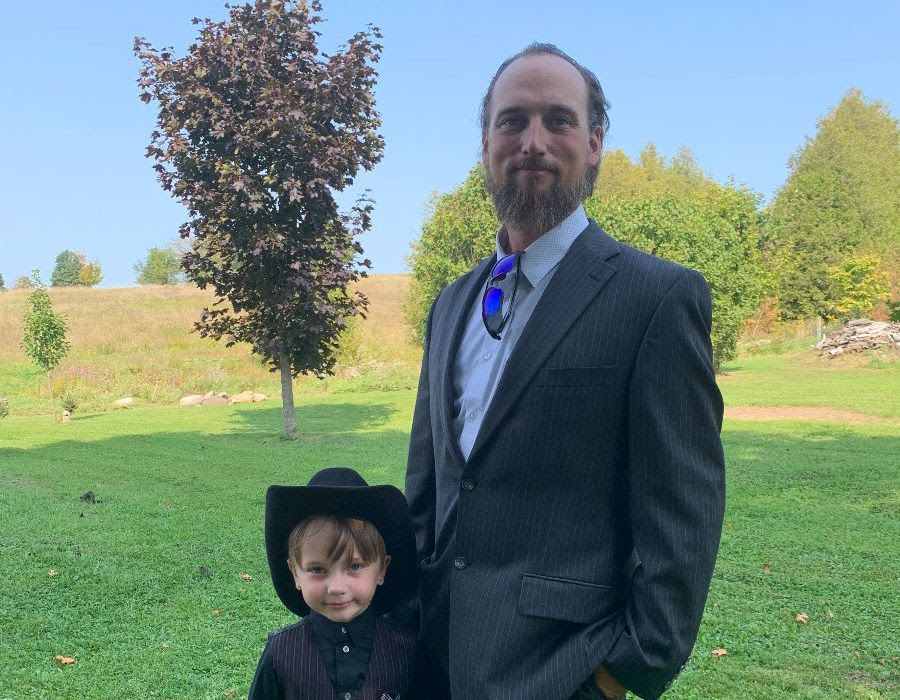
Evan Blackman with his son Damian (Photo courtesy of Evan Blackman)
Police arrested Evan in downtown Ottawa on February 18, 2022, during the violent suppression of the peaceful Freedom Convoy protest. Though police released him that same day, he later discovered that his Toronto-Dominion Bank accounts had been frozen. “The initial impact was drastic, being five hours away from home,” he explained. “It was an absolute shock to find out my bank accounts were frozen. As a self-employed worker, it not only affected my family, but my employees as well.”
Four days after the federal government invoked the Emergencies Act against the peaceful protesters resisting Covid vaccine mandates and lockdowns, police arrested Evan and charged him with mischief and obstruction. The Crown’s prosecution rested on a 14-minute drone video and the testimony of a single police officer. The video footage showed Evan attempting to de-escalate tensions between police and protestors. At one point, he was even seen holding others back and raising his hand to prevent conflict. The footage showed Evan kneeling in front of officers, hat in hand, singing O Canada.At his trial in October 2023, the judge dismissed all charges against Evan. The Crown failed to produce persuasive evidence that Evan had done anything criminal. The judge found the police officer’s testimony unreliable and even described Evan as a “peacemaker.”For a brief moment, it felt like Evan’s life could finally return to normal.
Evan Blackman with his son Damian (Photo courtesy of Evan Blackman)
Regrettably, the Ottawa Crown Attorney’s Office appealed the decision, claiming that the judge had made several legal errors. Lawyers provided by the Justice Centre, however, have turned the tables. In the retrial of this case, Evan’s legal team will argue that the freezing of his bank accounts violated his constitutional rights and will seek the dismissal of his case as a remedy if he is convicted.On July 4, 2025, a judge of the Ontario Court of Justice ordered the RCMP and TD Bank to produce key records related to how and why Evan’s accounts were frozen. Evan thanked the Justice Centre after the decision was made public, remarking, “I’m delighted that we will finally get records that may reveal why my bank accounts were frozen.” Evan’s retrial is scheduled to begin on Thursday, August 14, 2025. By supporting the Justice Centre with a donation, you’ll not only be supporting Evan’s case. You’ll be one step closer to protecting your own bank accounts from interference by Canadian governments.
This isthe first criminal trial in Canadian history to involve a Charter challenge against the use of emergency powers to freeze personal bank accounts. Evan’s experience remains a stark reminder of how quickly core freedoms can be threatened when governments violate Canadians’ rights in the name of public safety and national security.If you have not previously donated to the Justice Centre, please consider doing so today. You can join other freedom-loving Canadians who make it possible for us to defend your freedoms in courts of law and in the court of public opinion. Please consider becoming a monthly donor so that the Justice Centre can continue to defend your rights and freedoms throughout 2025. Yours sincerely,
Catherine Kronas, member of Ancaster Secondary School Council
The Hamilton Wentworth District School Board has reinstated a member of the School Council of Ancaster Secondary School after suspending her for publicly objecting to the routine reading of an Indigenous Land acknowledgement at a school council meeting in April. At the meeting Catherine Kronas registered her complaint and requested that her objection be noted in the minutes of the meeting.
In a letter this week reinstating Kronas, Yohana Otite, Human Rights and Equity Advisor · Hamilton-Wentworth District School Board, described the events following Kronas’ objection at the April Meeting writing, “The Board received allegations of hate and harm from parents and community members concerning your conduct. As a result, HWDSB’s Human Rights Office conducted a threshold assessment.” Adding “while the board reviewed the concerns the interim measure to pause your engagement with the school council (our emphasis) was taken to prevent further harm…”
In reinstating Kronas, Otite wrote, “the threshold assessment indicates your conduct does not amount to a Code of Conduct or Human Rights Policy Violation, however, the parents and community members who brought forward their concerns shared that they have experienced significant harm, which continues to create a concern around the school council climate.”
The Kronas suspension received no local coverage but was the subject of an article in the National Post. Kronas appealed for assistance from the Justice Centre for Constitutional Freedoms which issued a legal warning letter to the Hamilton-Wentworth District School Board over its suspension of Ms. Kronas. Constitutional lawyer Hatim Kheir stated that Ms. Kronas’ comments “were a reasonable and measured expression of a viewpoint held by many Canadians. “The Board’s decision to suspend her from the Council, which she has a right to sit on as an elected parent member, is an act of censorship that offends the right to freedom of expression,” explained Mr. Kheir. The Justice Centre is called for Kronas to be immediately reinstated and permitted to fulfill her elected duties without further retaliation for expressing her views. In the letter to the Hamilton Board the lawyers wrote:
The following information, which is necessary for Ms. Kronas to understand the allegation against her, is missing: Who made the complaint? Who experienced the harm allegedly caused by Ms. Kronas? What is the nature of the harm allegedly experienced? What did Ms. Kronas say or do that is alleged to have caused the harm? How did Ms. Kronas’ comment cause the alleged harm? Which provisions of the HWDSB Code of Conduct or Provincial Code of Conduct are alleged to have been breached by Ms. Kronas?
Kronas, who ran for the Board of Education in Ward 15 in 2022, was then described as an “anti-woke” candidate in a media profile for her objection to the HWDSB board’s DEI policies and its policies around gender. She told the Ancaster News the board should teach students to treat people equally regardless of skin colour or other factors, rather than seek equity’s “equality of outcomes among groups.” In the article she continued, “This comes down to the ideological basis. Are we living in a liberal society or are we living in a Marxist society?…I’m being called hateful, we’re being called racist, just for pushing back on some of these ideas.” In the election she finished second in the Ward 15 trustee race, but garnered 41 percent of the vote.
This isn’t a typical email. It’s an update on what’s happening behind the scenes at The Maple. Below, opinion editor Davide Mastracci shares how he found himself investigated by the RCMP, simply for doing journalism.
A couple months ago, we revealed that The Maple had been the target of a campaign to take us offline. Today, I can tell you the campaign has escalated, with critics wanting me in prison. In February, I published Find IDF Soldiers — a database of Canadians who have joined the Israeli military, based entirely on public information. With a list of 163 current and former IDF soldiers, it’s the largest in Canada, and offers rare insight into this group.Israel’s supporters have tried everything to get the site taken down, including hacking, suspension demands, discussing lawsuits, email campaigns, a multi-country media assault and death threats.
I recently learned something even more troubling: the RCMP investigated me.Documents I obtained show that someone complained to the RCMP about the project and called for me to be charged. The RCMP received the bogus complaint, screened it and rather than deciding to end things there, chose to investigate.They assigned an analyst to the complaint, who then ran my name through law enforcement databases, searched for information about me online and compiled a report.Unsurprisingly, the RCMP concluded I wasn’t a threat to “national security,” and that my journalism didn’t break any laws.
But the damage was done. My name is now in a police database used by at least 25 law enforcement agencies across Canada.Experts say this could follow me for years, and that it sends a message to other journalists: reporting on the wrong topic may land you in a police database. It’s chilling.Most journalists would stop here.I’m not one of them. I’ve spent years writing about Palestine. If threats and intimidation tactics were going to stop me, it would’ve happened a long time ago.And thankfully, I work at a publication that isn’t vulnerable to pressure the way most outlets are.
The Maple doesn’t depend on funding from advertisers, grants or major donors that can be scared off. That makes us hard to intimidate — but only if we have readers backing us.If we’re going to keep publishing this sort of work, we need to be able to withstand the tough moments that defang other publications. If we have you on our side, we can.If you believe in what we’re doing — fearless, independent journalism that can’t be bullied —then consider becoming a Maple member. Every membership is a lifeline. And if we’re going to keep publishing, we need more of them.
Because, the thing is, the threat isn’t over. I’m waiting on very overdue ATIP requests from CSIS, Ontario’s Solicitor General and Toronto Police. I don’t know what they’ll return, but I’m increasingly confident these agencies and departments looked into me because of complaints from powerful Israel supporters about my journalism.If that ends up being the case, we may have to finally hire a criminal lawyer. They’ve been willing to help me pro bono so far, but that can’t last forever.And if we want to keep publishing, we need to be ready — not scrambling after the fact.Your support doesn’t just help us do the journalism we want to — it helps protect it, and protect us. It ensures I can move forward with this work without being afraid. It makes me feel confident that you’ll have my back should anything happen.If you believe in independent journalism that won’t cower — even when it’s under attack — I hope you’ll support it. Already a member? Thank you. Your support has kept us alive, and I hope you’ll stay with us. If you’re in a place to do more, you can also make a one-time donation here.— Davide Mastracci Opinion editor, The Maple
OTTAWA: The Canadian Constitution Foundation (CCF) will appear at the Supreme Court of Canada from November 5-6 to intervene in Alford v Canada (Attorney General), a case that raises foundational questions about the meaning of parliamentary privilege and whether the Executive branch has the power to criminalize speech in Parliament.
Professor Ryan Alford of Lakehead University is challenging section 12 of the National Security and Intelligence Committee of Parliamentarians Act (NSICOP), which allows Members of Parliament with security clearance to be jailed for up to 14 years for disclosing classified information – even during debates in the House of Commons. Professor Alford takes the position that stripping committee members of parliamentary privilege would require a constitutional amendment.
The CCF will argue that Members of Parliament have a constitutional right to speak freely, and that NSICOP violates section 18 of the Constitution by allowing the Executive branch to interfere with Parliament’s exclusive authority to regulate its own speech. This undermines parliamentary independence and free debate.
The controversy around NSICOP drew national attention when Conservative Party of Canada leader Pierre Poilievre refused to obtain security clearance to review a classified report alleging foreign interference by sitting Members of Parliament and Senators, citing concerns that, due to NSICOP, doing so would mean forfeiting his right to speak about the report in Parliament.
“Members of Parliament must be able to speak freely in a healthy democracy,” said Christine Van Geyn, CCF Litigation Director. “This law is already having a chilling effect on debate. By giving the Executive branch power to control what can be said in Parliament, this Act strips Parliament of its constitutional authority and ultimately erodes accountability to the people.”
The CCF is represented in this case by Paul-Erik Veel and Amy Goudge of Lenczner Slaght.
Obituary published on Legacy.com by Hultgren Funeral Home and Cremation Center – Wheaton on Jul. 12, 2025. Deanna Spingola, Beloved Author, Historian, and Radio Host, February 17, 1944 – July 7, 2025.
Deanna Spingola, a dedicated student of history, prolific author, and respected voice on the Republic Broadcasting Network, passed away peacefully on July 7, 2025. She was widely known for her rigorous research and thought-provoking publications, most notably The Ruling Elite series, which examined pivotal geopolitical events of the 20th century. Born in the mid-20th century, Deanna fostered a lifelong passion for history and truth-seeking. Her early works included technical books on quilt design, reflecting her attention to detail and creative spirit. In 2011, she published The Ruling Elite: A Study in Imperialism, Genocide & Emancipation and later The Ruling Elite: Death, Destruction & Domination (2014), which challenged mainstream historical narratives and inspired many to view history through a critical lens. Through her long-running program on Republic Broadcasting Network, Deanna engaged listeners in deep discussions on history, finance, and power structures, earning a reputation as an insightful and persuasive commentator.
Ontario judge orders RCMP and TD Bank to release records tied to freezing Freedom Convoy protester Evan Blackman’s bank accounts.
Government’s use of the 2022 Emergencies Act faces scrutiny over civil liberties violations, including bank seizures and coerced tow truck conscription.
In 2023, Blackman was acquitted of mischief and obstruction charges, but Ottawa appealed, leading to an upcoming retrial in August 2025.
2024 court ruling found Trudeau’s invocation of the emergencies law “not justified,” highlighting overreach in targeting peaceful protesters.
Legal backers seek to link bank seizures to constitutional violations, framing the case as a landmark challenge to state powers.
Evan Blackman, one of hundreds whose accounts were frozen under the law, faces a retrial in August 2025 after being acquitted in 2023 of charges related to the Ottawa demonstrations. His lawyers argue that the seizure of his funds — a decision first reviewed as lawful but later condemned by federal judges — violates Charter rights to privacy and freedom of expression. The court’s demand for transparency could unravel the government’s case while exposing systemic flaws in its pandemic-era policies.
The legal fight over “extreme overreach”
The ruling demands disclosure of documents detailing how and why Blackman’s accounts were frozen under Section 53 of the Emergencies Act, which Trudeau invoked on February 14, 2022. The law, originally designed for responses to disasters like floods or terrorist threats, granted unprecedented power to block financial transactions, seize property and militarize law enforcement.
Constitutional lawyer Chris Fleury, representing Blackman’s Justice Center for Constitutional Freedoms (JCCF), called the seizure “an extreme overreach,” stressing that the records could prove the government “illegally punished peaceful dissent.” Blackman, an Ottawa-area protester detained after participating in nonviolent rallies, saw his three accounts frozen for over a week, potentially stifling his ability to prepare a defense during the original charges.
The JCCF emphasizes that this is the first criminal case in Canada attempting to halt proceedings under Section 8 of the Charter, which bars unreasonable searches or seizures, and Section 2(b), protecting free expression. Their stance draws strength from a 2024 Federal Court ruling by Justice Richard Mosley, who declared Trudeau’s emergency declaration “not justified,” arguing it failed to balance public interest with human rights.
The 2022 protests and their aftermath
The Freedom Convoy began on January 15, 2022, as a movement protesting vaccine mandates and pandemic restrictions. By early February, it swelled into hundreds of tractor-trailers blocking Ottawa’s streets, leading Trudeau to invoke the Emergencies Act—a move nearly all provinces condemned.
Documents now sought by the JCCF could clarify how authorities targeted nonviolent advocates. While the government framed protests as violent, much of the event unfolded as group camping, community meals and music, according to RCMP logs obtained by the National Post. Instead, most documented violence stemmed from state actions: videos showed mounted police trampling an elderly woman and attacking journalists.
Critics argue the law’s use set a dangerous precedent. Despite a special commission later endorsing Trudeau’s emergency declaration, federal courts — including Mosley’s decision — have since eroded its legitimacy.
What lies ahead: A trial with national implications?
Blackman’s retrial in August could become a landmark test of Canada’s emergency laws. His legal team plans to argue that the federal government’s seizure of funds was retaliation for political speech, violating the Charter. If successful, similar cases by over 100 protest-era plaintiffs might proceed, reshaping how authorities handle dissent.
Meanwhile, the RCMP and TD Bank have yet to publicly comment, though the ruling binds them to comply. The outcome may also influence current debates over pandemic-era policies, as critics question the viability of invoking “extreme measures” for non-violent public assemblies.
As Fleury noted, the case “exposes a dangerous precedent where the state weaponizes financial control to silence dissidents.” For civil liberties advocates, the ruling offers a rare chance to challenge a legacy of distrust in Trudeau’s leadership — and redefine the limits of crises authority.
A new day for accountability, or an open door for state power?
The Ontario court’s demand for transparency in Blackman’s case underscores a growing reckoning with the 2022 pandemic policies. While the protests seemed forgotten to some, the legal fallout continues to reveal a government unprepared to balance safety with constitutionality — and a judiciary increasingly willing to hold it to account.
As the Aug. 14 retrial nears, Canadians wait to learn more than Blackman’s fate: whether their next crisis will be met with calm stewardship… or another round of rushed, rights-eroding reforms.