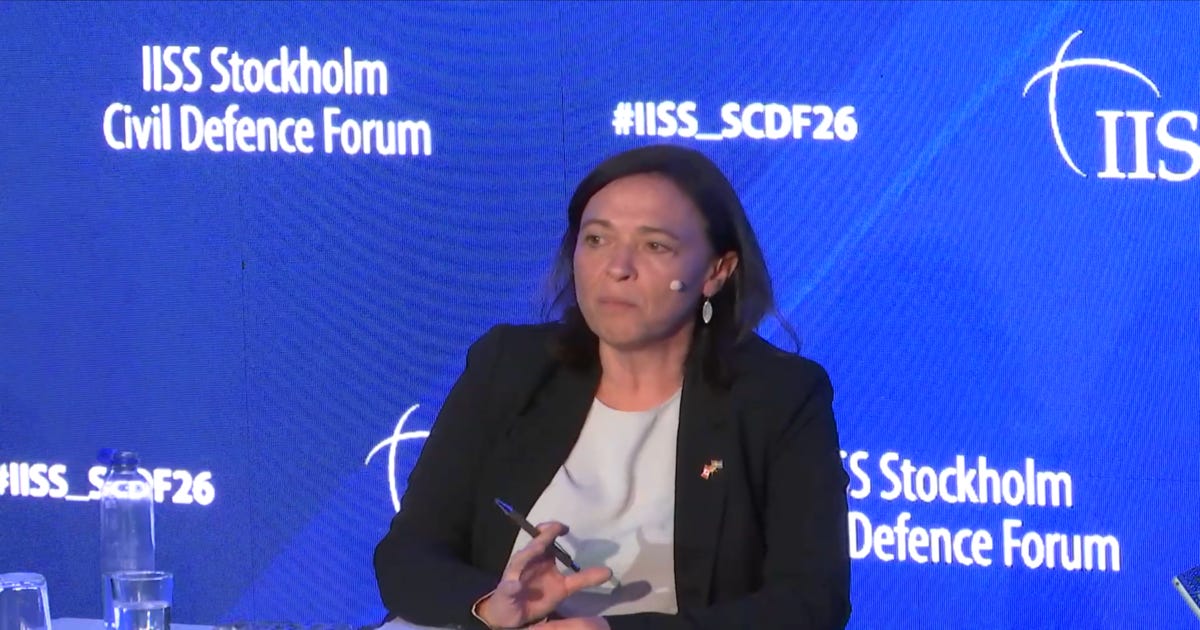
Geddes speaking at the ISS conference in Sweden: X
Public Safety Canada Deputy Minister Tricia Geddes recently told an international audience that alternative media was a top concern for the Liberal government and lauded the use of the Emergencies Act to quash peaceful Freedom Convoy protesters.
Geddes was in Stockholm, Sweden, to give a speech at the International Institute for Strategic Studies’ conference called Threats and Responses.
You won’t find stories like this in legacy media. Become a Juno News premium subscriber today to support bold, fearless independent journalism.
During the panel discussion, she also lauded the utility of the Emergencies Act, and how it has helped her government deal with “extremists”, but that there is “low trust in Canada in many of our government institutions and that’s something we need to build foundationally.”
“At the federal level, Canada’s priorities include concern with our relative vulnerability to information manipulation and polarizing narratives, and the growing skepticism of younger Canadians towards democracy, who shape their world online through alternative media,” she said on Tuesday.
“Foreign adversaries are seeking to leverage this vulnerability to their advantage. Protecting democratic institutions and the public by strengthening intelligence collection and information sharing across all levels of government.”
When asked what legal framework Ottawa was equipped with on the issue, Geddes said that the Carney government was “really struggling with the speed of moving legislative reform,” adding that they’ve been trying for eight years, and through multiple Parliaments, to get new online regulations passed.
“We’ve suffered through prorogations and changes in governments and haven’t been able to get across the finish line. So that’s a bit frustrating and challenging for us,” she said. “The technology and privacy debate is what is sort of the most acutely difficult legislative conversation in Canada.”
However, it was under former prime minister Justin Trudeau that Parliament was prorogued, which lasted for several months.
Geddes then went on to note how the Liberals have found “a lot of old legislation is proving to be extremely useful right now,” citing her government’s invocation of the Emergencies Act as a highly effective tool.
According to the deputy minister, while the Emergencies Act was created “many decades ago for different circumstances,” it has still proved to “give us the types of authorities that we need in extremists. So that’s helpful.”
The Emergencies Act was invoked for the first time during the 2022 Convoy protest against government mandates regarding the COVID-19 pandemic to quash peaceful protestors from demonstrating in Ottawa.
What Geddes failed to mention is that at the beginning of the year, the Federal Court of Appeals upheld a January 2024 Federal Court decision that the federal government’s invocation of the Emergencies Act was “unreasonable.”
Justice Richard Mosley’s earlier ruling had declared the Act’s economic and emergency measures violated the Charter of Rights and Freedoms.
On March 27, the final day of the Supreme Court’s deadline for appeal, the federal government then filed an appeal challenging the federal court’s landmark ruling, reopening litigation on its use of the Emergencies Act.
Geddes added that it has been “very difficult to get Canadians to understand the imminence of the terrorism threat in Canada,” which has made it difficult for the government to make any reforms, but now the population wants to meet the moment.
“We try to take advantage of the way Canadians have decided that there is a need to stand up for themselves at this moment and that is an area where we can tap into,” she said.
Emergencies Act appeal to the Supreme Court shows Mark Carney is not so different from Justin Trudeau after all
6
Protestors set up a blockade at the foot of the Ambassador Bridge, sealing off the flow of commercial traffic over the bridge into Canada from Detroit, on Feb. 10, 2022. The Freedom Convoy protests and blockades were nothing police couldn’t handle using the Criminal Code, writes Josh Dehaas. Photo by Cole Burston/Getty Images
There was never any question what Prime Minister Mark Carney thought about the Freedom Convoy protesters in Ottawa. In a Globe and Mail op-ed published on Feb. 7, 2022, the “Ottawa resident and former governor of the Bank of Canada and the Bank of England” wrote that the convoy was “terrorizing” people, that women were being forced to “flee abuse,” and that the elderly were “afraid to venture outside their homes.” He accused the organizers of “blatant treachery” and “sedition,” and proposed the government respond by “choking off the money.”
A week later, Prime Minister Justin Trudeau followed Carney’s advice, invoking the Emergencies Act for the first time in history to create shocking regulations that banned funding of or travelling to protests and ordered financial institutions to search for and seize bank accounts of suspects without warrants. This authoritarian overreach echoed around the world.
Still, I held out hope that the findings by a Federal Court judge and three judges of the Federal Court of Appeal that the invocation of the Act was unlawful and that the regulations made under it violated Charter rights would give Carney pause. Perhaps he believes in Charter rights more than his predecessor? If not, I thought maybe he would stand down from an appeal to emphasize a break with his predecessor. Turns out I was foolish to have been hopeful. In an application for leave to the Supreme Court of Canada that landed in my inbox on the last possible day, I learned that Carney is doubling-down on Trudeau’s illegal invocation.
In their application materials, the federal government makes the same basic argument they made before: some Freedom Convoy supporters had blockaded border crossings, and a handful of individuals near the Coutts, Alta., border blockade were found with a cache of firearms, so it was reasonable for Trudeau to take unprecedented measures to shut down freedom of expression and invade the privacy of all Freedom Convoy supporters nationwide.
As alarming as the blockades and the Coutts cache were, they were nothing police couldn’t handle using the Criminal Code. In fact, they had made their arrests and ended the border blockades by the time Trudeau dropped the bomb. As we, at the Canadian Constitution Foundation, explained in the federal courts — with agreement from all four judges who looked at the question — there was no justification offered by Trudeau for declaring a national emergency, suspending the right to support and travel to certain kinds of protests, and temporarily tossing away the ancient right to security against unreasonable searches by freezing bank accounts without warrants.
In their leave application, the government argues that the Federal Court of Appeal decision “hamstrings governments’ ability to respond effectively to future crises,” but this is simply not true. The Emergencies Act is explicit that governments can take extraordinary measures to deal with situations that pose a serious risk of violence and that cannot be dealt with using existing laws.
We must not forget that the Emergencies Act was Parliament’s genuinely noble response to previous prime ministers who had abused their power in times of crisis, including interning Japanese Canadians during the Second World War and denying habeas corpus to innocent Quebeckers during the 1970 October Crisis. It was designed to prevent prime ministers from over-reacting and suspending rights except when genuinely warranted. Like any law, it can be amended if Parliament sees fit. But why bother with democracy when you can roll the dice in the courts instead, I suppose? It turns out Carney is not so different from Trudeau after all. (National Post, March 18, 2026)
Josh Dehaas is Counsel with the Canadian Constitution Foundation, a legal charity that challenged the invocation of the Emergencies Act and the rules made under it in the Federal Court and Federal Court of Appeal.
Invocation of Emergencies Act was illegal https://cafe.nfshost.com/?p=10945
Christine Van Geyn20 Jan 2026
A generational civil liberties victory has been upheld. On Jan. 16, the Federal Court of Appeal held that the Trudeau government illegally invoked the Emergencies Act in 2022 in response to the Freedom Convoy.
The unanimous judgment, which upheld the lower court’s decision in 2024, is meticulous, devastating and leaves little room for doubt. Future governments facing political turmoil have been put on clear notice: they cannot casually reach for emergency powers to solve a domestic protest.
The case was brought by the Canadian Constitution Foundation (CCF) and the Canadian Civil Liberties Association, along with several individuals directly affected by the emergency measures. The court accepted the CCF’S argument that the Emergencies Act was never meant to be easy to use.
The act was deliberately crafted as a response to the abuses of the War Measures Act, infamously deployed by Pierre Trudeau during the October Crisis in 1970. Parliament replaced that law with one designed to restrain executive power, not expand it. As the Federal Court of Appeal emphasized, “one must not lose sight … of the history of the Act and of the context in which it was adopted.” Parliament, the court noted, “precisely circumscribed Cabinet’s discretion” to prevent the casual or political use of emergency powers.
Yet that is exactly what happened in February 2022.
The Trudeau government invoked the Emergencies Act in response to noisy and disruptive protests in Ottawa and blockades at several border crossings. The court rejected, point by point, the government’s attempt to justify that decision.
To invoke the act lawfully, cabinet had to reasonably believe that Canada faced a “threat to the security of Canada” — a term Parliament deliberately imported from the Canadian Security Intelligence Service (CSIS) Act and associated with serious violence. The government attempted to dilute that meaning, arguing that economic disruption and protest activity could qualify.
The court flatly rejected that argument. “To claim that the threshold for declaring a public order emergency … could be lower than the threshold for using the surveillance powers … under the CSIS Act would make little sense,” it wrote. “If anything, it should be the reverse.” Emergency powers, the judges made clear, demand more justification, not less — particularly when they authorize “a vast array of draconian powers without any prior authorization.”
Even more damaging was the court’s assessment of the evidence. Aside from the situation in Coutts, where a weapons cache was discovered but resolved using ordinary law before the Emergencies Act was invoked, there was no credible proof of serious violence: “When properly understood as requiring bodily harm, the evidence is quite simply lacking.”
CSIS ITSELF HAD ASSESSED THERE WAS NO THREAT TO NATIONAL SECURITY.
CSIS itself had assessed that there was no threat to national security, and the government invoked emergency powers before a requested alternative threat assessment was completed.
The court’s conclusion was blunt: “As disturbing and disruptive as the blockades and protests could be, they fell well short of a threat to national security.”
The government also failed the Emergencies Act’s “last resort” requirement. Emergency powers may be used only when existing laws are insufficient. Yet the protests were ultimately cleared using the Criminal Code — the very tools already available at the time. The RCMP commissioner at the time had even advised the government that police had not exhausted their existing powers.
What was lacking in Ottawa, the court observed, was not legal authority but policing resources and co-ordination. That is not a national emergency. It is a failure of governance.
Equally damning was the government’s disregard for provincial opposition. Most provinces warned that invoking the Emergencies Act would be unnecessary and divisive. Cabinet failed to meaningfully engage with that opposition.
“In a federation,” the court wrote, “provinces should be left to determine for themselves how best to deal with a critical situation, especially when it largely calls for the application of the Criminal Code by police forces.” The judges emphasized that if the situation does not exceed capacity or authority of the provinces, “they should be left to their own devices.”
The regulations enacted after the declaration fared no better under constitutional scrutiny.
The court ruled that the sweeping ban on assemblies violated freedom of expression by criminalizing mere attendance at protests, including peaceful expression on Parliament Hill. Individuals could face up to five years in prison “not because of anything they were doing,” but because someone else nearby might breach the peace. That, the judges held, was grossly overbroad and unconstitutional.
Perhaps most chilling was the ruling on the financial measures. Banks were compelled to share Canadians’ private financial information with police without a warrant, without notice, and without recourse. Financial institutions were effectively deputized as agents of the state and told to “leverage the news” and social media to identify suspects.
The court found that this ad hoc system “lacked procedural safeguards” and allowed privacy to be invaded based on “potentially unfounded, subjective beliefs.” It violated the Charter’s protection against unreasonable search and could not be justified.
This decision now stands as binding precedent. It places real legal constraints on future governments and ensures that the Emergencies Act cannot be repurposed as a political convenience. It restores the act to what Parliament intended: a narrow, exceptional tool, not a blunt instrument against dissent.
The government spent millions defending the indefensible. It lost completely. And in doing so, it handed Canadians one of the most important civil liberties rulings in a generation.
That is worth celebrating. (National Post, January 29, 2026)
Christine Van Geyn is the litigation director for the Canadian
Constitution Foundation.
A rights ruling to be celebrated
Invocation of Emergencies Act was illegal
Christine Van Geyn20 Jan 2026
A generational civil liberties victory has been upheld. On Jan. 16, the Federal Court of Appeal held that the Trudeau government illegally invoked the Emergencies Act in 2022 in response to the Freedom Convoy.
The unanimous judgment, which upheld the lower court’s decision in 2024, is meticulous, devastating and leaves little room for doubt. Future governments facing political turmoil have been put on clear notice: they cannot casually reach for emergency powers to solve a domestic protest.
The case was brought by the Canadian Constitution Foundation (CCF) and the Canadian Civil Liberties Association, along with several individuals directly affected by the emergency measures. The court accepted the CCF’S argument that the Emergencies Act was never meant to be easy to use.
The act was deliberately crafted as a response to the abuses of the War Measures Act, infamously deployed by Pierre Trudeau during the October Crisis in 1970. Parliament replaced that law with one designed to restrain executive power, not expand it. As the Federal Court of Appeal emphasized, “one must not lose sight … of the history of the Act and of the context in which it was adopted.” Parliament, the court noted, “precisely circumscribed Cabinet’s discretion” to prevent the casual or political use of emergency powers.
Yet that is exactly what happened in February 2022.
The Trudeau government invoked the Emergencies Act in response to noisy and disruptive protests in Ottawa and blockades at several border crossings. The court rejected, point by point, the government’s attempt to justify that decision.
To invoke the act lawfully, cabinet had to reasonably believe that Canada faced a “threat to the security of Canada” — a term Parliament deliberately imported from the Canadian Security Intelligence Service (CSIS) Act and associated with serious violence. The government attempted to dilute that meaning, arguing that economic disruption and protest activity could qualify.
The court flatly rejected that argument. “To claim that the threshold for declaring a public order emergency … could be lower than the threshold for using the surveillance powers … under the CSIS Act would make little sense,” it wrote. “If anything, it should be the reverse.” Emergency powers, the judges made clear, demand more justification, not less — particularly when they authorize “a vast array of draconian powers without any prior authorization.”
Even more damaging was the court’s assessment of the evidence. Aside from the situation in Coutts, where a weapons cache was discovered but resolved using ordinary law before the Emergencies Act was invoked, there was no credible proof of serious violence: “When properly understood as requiring bodily harm, the evidence is quite simply lacking.”
CSIS ITSELF HAD ASSESSED THERE WAS NO THREAT TO NATIONAL SECURITY.
CSIS itself had assessed that there was no threat to national security, and the government invoked emergency powers before a requested alternative threat assessment was completed.
The court’s conclusion was blunt: “As disturbing and disruptive as the blockades and protests could be, they fell well short of a threat to national security.”
The government also failed the Emergencies Act’s “last resort” requirement. Emergency powers may be used only when existing laws are insufficient. Yet the protests were ultimately cleared using the Criminal Code — the very tools already available at the time. The RCMP commissioner at the time had even advised the government that police had not exhausted their existing powers.
What was lacking in Ottawa, the court observed, was not legal authority but policing resources and co-ordination. That is not a national emergency. It is a failure of governance.
Equally damning was the government’s disregard for provincial opposition. Most provinces warned that invoking the Emergencies Act would be unnecessary and divisive. Cabinet failed to meaningfully engage with that opposition.
“In a federation,” the court wrote, “provinces should be left to determine for themselves how best to deal with a critical situation, especially when it largely calls for the application of the Criminal Code by police forces.” The judges emphasized that if the situation does not exceed capacity or authority of the provinces, “they should be left to their own devices.”
The regulations enacted after the declaration fared no better under constitutional scrutiny.
The court ruled that the sweeping ban on assemblies violated freedom of expression by criminalizing mere attendance at protests, including peaceful expression on Parliament Hill. Individuals could face up to five years in prison “not because of anything they were doing,” but because someone else nearby might breach the peace. That, the judges held, was grossly overbroad and unconstitutional.
Perhaps most chilling was the ruling on the financial measures. Banks were compelled to share Canadians’ private financial information with police without a warrant, without notice, and without recourse. Financial institutions were effectively deputized as agents of the state and told to “leverage the news” and social media to identify suspects.
The court found that this ad hoc system “lacked procedural safeguards” and allowed privacy to be invaded based on “potentially unfounded, subjective beliefs.” It violated the Charter’s protection against unreasonable search and could not be justified.
This decision now stands as binding precedent. It places real legal constraints on future governments and ensures that the Emergencies Act cannot be repurposed as a political convenience. It restores the act to what Parliament intended: a narrow, exceptional tool, not a blunt instrument against dissent.
The government spent millions defending the indefensible. It lost completely. And in doing so, it handed Canadians one of the most important civil liberties rulings in a generation.
That is worth celebrating. (National Post, January 29, 2026)
Christine Van Geyn is the litigation director for the Canadian
4. The politicians who imposed this vile police state act on Canadians, especially Justin Trudeau and Chrystia Freeland be sued for violation of Canadians’ civil rights.
Story by Jim Bronskill
• 6h •
OTTAWA — The Federal Court of Appeal has ruled it was unreasonable for the Liberal government to use the Emergencies Act four years ago to quell protests in the national capital and at key border points.
The decision issued Friday affirms a 2024 Federal Court ruling that rejected use of the emergencies law and found invocation of the act led to the infringement of constitutional rights.
The Federal Court of Appeal said the government lacked a basis to declare that the events across Canada posed a threat to national security or amounted to a national emergency — requirements that must be satisfied to invoke the Emergencies Act.
For about three weeks in January and February 2022, downtown Ottawa was filled with protesters, including many in large trucks that blocked streets around Parliament Hill.
The usually placid city core was beset by blaring horns from big rigs, diesel fumes, makeshift encampments and even a hot tub and bouncy castle as protest participants settled in.
The influx of people, including some with roots in the far-right movement, prompted many businesses to temporarily shut down and aggravated residents with noise, pollution and harassing behaviour.
Public anger mounted over a lack of enforcement action by Ottawa police.
While many people demonstrated against COVID-19 health restrictions, the protest attracted some with a variety of grievances against then-prime minister Justin Trudeau and his government.
Trucks also jammed key border crossings to the United States, including routes at Windsor, Ont., and Coutts, Alta.
On Feb. 14, 2022, the government invoked the Emergencies Act, which allowed for temporary measures, including regulation and prohibition of public assemblies, the designation of secure places, direction to banks to freeze assets, and a ban on support for protest participants.
It was the first time the law had been used since it replaced the War Measures Act in 1988.
In a Feb. 15 letter to premiers, Trudeau said the federal government believed it had reached a point “where there is a national emergency arising from threats to Canada’s security.”
The Public Order Emergency Commission, which carried out a mandatory review after the use of the act, concluded in early 2023 that the federal government had met the very high legal standard for using the law.
The Trudeau government’s move was also scrutinized in Federal Court.
The Canadian Civil Liberties Association and several other groups and individuals argued in court that Ottawa lacked sound statutory grounds to usher in the emergency measures.
The government contended the steps taken to deal with the turmoil were targeted, proportional and time-limited, and complied with the Charter of Rights and Freedoms.
Richard Mosley, the Federal Court judge who heard the case, concluded the federal decision to issue the proclamation did not bear the hallmarks of reasonableness — justification, transparency and intelligibility — and was not supported in relation to the relevant factual and legal constraints.
Ultimately, there “was no national emergency justifying the invocation of the Emergencies Act,” Mosley said in his January 2024 ruling.
He also found the regulations barring participation in public assemblies violated the Charter guarantee of free expression. He said the scope of the regulations was overbroad and captured people “who simply wanted to join in the protest by standing on Parliament Hill carrying a placard.”
He also cited the federal government’s failure to require that “some objective standard be satisfied” before bank accounts were frozen, concluding this breached the Charter prohibition against unreasonable search or seizure.
The federal government appealed the decision, saying it was unfair to fault federal decision-making using “20/20 hindsight.”
The three-judge Federal Court of Appeal panel said that as disturbing and disruptive as the blockades and the “Freedom Convoy” protests in Ottawa could be, “they fell well short of a threat to national security.”
The Court of Appeal said this was borne out by the Canadian Security Intelligence Service’s own assessment, and the judges pointed to the fact that although an alternative threat assessment was requested, the Emergencies Act was invoked before it could be completed.
The Emergencies Act defines a national emergency as an urgent and critical situation of a temporary nature that seriously endangers the lives, health or safety of Canadians, exceeds the capacity or authority of a province to deal with it and cannot be effectively dealt with under any other law of Canada.
The Court of Appeal concluded the government “did not have reasonable grounds to believe that a national emergency existed,” taking into account the wording of the act, its constitutional underpinning and the record that was before it at the time the decision was made.
The judges said the failure to meet the requirements to declare a public order emergency led them to conclude the federal proclamation “was unreasonable” and exceeded the bounds of legal authority.
Conservative Leader Pierre Poilievre said on social media Friday that by upholding the Federal Court’s decision, the Federal Court of Appeal is upholding Charter rights.
“When this Liberal government divides people and violates their freedoms of thought, belief, opinion and expression, it loses,” Poilievre said. “A Conservative Government will ensure the Emergencies Act can never be used again to silence political opposition.”
Canadian Civil Liberties Association executive director Howard Sapers said the court decision will force governments to consider in future how they meet the legislative thresholds in the Emergencies Act.
“This decision provides some guidance and some guardrails in terms of interpreting the legislation, refining the understanding of it,” he said during a media conference Friday. “The act could still be used and a government could still try to abuse it, but at least now there’s some there’s some precedent decision.”
It was not clear Friday whether the federal government would seek leave to appeal the ruling to the Supreme Court of Canada.
Simon Lafortune, a spokesman for Public Safety Minister Gary Anandasangaree, said the government was reviewing the ruling and assessing next steps.
He said the government “remains steadfast in its commitment to ensuring the safety and security of Canadians.”
This report by The Canadian Press was first published Jan. 16, 2026.
Ontario dad demands answers after his bank accounts are frozen in case that could strengthen the Charter rights of all Canadians Dear friend of freedom,Every day, Canadians rely on access to their bank accounts to pay bills, manage expenses, and support their families.But imagine discovering that your bank accounts had been frozen, with no explanation and no warning.Your online banking access denied. Your ATM cash withdrawal requests denied. Your pre-authorized payments blocked, jeopardizing your vehicle, mortgage, or insurance payments. Evan Blackman experienced this, along with hundreds of other Canadians.
Evan Blackman with his son Damian (Photo courtesy of Evan Blackman)
Police arrested Evan in downtown Ottawa on February 18, 2022, during the violent suppression of the peaceful Freedom Convoy protest. Though police released him that same day, he later discovered that his Toronto-Dominion Bank accounts had been frozen. “The initial impact was drastic, being five hours away from home,” he explained. “It was an absolute shock to find out my bank accounts were frozen. As a self-employed worker, it not only affected my family, but my employees as well.”
Four days after the federal government invoked the Emergencies Act against the peaceful protesters resisting Covid vaccine mandates and lockdowns, police arrested Evan and charged him with mischief and obstruction. The Crown’s prosecution rested on a 14-minute drone video and the testimony of a single police officer. The video footage showed Evan attempting to de-escalate tensions between police and protestors. At one point, he was even seen holding others back and raising his hand to prevent conflict. The footage showed Evan kneeling in front of officers, hat in hand, singing O Canada.At his trial in October 2023, the judge dismissed all charges against Evan. The Crown failed to produce persuasive evidence that Evan had done anything criminal. The judge found the police officer’s testimony unreliable and even described Evan as a “peacemaker.”For a brief moment, it felt like Evan’s life could finally return to normal.
Evan Blackman with his son Damian (Photo courtesy of Evan Blackman)
Regrettably, the Ottawa Crown Attorney’s Office appealed the decision, claiming that the judge had made several legal errors. Lawyers provided by the Justice Centre, however, have turned the tables. In the retrial of this case, Evan’s legal team will argue that the freezing of his bank accounts violated his constitutional rights and will seek the dismissal of his case as a remedy if he is convicted.On July 4, 2025, a judge of the Ontario Court of Justice ordered the RCMP and TD Bank to produce key records related to how and why Evan’s accounts were frozen. Evan thanked the Justice Centre after the decision was made public, remarking, “I’m delighted that we will finally get records that may reveal why my bank accounts were frozen.” Evan’s retrial is scheduled to begin on Thursday, August 14, 2025. By supporting the Justice Centre with a donation, you’ll not only be supporting Evan’s case. You’ll be one step closer to protecting your own bank accounts from interference by Canadian governments.
This isthe first criminal trial in Canadian history to involve a Charter challenge against the use of emergency powers to freeze personal bank accounts. Evan’s experience remains a stark reminder of how quickly core freedoms can be threatened when governments violate Canadians’ rights in the name of public safety and national security.If you have not previously donated to the Justice Centre, please consider doing so today. You can join other freedom-loving Canadians who make it possible for us to defend your freedoms in courts of law and in the court of public opinion. Please consider becoming a monthly donor so that the Justice Centre can continue to defend your rights and freedoms throughout 2025. Yours sincerely,
Ontario judge orders RCMP and TD Bank to release records tied to freezing Freedom Convoy protester Evan Blackman’s bank accounts.
Government’s use of the 2022 Emergencies Act faces scrutiny over civil liberties violations, including bank seizures and coerced tow truck conscription.
In 2023, Blackman was acquitted of mischief and obstruction charges, but Ottawa appealed, leading to an upcoming retrial in August 2025.
2024 court ruling found Trudeau’s invocation of the emergencies law “not justified,” highlighting overreach in targeting peaceful protesters.
Legal backers seek to link bank seizures to constitutional violations, framing the case as a landmark challenge to state powers.
Evan Blackman, one of hundreds whose accounts were frozen under the law, faces a retrial in August 2025 after being acquitted in 2023 of charges related to the Ottawa demonstrations. His lawyers argue that the seizure of his funds — a decision first reviewed as lawful but later condemned by federal judges — violates Charter rights to privacy and freedom of expression. The court’s demand for transparency could unravel the government’s case while exposing systemic flaws in its pandemic-era policies.
The legal fight over “extreme overreach”
The ruling demands disclosure of documents detailing how and why Blackman’s accounts were frozen under Section 53 of the Emergencies Act, which Trudeau invoked on February 14, 2022. The law, originally designed for responses to disasters like floods or terrorist threats, granted unprecedented power to block financial transactions, seize property and militarize law enforcement.
Constitutional lawyer Chris Fleury, representing Blackman’s Justice Center for Constitutional Freedoms (JCCF), called the seizure “an extreme overreach,” stressing that the records could prove the government “illegally punished peaceful dissent.” Blackman, an Ottawa-area protester detained after participating in nonviolent rallies, saw his three accounts frozen for over a week, potentially stifling his ability to prepare a defense during the original charges.
The JCCF emphasizes that this is the first criminal case in Canada attempting to halt proceedings under Section 8 of the Charter, which bars unreasonable searches or seizures, and Section 2(b), protecting free expression. Their stance draws strength from a 2024 Federal Court ruling by Justice Richard Mosley, who declared Trudeau’s emergency declaration “not justified,” arguing it failed to balance public interest with human rights.
The 2022 protests and their aftermath
The Freedom Convoy began on January 15, 2022, as a movement protesting vaccine mandates and pandemic restrictions. By early February, it swelled into hundreds of tractor-trailers blocking Ottawa’s streets, leading Trudeau to invoke the Emergencies Act—a move nearly all provinces condemned.
Documents now sought by the JCCF could clarify how authorities targeted nonviolent advocates. While the government framed protests as violent, much of the event unfolded as group camping, community meals and music, according to RCMP logs obtained by the National Post. Instead, most documented violence stemmed from state actions: videos showed mounted police trampling an elderly woman and attacking journalists.
Critics argue the law’s use set a dangerous precedent. Despite a special commission later endorsing Trudeau’s emergency declaration, federal courts — including Mosley’s decision — have since eroded its legitimacy.
What lies ahead: A trial with national implications?
Blackman’s retrial in August could become a landmark test of Canada’s emergency laws. His legal team plans to argue that the federal government’s seizure of funds was retaliation for political speech, violating the Charter. If successful, similar cases by over 100 protest-era plaintiffs might proceed, reshaping how authorities handle dissent.
Meanwhile, the RCMP and TD Bank have yet to publicly comment, though the ruling binds them to comply. The outcome may also influence current debates over pandemic-era policies, as critics question the viability of invoking “extreme measures” for non-violent public assemblies.
As Fleury noted, the case “exposes a dangerous precedent where the state weaponizes financial control to silence dissidents.” For civil liberties advocates, the ruling offers a rare chance to challenge a legacy of distrust in Trudeau’s leadership — and redefine the limits of crises authority.
A new day for accountability, or an open door for state power?
The Ontario court’s demand for transparency in Blackman’s case underscores a growing reckoning with the 2022 pandemic policies. While the protests seemed forgotten to some, the legal fallout continues to reveal a government unprepared to balance safety with constitutionality — and a judiciary increasingly willing to hold it to account.
As the Aug. 14 retrial nears, Canadians wait to learn more than Blackman’s fate: whether their next crisis will be met with calm stewardship… or another round of rushed, rights-eroding reforms.
Clayton McAllister, a truck driver from London, Ontario, attended The Freedom Convoy protest in Ottawa, joining many others in a movement that began in early 2022. The convoy was organized by truck drivers protesting the federal government’s COVID-19 vaccine mandate for cross-border truckers and other pandemic restrictions.
As participants drove to Ottawa in late January to demand an end to the mandates and a restoration of personal freedoms, the protest quickly gained momentum. Big rig trucks blocked downtown Ottawa streets, creating significant disruptions and attracting widespread attention. The demonstration lasted for weeks before the government invoked the Emergencies Act in mid-February, granting law enforcement sweeping powers to clear protestors and remove the blockades.
McAllister did not attend the protest as a truck driver, but went to show support for the truckers’ cause. Driving his pickup truck and trailer loaded with donated food and supplies, he planned to stay for only two days. However, after witnessing the mainstream media’s portrayal of protestors as “terrorists,” McAllister felt compelled to remain longer. He argued that this characterization was “not the case at all.”
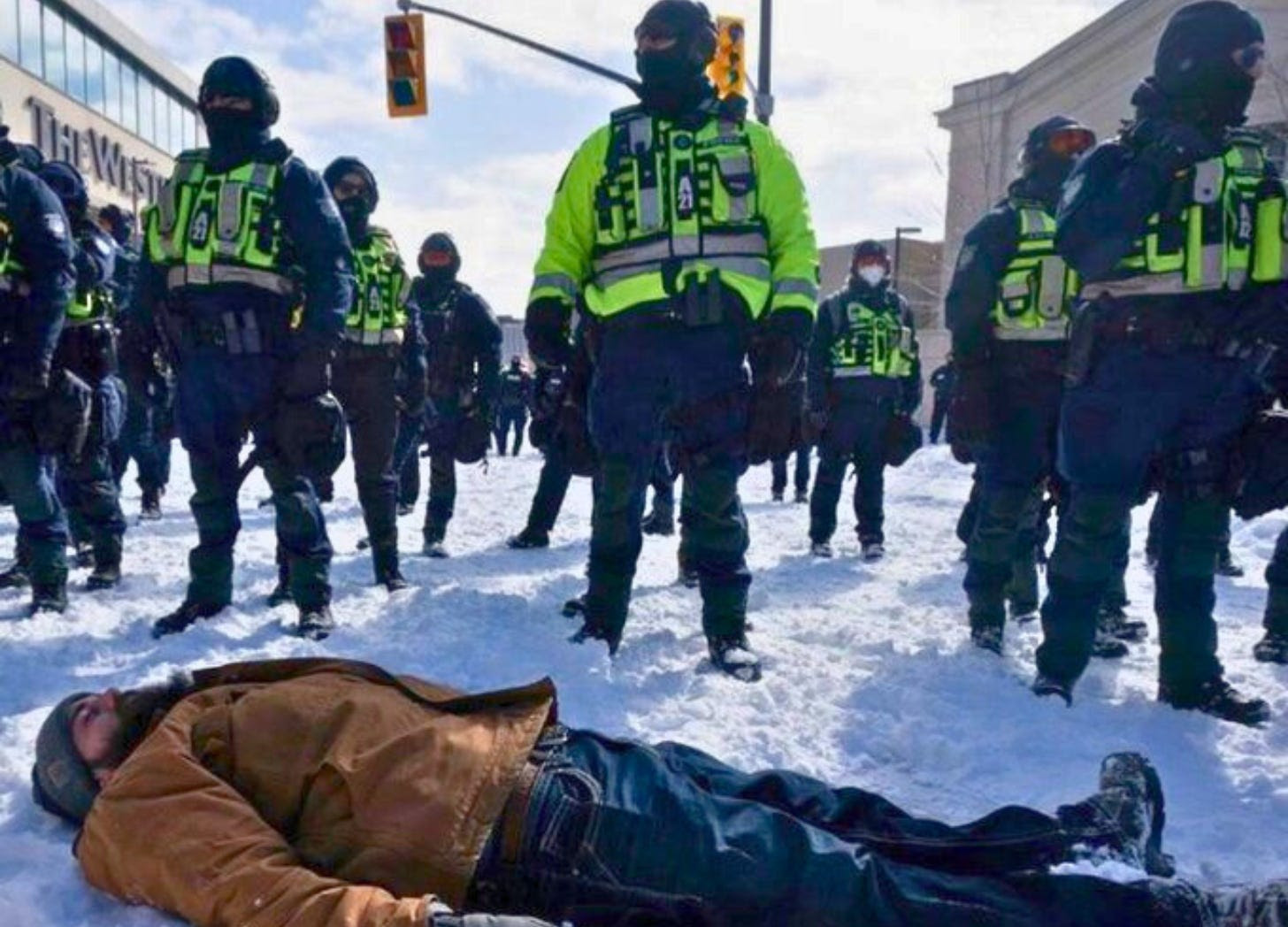
Arrested shortly after the Emergencies Act was invoked, McAllister faced charges of mischief, resisting arrest, and disturbing the peace. Recalling the day of his arrest, he described how, after police began moving in, he lay down in front of them in the snow before being taken into custody. He was placed in a paddy wagon and left there for eight hours, denied access to a lawyer. Eventually, he was driven out of town and dropped off at a gas station with his phone battery almost dead.
Adding to the ordeal, police seized the keys to McAllister’s truck, which was parked in downtown Ottawa, leaving him unable to retrieve it. Two days later, he watched on TV as officers smashed the windows of his truck before it was towed away. Later, McAllister discovered that all of his bank accounts had been frozen.
Nearly two and a half years later, McAllister received a major victory when the Crown notified his lawyer that all charges against him would be withdrawn. Initially, the Crown offered McAllister a peace bond, with a restriction preventing him from attending any protest, gathering, or rally with more than 25 people for one year.
McAllister rejected the offer, standing firm on his belief that “I’m not giving in to being silenced—that’s the main principle I’m fighting for.” The Crown returned with a revised offer—a peace bond without protest restrictions, provided McAllister wrote a 100-word paragraph explaining the difference between a political protest and criminal mischief. McAllister accepted this offer.
In February of this year, federal court judge Justice Richard G. Mosley ruled that the invocation of the Emergencies Act was unconstitutional. This landmark decision triggered a wave of lawsuits against the federal government, with McAllister joining 19 other plaintiffs in a lawsuit seeking $2 million in damages each. The federal government has filed an appeal challenging Justice Mosley’s decision.
McAllister’s lawyer, Ian McCuaig, spoke with The Canadian Independent, expressing satisfaction with the verdict and noting that “Mr. McAllister is happy, and that is a measure of success.” McCuaig emphasized McAllister’s strong defense, which centered on multiple Charter violations.
He argued that McAllister’s rights had been repeatedly breached, including violations of his section 10 rights, as he was denied access to a lawyer and had his property unlawfully seized. Additionally, McCuaig cited unlawful detention and a breach of section 7, pointing out that McAllister had been “driven against his will to a remote location and abandoned.” These violations, McCuaig contended, made “a compelling argument for a stay of proceedings.”
McCuaig also highlighted the importance of the outcome in preserving McAllister’s section 2 rights, which guarantee freedom of movement and association. “His right to engage in protected expression was not compromised,” McCuaig said, adding, “That was a priority for me, as someone who values those rights dearly.”
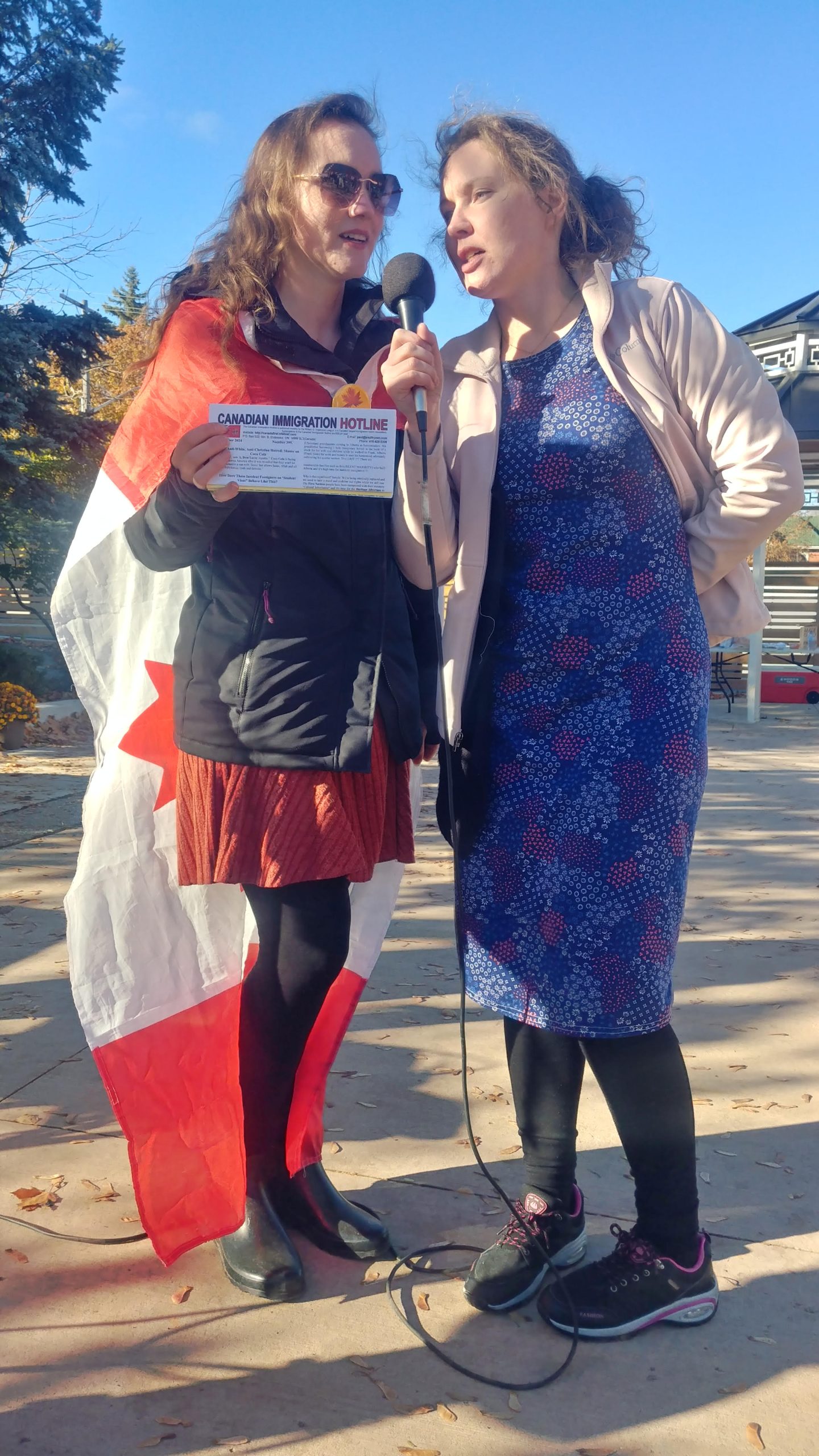
Today CAFE attended the bimonthly freedom rally in Shelburne. Great sunny Autumn weather and fellowship.
I gave a short talk on the abuse -by-process often used by Canada’s politicized justice system. I reported on the case of London-area freedom fighter Clayton McAllister. He was the first trucker after Tyrant Trudeau invoked the Emergencies Act. He simply lay down in the snow. He was arrested and faces charges of mischief, violating a Court order, trespass and resisting arrest. The torrent of charges are the acts of a vengeful state against a gentle non-violent trucker. His one month long trial was to open in Ottawa, October 21, 2024. At the last minute, the Crown offered to drop the charges and he would sign a one-year peace bond. Among other conditions, he would not be allowed to attend a demonstration of more than 25 people. In this way, the enemies of freedom often restrict dissidents WITHOUT a conviction. Clayton wisely refused. Now, it’s up to the Crown whether to drop the charges of go to trial.
The Crown’s tactics are abuse-by-process aimed to break dissidents.
CCF files materials in appeal of decision that found use of Emergencies Act against truckers unlawful In case you missed it, the Canadian Constitution Foundation filed its materials recently in the appeal of the Federal Court decision that declared that the Trudeau government’s unprecedented use of the Emergencies Act in February 2022 was unlawful. In a decision released on January 23, 2024, Justice Mosley sided with the Canadian Constitution Foundation and other public interest litigants when he found that the Trudeau government’s use of the Emergencies Act was illegal and unconstitutional. It remains just as important now as it did in 2022 to uphold this victory at every level of court the government wants to fight us in. A strong precedent needs to be upheld for when it is and isn’t appropriate to invoke the Act due to how much power this extraordinary law gives governments to sidestep rights and important democratic checks and balances. THANK YOU again to all those who donated in support of this next stage of this case. Your support means this case continues with strong backing from Canadians. We raised over $65,000 on top of the $40,000 matching offer provided by a generous CCF donor. We expect the government to do everything in their power to stop us, and that may include tactics to increase costs and to delay the case, so this amazing support will directly ensure we win again at this higher level of court. Thank you so much. You can find our filed materials for this appeal here, and read our full press release here.
UPDATE! The Emergencies Act Appeal is heading to court!
CCF Litigation Director Christine Van Geyn also released a new YouTube video covering the upcoming appeal described above





 G
G