The Alternative Forum has run monthly meetings in Toronto, since January, 1979. It’s an institution but, from time to time, its meeting space has been cancelled, often by those with high ideals – the Toronto Public Library, the Royal Canadian Legion. In February, 2025, when we moved our regular venue to Legion 101, after being abruptly cancelled – no reason given – by a hotel we’d used for some years, we always knew we were on borrowed time. The Royal Canadian Legion has had a vile reputation for cancelling meetings, despite the bumph you’ll hear around Remembrance Day about fighting for basic freedoms in two world wars. After putting himself of the line, at his own expense, to promote support for the Legion hockey commentator Don Cherry was fired by Sportsnet owned by Rogers. His sin was that he appeared to be lecturing newcomers to get with the programme and support the poppy campaign. The cowardly Legion promptly tossed their benefactor under the bus. “Mr. Cherry’s personal opinion was hurtful, divisive and in no way condoned by the Legion,” a smarmy statement said. The Legion cancelled or refused several bookings by the Canadian National Party in 2019. After years of playing her violin and often volunteering at the Jasper, Alberta Legion, Monika Schaefer was banned from the Legion in Jasper after her video Sorry, Mon, I was Wrong About the Holocaust became known. This was ruinous for her. The Legion was the venue for several musical groups she was in. Even controversialist and Zionist Ezra Levant was deplatformed. In 2019, he was launching his book The Libranos. He chose the Legion on North Yonge Street but was banned as “too controversial.”
On July 7, as Director of the Alternative Forum, I received an e-mail from Cindy Prentice, Head of Operations for Legion 101: “I was contacted by Legion Command who has told us we are not permitted to rent to you and your group going forward.” I inquired: “Is there a specific reason given by Legion Command for this decision? We’ve always paid our bills and, I trust, left the place in good order.” Her response was about as clear as fog: “They did not explain, just told us to cease and desist renting to you.” I inquired further: “I am truly mystified. Both my late parents served in WW II. Can I contact anyone higher up?” No response. They stand on guard for ?????? – Paul Fromm
, Today has been a whirlwind. The establishment is desperate to make sure DOMCON26 doesn’t happen. They are pulling out all the stops. They are completely weaponizing the system against us. They know that if our ideas get any oxygen they will spread off like wildfire. After weeks of smears by anti-Canadian activists, hit pieces in the press, attacks from politicians, and getting censored by Instagram, now the Hamilton Police is involved.
Yesterday, executive officer Darren Murphy reached out to me threatening to impose any additional police expenses on the Dominion Society to try and get us to back down. Today we learn the Hamilton Police service has been going venue-by-venue telling owners they cannot host us. These are straight up mafia intimidation tactics! It’s one thing when it was just angry activists campaigning against us, but the police? We have committed no crimes. We are holding a peaceful political gatherings in line with our fundamental democratic rights and the police is doing everything they can to cancel our event.
This is the state of Canada. As a result of the actions of Hamilton Police, two venues have now cancelled on us. But we’re not backing down. All day we have been scrambling to solve the problems they keep throwing at us. Every challenge has been overcome. We will not be stopped.
It is a crucial that DOMCON26 takes place, not only for our organization but for the country. We need to demonstrate to the establishment that the nationalist movement cannot be stopped, that they can’t just oppress us because they disagree with our politics. We have been forced to incur many last minute expenses to ensure DOMCON26 goes on as planned. We were already organizing the event at cost to provide an affordable but premium experience for our audience. If you can spare anything during this challenging time, please donate today.Despite their best efforts, DOMCON26 will be historic. Long Live Canada, Dominion Society Team
‘We Don’t Need A Political Police,” Says Fromm HAMILTON, August 27, 2026. “We don’t need a political police in Hamilton. This is not communist Cuba,” Mayoralty candidate Paul Fromm said tonight on learning that the Hamilton Police has posted a message asked ” Anyone with information regarding a recent venue booking for August 29 [for the Dominion Society conference] is asked to contact Hamilton Police at 905-546-4707 or email dmurphy@hamiltonpolice.ca“ “The duty of the Hamilton Police is to preserve law and order, not to censor opinion,” Fromm adds. A voice message from Hamilton Police explains that the Dominion Society’s message is not “one we approve.” “The police are not tasked with approving political opinions, at least not in a democratic society,” Fromm insists. “Their statement that the Dominion Society’s messaging ‘is divisive and exclusionary’ is outrageous nonsense and irrelevant,” Fromm says. “Any disagreement is divisive. Canada’s recent immigration policies which are replacing the European founding/settler people are ‘divisive’,” Fromm adds. “Recent mass immigration has stressed our medical, welfare and transportation systems,” Fromm says. “Even former Prime Minister Justin Trudeau admitted his policies had been too much too fast.” “Nearly 16 per cent of Hamilton’s high tax burden goes to support the police,” Fromm explains. “Of course, policing is necessary and I’m not part of the defund-the-police crowd, but taxpayers have the right to expect politically neutral policing and policing that upholds the right of free speech.” Paul Fromm is the director of the Canadian Association for Free Expression.______________________________________________________________________________STATEMENT FROM THE HAMILTON POLICE
DomCon Continues to Search for Hamilton Venue
Hamilton Police are aware that the Dominion Society of Canada continues to seek venues within Hamilton to host its DomCon conference, despite its statement to media indicating it will be moving the conference out of town.
An alternate booking had been secured at another local venue but was cancelled by the venue earlier this morning.
Hamilton Police continue to encourage venues to consider the impact this event and its messaging may have on the broader community when making decisions about hosting it. Anyone with information regarding a recent venue booking for August 29 is asked to contact Hamilton Police at 905-546-4707 or email dmurphy@hamiltonpolice.ca.
Hamilton Police are working closely with our local partners and have developed an operational plan to ensure appropriate resources are in place should the event proceed in Hamilton.
The messaging associated with DomCon is divisive and exclusionary and can negatively impact the sense of safety and belonging within our community. We have heard those concerns from members of the community and take them seriously.
Our priority remains the safety of everyone in Hamilton, and we will continue to monitor the situation and respond as appropriate
Former Political Prisoner Brad Love Handcuffed to Hospital Gurney for Having Canadian Immigration Hotline in His Pocket
Fort McMurray, August 19, 2026 He had fainted on a sidewalk. A nosey ambulance driver searched his jacket pocket (not his pants) for a wallet. He found a copy of my Canadian Immigration Hotline newsletter. He freaked out and called police. The RCMP showed up, accompanied Brad to the local hospital and handcuffed this dissident to a gurney. I spoke to dissident citizen journalist Brad Love today. Mid afternoon, he was returning from shopping with a six-pack of beer and a few groceries. As he exited the bus, he fainted near an ambulance station. Two attendants, one White, one Black, came to help. At first, he could not say his name. The White man went through his jacket pocket searching for ID but found a copy of the Canadian Immigration Hotline newsletter which I edit. “Do you see who’s caring for you?” the belligerent White attendant hissed at the groggy Love, pointing at the Black man. The righteous White attendant phoned the police. The constabulary showed up at the hospital and handcuffed the owner of the newsletter to a gurney. Love was diagnosed as “lactose deficient.” Mr. Love escaped the clutches of the super woke and returned home by cab about eight hours later. Both his carton of beer and his watch had disappeared. Paul Fromm
Tomorrow night in Toronto, Canada’s largest food bank is hosting a debate about hunger and food prices — while banning the PPC candidate who wants to challenge the dairy cartel.
Daily Bread Food Bank is hosting the Beaches—East York all-candidates debate.
There are six candidates on the ballot. Only four are being allowed on stage.
PPC candidate Michel Lachance is one of the two being excluded.
And here’s what makes this especially outrageous.
Daily Bread lists Dairy Farmers of Ontario among its largest in-kind food donors, while every party it is allowing on stage supports supply management — the government-protected system that keeps milk, eggs and poultry artificially expensive.
The PPC is the only party that wants to end it.
At a debate supposedly about hunger and food affordability, the one party willing to challenge this system is the party they don’t want Canadians to hear from.
That’s why we need your help tomorrow.
First, send Daily Bread an email demanding they open the stage to all six candidates.
We’ve created a simple form that takes about 60 seconds:
Then, if you’re anywhere in Toronto or the surrounding area, come to the debate yourself.
Register for a free ticket, fill the room, and ask the organizers — and the other candidates — why they continue to prop up the dairy industry and supply management while trying to silence the only party willing to challenge it.
WARNING CANADIANS: WATCH WHAT YOU SAY OR POST ONLINE
I’m seriously concerned about where Canada is heading, and I think Canadians need to start paying attention to how all these pieces are coming together.
This isn’t about something that might begin someday.
Canada already has criminal hate-speech laws. Police already investigate communications, including online communications, when they believe they may cross into criminal hate or other offences. The RCMP itself publishes an investigator’s guide explaining how police investigate hate crimes and incidents.
And now we’re building even more specialized machinery around it.
In April 2026, Ontario’s Legislature passed a motion calling for the establishment of a specialized Hate Crime Prosecutions Unit.
Supporters say specialized Crown prosecutors will provide expertise for complicated hate-motivated cases and better protect targeted communities.
But I’m asking a different question:
WHO GETS TO DEFINE HATE?
Because whoever controls that definition holds enormous power.
Think about it.
Speeding is measurable. If the speed limit is 100 km/h and you’re doing 130, there’s little debate about what happened.
Words aren’t that simple.
Political arguments aren’t that simple.
Religious beliefs aren’t that simple.
What one person considers offensive, another considers legitimate criticism.
What happens when somebody strongly criticizes immigration policy?
What about criticizing Christianity, Islam or Judaism?
What about criticizing Israel or another foreign government?
What about gender policies?
What about quoting religious scripture?
What about criticizing government policies, politicians or political movements?
Under Canadian law today, simply offending somebody or expressing a controversial political opinion does not automatically make it criminal hate speech.
That distinction matters.
The Criminal Code sets specific thresholds. Section 319 includes public incitement of hatred and the wilful promotion of hatred against an identifiable group. The law also contains specific defences for the wilful-promotion offence, including truth, certain good-faith religious arguments and certain public-interest discussions.
But here’s something Canadians should understand:
The criminal penalties are real.
Public incitement of hatred and wilful promotion of hatred can each carry a maximum sentence of two years imprisonment when prosecuted by indictment.
And Canada has recently gone even further in defining hatred in federal law. In June 2026, stronger federal hate-crime legislation became law, defining hatred as an emotion of an “intense and extreme nature” associated with vilification and detestation. The government says this reflects the standard Canadian courts were already applying.
So yes, there is a legal definition.
But that doesn’t end my concern.
Because laws change.
Governments change.
Definitions can change.
Enforcement priorities can change.
And institutions created by one government are inherited by the next.
That’s why I’m looking at the whole picture, instead of each development separately.
We already have hate-speech offences.
We already have police investigating allegations involving communications.
We already have the possibility of criminal prosecution and imprisonment when the legal threshold is crossed.
Now Ontario is specializing prosecutors to handle hate-crime cases.
That’s where 1984 starts coming into my mind.
I’m not saying Canada literally became George Orwell’s 1984 overnight.
I’m saying people should remember how government power grows.
A law here.
A new definition there.
A specialized unit.
Another enforcement tool.
Another amendment.
Every individual step can be presented as reasonable and necessary.
Then five, ten or twenty years later, Canadians could find themselves living under a system very different from the one they originally agreed to.
And there’s another consequence that concerns me almost as much as prosecution:
SELF-CENSORSHIP.
Government doesn’t have to put millions of people in jail to change how millions of people speak.
If Canadians become afraid to discuss immigration, religion, gender, war, protests, vaccines or government policy because they’re wondering whether somebody will report their Facebook post, people will start policing their own words.
That’s when free expression begins disappearing without anybody officially announcing that free expression has been taken away.
Today you may completely agree with the government about what constitutes unacceptable speech.
But governments don’t last forever.
Political power changes hands.
So ask yourself a very simple question:
Would you still support giving government that power if your biggest political opponent controlled it tomorrow?
That’s the test we should apply to every government power.
Real threats should be prosecuted.
Violence should be prosecuted.
Genuine criminal hatred that meets the legal standard should be dealt with according to law.
But Canadians must defend lawful freedom of expression just as fiercely.
Because freedom of expression was never meant only to protect popular opinions.
It’s most important when somebody says something controversial, offensive or unpopular while remaining within the law.
So I’m watching this very closely.
Watch the laws.
Watch the definitions.
Watch the institutions being built around them.
Watch what happens to the line between offensive speech and criminal speech.
And never stop asking the most important question:
WHO GETS TO DEFINE HATE, AND WHO WATCHES THE PEOPLE WITH THE POWER TO DEFINE IT?
Because whoever controls the boundaries of acceptable language can hold tremendous power over everyone else.
FREEDOM of speech is under threat from authorities seeking to impose international rules on nation states and deny access to information. This is not the first time English people have been called upon to oppose the centralisation of power and control of knowledge. Civil wars were fought in defence of the principles of Magna Carta. The Reformation removed the corrupt and stifling influence of the Catholic Church. International wars have been fought against the ambitions of authoritarian regimes.
This year marks the 500th anniversary of William Tyndale’s English translation of the New Testament. Its impact on the development of the English language, religious liberty, and national identity was immense. Tyndale, a multi-lingual scholar from Gloucestershire, translated the Bible into English from its Latin, Greek and Hebrew versions, enabling more people to read and understand Scripture for themselves. Before then, religious teaching had been restricted to an elite group of learned men deemed to be ‘best qualified’ to decide how Scripture should be interpreted and explained to the majority.
The invention of the printing press dramatically increased access to information in books and pamphlets. In a similar way, the internet has democratised knowledge and the seeking of truth. When the printing and distribution of his Bible was banned in England, Tyndale travelled to Germany where a clandestine printer produced hundreds of pocket editions of his translated Bible. These were then smuggled into England. He was hunted across Europe and eventually captured in Antwerp, where he was executed by strangulation and then burned at the stake. Today, Tyndale should be remembered as one in a long line of Englishmen who stood up for freedom of conscience and the right to free speech.
Christianity has a remarkably long association with the people of the British Isles. Folklore tells of Christ visiting England alongside his metal-trading uncle, Joseph of Arimathea. According to Orthodox tradition the first Bishop of Britain was Saint Aristobulus, one of the Seventy Apostles sent around the Roman Empire. He arrived in Britain shortly after the Roman invasion in AD 43. At this time, Christians who proclaimed their faith were persecuted by the authorities; nevertheless, they remained defiant and refused to stay silent about their beliefs. The early Church was characterised by cults built around local Romano-British martyrs, such as Saint Alban. Many of these saints have since been lost to the Anglican Church, but are still celebrated by the Orthodox Church.
Following the Roman withdrawal in AD 410, indigenous Romano-Britons were unable to prevent the widespread settlement of Anglo-Saxon pagans. Christianity was confined to the western and northern parts of the British Isles, and was introduced to the Anglo-Saxons in England in the early 7thcentury. Biblical principles and Christian moral guidance underpin English common law, which developed from a series of legal precedents taken from the wisdom, customs, and traditions of the Anglo-Saxons. For hundreds of years, this legal system has provided a defence of individual freedoms and rights.
The ‘Golden Rule’ in the Gospel of Luke ‘to do unto others as you would have them do to you’ is lost on many in the modern secular age. Unnecessarily abusive social media posts considered ‘hurtful’ are used as an excuse by authorities to clamp down on freedom of expression and speech. This has been helped by the English legal system moving away from flexible, common-sense case law and towards poorly defined statutory codes that are open to subjective interpretation by social media platform moderators and unelected judges.
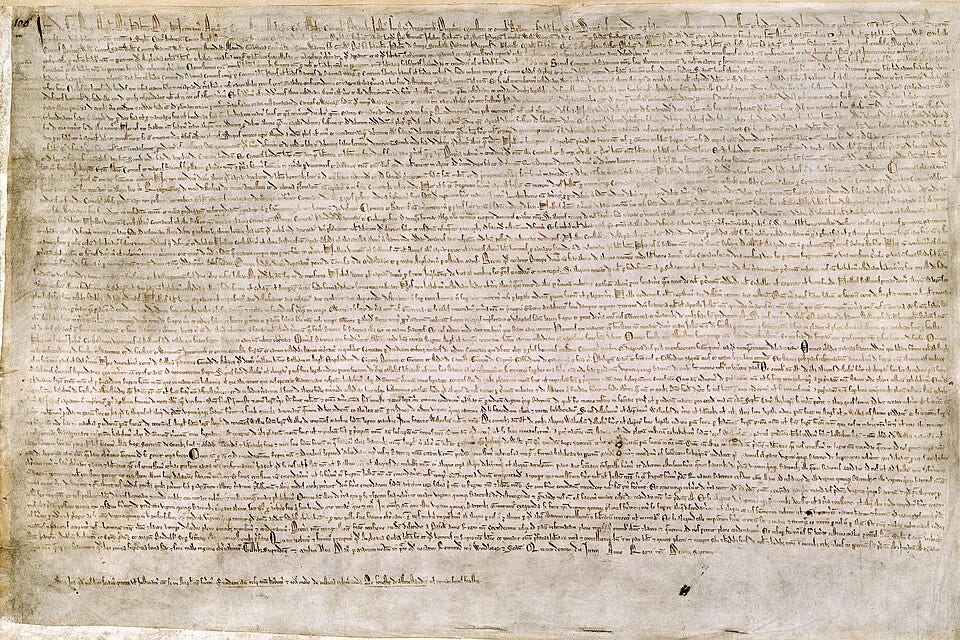
Magna Carta was sealed by King John in 1215. Its principal author, Stephen Langton (Archbishop of Canterbury at the time), opposed the notion that monarchs could act above the law. He believed that morally upstanding citizens were a prerequisite for a just and prosperous Christian society. Individuals needed to operate with honour and integrity to find their true sense of spiritual and secular purpose. For this to happen they had to be free, and a system of law based on truth, fairness and transparency had to underpin these freedoms. If all people were treated were treated equally under the law, individual rights and freedoms would be respected across society. Today, this basic concept, the cornerstone of Western civilisation, is at risk from legally enforceable protected characteristics which have created a hierarchy of victimhood and ill-defined differentiation.
In the 14th century, English dissenters challenged the authority and corruption of the Catholic Church. The Lollards (a ‘proto-Protestant’ movement) included academics such as John Wycliffe (the first translator of the English Bible), and radical priests including John Ball (one of the leaders of the Peasants’ Revolt). Although many dissenting Lollards were hunted down by the authorities, their ideas never disappeared. Wycliffe’s work would later influence reformers such as Martin Luther. In the 16th century, a new Protestant theology based on a deep understanding of the Bible emerged in parts of Europe and in England.
Tensions between Catholicism and various strands of Protestantism existed at this time. Christian attitudes towards religious tolerance were influenced by the 17th century English philosopher John Locke, who argued for a separation of government and religion. This was based on a recognition that individuals could not be forced into a particular faith or way of thinking, as this only came with a genuine change of mind. Furthermore, while governments have powers to impose laws by force, they have no power to change what an individual believes to be true. The Toleration Act 1689 put much of this reasoning into law.
Western nations have since thrived in an atmosphere of tolerance, underpinned by the right to freedom of speech. For Christians, the role of nations is integral to God’s redemptive plan, and in the Gospel of Matthew there is reference to Jesus telling his disciples to ‘go and make disciples of all nations’. The new covenant in the New Testament is a promise from God that does not just apply to one specific group. Anyone in any nation who believes can be part of the covenant, and each nation should protect the right of every person to have a faith if they chose to.
English missionaries spread Christianity across northern Europe during the early Middle Ages. In the 18th and 19th centuries, they took the Gospel message around the world, helping to end slavery, human sacrifice and widow-burning. English Christians developed a just legal system, reformed a corrupt Church, and introduced greater religious and political toleration. It is worrying that modern-day secular leaders fail to acknowledge our Christian heritage. The freedoms and liberties we enjoy today did not just arrive overnight. They have been fought for over many generations. While we remember the sacrifice made by William Tyndale some 500 years ago, we should also remember that it takes only one or two neglectful generations to erase a historic legacy that represents the pinnacle of human achievement.
FREEDOM of speech is under threat from authorities seeking to impose international rules on nation states and deny access to information. This is not the first time English people have been called upon to oppose the centralisation of power and control of knowledge. Civil wars were fought in defence of the principles of Magna Carta. The Reformation removed the corrupt and stifling influence of the Catholic Church. International wars have been fought against the ambitions of authoritarian regimes.
This year marks the 500th anniversary of William Tyndale’s English translation of the New Testament. Its impact on the development of the English language, religious liberty, and national identity was immense. Tyndale, a multi-lingual scholar from Gloucestershire, translated the Bible into English from its Latin, Greek and Hebrew versions, enabling more people to read and understand Scripture for themselves. Before then, religious teaching had been restricted to an elite group of learned men deemed to be ‘best qualified’ to decide how Scripture should be interpreted and explained to the majority.
The invention of the printing press dramatically increased access to information in books and pamphlets. In a similar way, the internet has democratised knowledge and the seeking of truth. When the printing and distribution of his Bible was banned in England, Tyndale travelled to Germany where a clandestine printer produced hundreds of pocket editions of his translated Bible. These were then smuggled into England. He was hunted across Europe and eventually captured in Antwerp, where he was executed by strangulation and then burned at the stake. Today, Tyndale should be remembered as one in a long line of Englishmen who stood up for freedom of conscience and the right to free speech.
Christianity has a remarkably long association with the people of the British Isles. Folklore tells of Christ visiting England alongside his metal-trading uncle, Joseph of Arimathea. According to Orthodox tradition the first Bishop of Britain was Saint Aristobulus, one of the Seventy Apostles sent around the Roman Empire. He arrived in Britain shortly after the Roman invasion in AD 43. At this time, Christians who proclaimed their faith were persecuted by the authorities; nevertheless, they remained defiant and refused to stay silent about their beliefs. The early Church was characterised by cults built around local Romano-British martyrs, such as Saint Alban. Many of these saints have since been lost to the Anglican Church, but are still celebrated by the Orthodox Church.
Following the Roman withdrawal in AD 410, indigenous Romano-Britons were unable to prevent the widespread settlement of Anglo-Saxon pagans. Christianity was confined to the western and northern parts of the British Isles, and was introduced to the Anglo-Saxons in England in the early 7thcentury. Biblical principles and Christian moral guidance underpin English common law, which developed from a series of legal precedents taken from the wisdom, customs, and traditions of the Anglo-Saxons. For hundreds of years, this legal system has provided a defence of individual freedoms and rights.
The ‘Golden Rule’ in the Gospel of Luke ‘to do unto others as you would have them do to you’ is lost on many in the modern secular age. Unnecessarily abusive social media posts considered ‘hurtful’ are used as an excuse by authorities to clamp down on freedom of expression and speech. This has been helped by the English legal system moving away from flexible, common-sense case law and towards poorly defined statutory codes that are open to subjective interpretation by social media platform moderators and unelected judges.
Magna Carta was sealed by King John in 1215. Its principal author, Stephen Langton (Archbishop of Canterbury at the time), opposed the notion that monarchs could act above the law. He believed that morally upstanding citizens were a prerequisite for a just and prosperous Christian society. Individuals needed to operate with honour and integrity to find their true sense of spiritual and secular purpose. For this to happen they had to be free, and a system of law based on truth, fairness and transparency had to underpin these freedoms. If all people were treated were treated equally under the law, individual rights and freedoms would be respected across society. Today, this basic concept, the cornerstone of Western civilisation, is at risk from legally enforceable protected characteristics which have created a hierarchy of victimhood and ill-defined differentiation.
In the 14th century, English dissenters challenged the authority and corruption of the Catholic Church. The Lollards (a ‘proto-Protestant’ movement) included academics such as John Wycliffe (the first translator of the English Bible), and radical priests including John Ball (one of the leaders of the Peasants’ Revolt). Although many dissenting Lollards were hunted down by the authorities, their ideas never disappeared. Wycliffe’s work would later influence reformers such as Martin Luther. In the 16th century, a new Protestant theology based on a deep understanding of the Bible emerged in parts of Europe and in England.
Tensions between Catholicism and various strands of Protestantism existed at this time. Christian attitudes towards religious tolerance were influenced by the 17th century English philosopher John Locke, who argued for a separation of government and religion. This was based on a recognition that individuals could not be forced into a particular faith or way of thinking, as this only came with a genuine change of mind. Furthermore, while governments have powers to impose laws by force, they have no power to change what an individual believes to be true. The Toleration Act 1689 put much of this reasoning into law.
Western nations have since thrived in an atmosphere of tolerance, underpinned by the right to freedom of speech. For Christians, the role of nations is integral to God’s redemptive plan, and in the Gospel of Matthew there is reference to Jesus telling his disciples to ‘go and make disciples of all nations’. The new covenant in the New Testament is a promise from God that does not just apply to one specific group. Anyone in any nation who believes can be part of the covenant, and each nation should protect the right of every person to have a faith if they chose to.
English missionaries spread Christianity across northern Europe during the early Middle Ages. In the 18th and 19th centuries, they took the Gospel message around the world, helping to end slavery, human sacrifice and widow-burning. English Christians developed a just legal system, reformed a corrupt Church, and introduced greater religious and political toleration. It is worrying that modern-day secular leaders fail to acknowledge our Christian heritage. The freedoms and liberties we enjoy today did not just arrive overnight. They have been fought for over many generations. While we remember the sacrifice made by William Tyndale some 500 years ago, we should also remember that it takes only one or two neglectful generations to erase a historic legacy that represents the pinnacle of human achievement.
Now, about my brother Alfred Schaefer, who was moved back to the Stadelheim prison on July 7th, 2026. It is, unfortunately, a serious down-grade in living conditions. The reason for the move is that he is now a prisoner on remand, and the Bernau prison is only for prisoners who have been sentenced already. Alfred’s 10-month sentence which he had been serving for the Augsburg episode where a group of German truth-tellers at a peaceful gathering were unceremoniously “interrupted” by a gang of about 100 police officers, after which Alfred was charged with forbidden words.
He now has a new 53-page document containing 22 new charges facing him, and no trial date has been set yet. These new charges are for the peaceful expression of ideas and words – simply noticing patterns – on videos which he has appeared in since 2022. While rape-fugees roam free in Germany, political dissidents are locked into cages.
Please write Alfred. I recommend keeping it short and encouraging. Postcards or other nice cards are great! There is no need to “educate” Alfred, as these things can be used as “evidence” against Alfred. Just a short note of encouragement, and to let him know that he is NOT forgotten. Thank you! — Monika Schaefer
You’ve probably heard about the Assembly of First Nations passing an emergency resolution demanding that the government make residential school “denialism” a criminal offence.
Grand Chief Garrison Settee believes that demanding evidence of unmarked graves should be considered “residential school denialism” and made into a hate crime.
But here’s the problem: at sites like the one in Kamloops, ground-penetrating radar flagged anomalies that the tribe itself said it “suspects” are unmarked graves.
No excavations have been done. No bodies have been found. And yet, asking for proof could soon land you in prison.
People can lie, but we are not obliged to believe their lies. We are free to tell the truth. That is not hatred.
Section 2 of the Charter of Rights and Freedoms protects freedom of conscience, thought, belief, opinion, and expression.
These rights exist for ideas that the government finds inconvenient, wrong, or threatening.
A right that only protects approved opinions is not a right. It’s a permission slip.
Give the government the power to declare one historical interpretation criminal, and you’ve given it the power to declare any interpretation criminal.
If a historical claim is as strong as its defenders believe, it wins in open debate.
If it needs the Criminal Code to win, that says something about the confidence of the case, not the guilt of the dissenter.
The answer to an argument you hate is a better argument, not a subpoena.
The People’s Party of Canada will always fight for your freedom of speech.
Don’t let them criminalize the truth. Stand with us!
‘Denialism’ law ‘the opposite of the spirit of reconciliation’
MICHAEL HIGGINS Comment
Lawyer settles suit over ‘graves’
‘Denialism’ law ‘the opposite of the spirit of reconciliation’
[Would-be Indian cesnors want to send you to jail for questioning this gobbledegook: “
He said he recently visited the Kamloops site and that First Nations did not have to prove there were bodies by exhuming them.
“They are there and they send us messages telling us they’re there,” he said. “You can tell they’re there, right? Feel the power and the energy. For somebody that’s not from our communities, that doesn’t understand our culture, you cannot understand what that means.”]
24 Jul 2026
Making criminals out of people who merely ask questions about the residential school system is not the path to reconciliation, says B.C. lawyer Jim Heller.
Goodwill and open dialogue are needed far more than trying to imprison people under a “denialism” law, according to Heller, whose defamation suit against his own law society over potential graves at the former Kamloops Indian Residential School was recently settled.
Heller sees the Kamloops controversy as a societal sickness where facts and truth are sidelined in favour of ideology.
“As a lawyer, it is all about promoting, developing, respecting and fine-tuning a process, all in order to ask a question. That’s what it’s all about, this kind of rigorous, analytical, open, rational thinking. And that is the foundation of everything. It’s so fundamental,” he said in an interview Tuesday.
But rigour and analysis are now absent in many parts of our institutions, leaving them open to attack from outside forces, he said.
“There’s a weakening and a sickness in our society, and it’s just kind of permeated the institutions,” Heller said.
“It’s got to be cured. But maybe that won’t happen. Maybe we’re just softening so that we’ll have so little resistance for whatever’s next, whether it’s the Islamification of Canada or the CCP (Chinese Communist Party) or some sort of controls we can’t even anticipate.”
Heller found himself in a battle with the Law Society of British Columbia (LSBC) over anomalies discovered by ground-penetrating radar at the former Kamloops Residential School. He objected to mandatory law society educational materials that contained the phrase, “On May 27, 2021, the Tk’emlúps te Secwépemc Nation reported the discovery of an unmarked burial site containing the bodies of 215 children on the former Kamloops Indian Residential School grounds.”
When Heller submitted a resolution to the law society’s annual general meeting stating that no graves had been discovered and asking the LSBC to insert the word “potential” when discussing the anomalies, he suddenly found himself under attack. One critic was the BC First Nations Justice Council, which issued a statement referencing a “growing disillusioned sect” that was using “denialism” to downplay the horrors of residential schools.
Heller claimed the LSBC posted a link to the press release in an online statement knowing it was defamatory. His lawsuit alleged the LSBC refused to take down the press release and issue an apology and a retraction.
We need goodwill, the presumption of goodwill so we can have some real dialogue.
The law society denied defaming Heller as his suit moved through the courts. The case has now been settled, although the terms are confidential.
In May this year, the law society issued a clarification stating that “to the degree it was understood by some to have defamed Mr. Heller, the Law Society wishes to confirm that was not its intention.”
What is so utterly bizarre about the case is that Heller was only trying to insert the word “potential” in relation to the graves, which would have been truthful and factual. No graves and no bodies have been found at the site despite a press release in 2021 from the Tk’emlúps te Secwépemc that talked of “the remains of 215 children” at Kamloops.
As Heller pointed out, even the Tk’emlúps te Secwépemc has changed the way it discusses the matter, now opting for terms like “potential graves” and “anomalies” at Kamloops.
The danger for people like Heller is that they would almost certainly find themselves in the crosshairs of the law should “denialism” of residential schools get into the Criminal Code.
Last week, First Nations held a press conference to call for a ban on residential school denialism, echoing a recent failed attempt by a senator to make it illegal for anyone to engage in the “condoning, denying or downplaying” of residential schools, with a proposed maximum penalty of two years’ imprisonment.
During the press conference, Manitoba Keewatinowi Okimakanak Grand Chief Garrison Settee said Canada was perpetuating hate by not passing a denialism law.
He said he recently visited the Kamloops site and that First Nations did not have to prove there were bodies by exhuming them.
“They are there and they send us messages telling us they’re there,” he said. “You can tell they’re there, right? Feel the power and the energy. For somebody that’s not from our communities, that doesn’t understand our culture, you cannot understand what that means.”
Such a stance does not sit well with Heller.
“He’s saying, ‘We know this is true. The dead kids are there; they’re talking to us.’ That’s one thing for them to have that kind of outrageous belief and to make a point of doing a press conference,” said Heller, “but you combine that with, ‘And we’re going to court to make it illegal for you to even raise an eyebrow about that.’ Well that’s pretty incredible.”
Heller added that First Nations “speak in terms of potential and anomalies, but they still won’t have a discussion. That’s ridiculous. The very fact that you’re using tentative language is like an invitation to talk.
“This is the opposite of the spirit of reconciliation. It’s just crazy. We need goodwill, the presumption of goodwill so we can have some real dialogue.”
Unfortunately, constructive dialogue, discussion and discourse are sadly lacking in today’s Canada.
‘Denialism’ law ‘the opposite of the spirit of reconciliation’
National Post – (Latest Edition)
24 Jul 2026
MICHAEL HIGGINS Comment
B.C. lawyer Jim Heller, shown, sees the Kamloops graves controversy as a societal sickness where facts and truth are sidelined in favour of ideology, writes Michael Higgins.
Making criminals out of people who merely ask questions about the residential school system is not the path to reconciliation, says B.C. lawyer Jim Heller.
Goodwill and open dialogue are needed far more than trying to imprison people under a “denialism” law, according to Heller, whose defamation suit against his own law society over potential graves at the former Kamloops Indian Residential School was recently settled.
Heller sees the Kamloops controversy as a societal sickness where facts and truth are sidelined in favour of ideology.
“As a lawyer, it is all about promoting, developing, respecting and fine-tuning a process, all in order to ask a question. That’s what it’s all about, this kind of rigorous, analytical, open, rational thinking. And that is the foundation of everything. It’s so fundamental,” he said in an interview Tuesday.
But rigour and analysis are now absent in many parts of our institutions, leaving them open to attack from outside forces, he said.
“There’s a weakening and a sickness in our society, and it’s just kind of permeated the institutions,” Heller said.
“It’s got to be cured. But maybe that won’t happen. Maybe we’re just softening so that we’ll have so little resistance for whatever’s next, whether it’s the Islamification of Canada or the CCP (Chinese Communist Party) or some sort of controls we can’t even anticipate.”
Heller found himself in a battle with the Law Society of British Columbia (LSBC) over anomalies discovered by ground-penetrating radar at the former Kamloops Residential School. He objected to mandatory law society educational materials that contained the phrase, “On May 27, 2021, the Tk’emlúps te Secwépemc Nation reported the discovery of an unmarked burial site containing the bodies of 215 children on the former Kamloops Indian Residential School grounds.”
When Heller submitted a resolution to the law society’s annual general meeting stating that no graves had been discovered and asking the LSBC to insert the word “potential” when discussing the anomalies, he suddenly found himself under attack. One critic was the BC First Nations Justice Council, which issued a statement referencing a “growing disillusioned sect” that was using “denialism” to downplay the horrors of residential schools.
Heller claimed the LSBC posted a link to the press release in an online statement knowing it was defamatory. His lawsuit alleged the LSBC refused to take down the press release and issue an apology and a retraction.
We need goodwill, the presumption of goodwill so we can have some real dialogue.
The law society denied defaming Heller as his suit moved through the courts. The case has now been settled, although the terms are confidential.
In May this year, the law society issued a clarification stating that “to the degree it was understood by some to have defamed Mr. Heller, the Law Society wishes to confirm that was not its intention.”
What is so utterly bizarre about the case is that Heller was only trying to insert the word “potential” in relation to the graves, which would have been truthful and factual. No graves and no bodies have been found at the site despite a press release in 2021 from the Tk’emlúps te Secwépemc that talked of “the remains of 215 children” at Kamloops.
As Heller pointed out, even the Tk’emlúps te Secwépemc has changed the way it discusses the matter, now opting for terms like “potential graves” and “anomalies” at Kamloops.
The danger for people like Heller is that they would almost certainly find themselves in the crosshairs of the law should “denialism” of residential schools get into the Criminal Code.
Last week, First Nations held a press conference to call for a ban on residential school denialism, echoing a recent failed attempt by a senator to make it illegal for anyone to engage in the “condoning, denying or downplaying” of residential schools, with a proposed maximum penalty of two years’ imprisonment.
During the press conference, Manitoba Keewatinowi Okimakanak Grand Chief Garrison Settee said Canada was perpetuating hate by not passing a denialism law.
He said he recently visited the Kamloops site and that First Nations did not have to prove there were bodies by exhuming them.
“They are there and they send us messages telling us they’re there,” he said. “You can tell they’re there, right? Feel the power and the energy. For somebody that’s not from our communities, that doesn’t understand our culture, you cannot understand what that means.”
Such a stance does not sit well with Heller.
“He’s saying, ‘We know this is true. The dead kids are there; they’re talking to us.’ That’s one thing for them to have that kind of outrageous belief and to make a point of doing a press conference,” said Heller, “but you combine that with, ‘And we’re going to court to make it illegal for you to even raise an eyebrow about that.’ Well that’s pretty incredible.”
Heller added that First Nations “speak in terms of potential and anomalies, but they still won’t have a discussion. That’s ridiculous. The very fact that you’re using tentative language is like an invitation to talk.
“This is the opposite of the spirit of reconciliation. It’s just crazy. We need goodwill, the presumption of goodwill so we can have some real dialogue.”
Unfortunately, constructive dialogue, discussion and discourse are sadly lacking in today’s Canada.