Canadian Constitution Foundation in the Federal Court today
TORONTO: The Canadian Constitution Foundation is in the Federal Court today seeking the disclosure of information which goes to the heart of the government’s decision to invoke the Emergencies Act on February, 14, 2022.
The CCF will seek an order for the Attorney General to deliver unredacted documents, including minutes of the Incident Response Group and Cabinet meetings leading up to the declaration of the Emergencies Act.
The government invoked cabinet confidence, and subsequently, national security privilege over many documents relevant to a judge’s determination of whether the government was justified in declaring a public order emergency.
“The government’s failure to disclose wide swaths of evidence that go to the question of whether it was justified in invoking the Emergencies Act is an attempt to evade meaningful judicial review. Allowing these documents to remain secret would undermine the integrity of the proceedings in this historic matter if a litigant is pre-empted from arguing in court that the government acted unconstitutionally”, said Christine Van Geyn, the CCF’s Litigation Director. Members of the public may request a link for the hearing here: https://www.fct-cf.gc.ca/en/court-files-and-decisions/hearing-lists
The charter that defends rights, but also tells government how to quash them
Not everyone is inclined to cheer the charter as a bulwark of liberty. ‘We are less free today than 40 years ago,”’ said John Carpay, president of the JCCF Author of the article: Tristin Hopper Publishing date: Apr 15, 2022 • April 15, 2022 • 7 minute read • 91 Comments
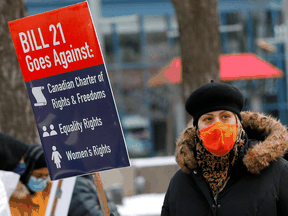
The notwithstanding clause is how provincial governments can consistently maintain legislation, such as Quebec’s Bill 21, that are a pretty obvious curb on fundamental freedoms. Photo by Darren Makowichuk/Postmedia/File
The decision was a surprise to Canadians, where any number of similar challenges had failed.
Time after time during the COVID-19 pandemic, Canadian governments imposed extraordinary public health measures that seemed to be naked infringements on Canadians’ charter rights. Mandated church closures that violated protections on “freedom of religion.” Bans on gatherings that curbed “freedom of association.” Border and travel strictures that undermined charter guarantees on mobility rights.
But the courts didn’t care. Whenever a pandemic case hit the docket, courts “erred too far on the side of deferring to government,” Joanna Baron, the executive director of the Canadian Constitution Foundation, told the National Post.
Sunday marks the 40th anniversary of Canada repatriating its constitution, a process that included passage of the Charter of Rights and Freedoms. The charter has often been praised as one of Canada’s leading modern accomplishments and its “gift to the world.” But it’s also one of the world’s only constitutions that explicitly gives the state a roadmap on how to quash the very “fundamental freedoms” it cites. It’s why, four decades in, not everyone is inclined to cheer it as a bulwark of liberty.
“I cannot think of any freedom … that the charter has brought to us,” said John Carpay, president of the Justice Centre for Constitutional Freedoms, a group that has been particularly active in challenging pandemic mandates and defending the organizers of Freedom Convoy. “We are less free today than 40 years ago,” he said.
If governments are looking to do an end-run around charter-enumerated rights, there are two primary sections of the document they turn to. Section 1, which is literally the first line of text in the charter, explicitly states that rights and freedoms are protected in Canada only to “reasonable limits.”
According to an official government of Canada guide to the charter, the purpose of this section is to remind Canadians that “rights can be limited by law so long as those limits can be shown to be reasonable in a free and democratic society.”
The notwithstanding clause allows provincial governments to knowingly pass legislation that treads on a fundamental freedom.
If such a legislative override had existed in the U.S. Constitution, many of the most iconic Supreme Court decisions of the civil rights movement might not have mattered. Brown vs. Board of Education — the 1954 decision that struck down school segregation — could simply have been ignored by states invoking the notwithstanding clause.
In Quebec, it’s how provincial governments can consistently maintain legislation that are a pretty obvious curb on fundamental freedoms. Bill 21, a provincial law passed in 2019, bars government employment to any Quebecer who wears religious garb such as turbans or hijabs. Any charter challenge against Bill 21 would likely be a slam dunk on the “freedom of religion” clause, but Quebec would simply be able to soldier on with the law by invoking the notwithstanding clause.
The Canadian Constitution Foundation has questioned the constitutionality of orders requiring face coverings in certain Ontario municipalities.
In a letter to Dr. Nicola Mercer,
medical officer of health at the Wellington-Dufferin-Guelph public
health region, the CCF said that a June 12 order imposing the use of
mandatory face coverings in commercial establishments breached s. 7, s.
15 and s. 8 of the Canadian Charter of Rights and Freedoms.
The order prima facie violates the right to liberty of the
person under s. 7 because it forces people to cover their faces and
interferes with their bodily integrity, the CCF said. It also infringes
the right to non-discrimination on the basis of disability under s. 15
since it imposes a disproportionate burden on persons with disabilities,
including breathing problems like asthma and emphysema or trauma-based
phobia of breathing obstructions.
“[I]f a person has PTSD related to having their breathing obstructed,
they should not need to discuss this with strangers in order to buy
toilet paper or fill up their gas tank,” said Christine Van Geyn,
litigation director at the CCF.
The order does include an exemption which allows such individuals to
forgo masks, but the CCF argues that requiring a person to disclose
private health information in order to claim an exemption infringes
privacy rights under s. 8, particularly the right to informational
privacy. Forcing such a disclosure may cause a person with trauma-based
phobia to re-experience the traumatic experience and suffer reputational
harm.
The CCF said that the order should be repealed or at least amended
due to these issues. Tested against the requirements found in R. v. Oakes,
the limitation imposed by the order is not rationally connected to the
objective, is not minimally impairing and is not proportionate, the CCF
said.
To support its argument of a lack of rational connection to the
objective, the CCF cited the relatively low local rate of community
transmission in the area and questioned why the order applies to retail
commercial establishments but not to other places also subject to public
gatherings, such as churches or community centres. The CCF said that
the order should be amended to require masks only when physical
distancing of six feet is impossible.
The order is not minimally impairing because it fails to consider its
impact on the privacy and equality rights of persons with disabilities,
who risk reliving trauma and experiencing reputational harm, the CCF
said. Therefore, the CCF asks for an amendment to the effect that an
employee of a commercial establishment should accept a claim for a
medical exemption at face value, without requiring a disclosure of
private health information.
Most Read
The CCF then said that the $5,000 fine imposed on commercial
establishments who do not enforce the order is disproportionate, given
that much lower fines were implemented during the peak of the outbreak.
The order should be amended to set a $500 fine instead, the CCF said.
“It is our strong preference not to commence litigation, when simple
amendments to the Order would achieve the goal of protecting both the
health and the rights of citizens,” wrote Van Geyn.
The CCF intends to send letters to other Ontario communities with
similar orders either implemented or contemplated, such as York Region,
Kingston and Waterloo.