
Legal Witchcraft and Victimhood Inversion
December 6, 2025/0 Comments/in Featured Articles, Free Speech/by Tom Sunic, Ph.D.
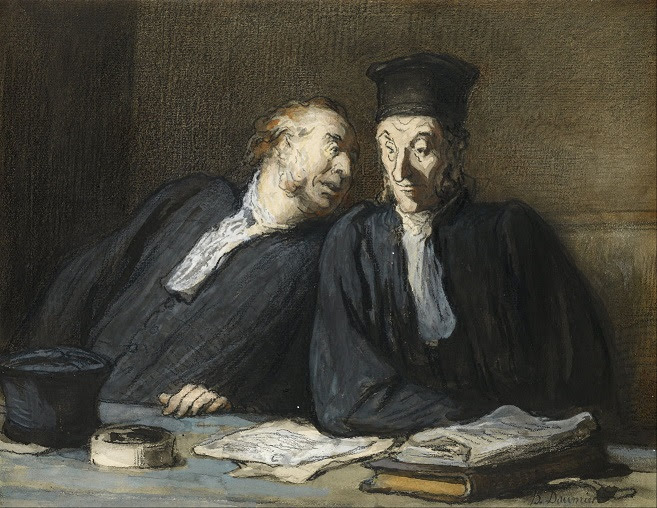
Honoré Daumier (1808–1879), Two Lawyers Conversing
Despite the commendable efforts of President Donald Trump and Secretary Marco Rubio to alert the American public to the rising tide of free-speech suppression in the EU, Soviet-style legal practices in certain segments of the EU judiciary remain very much alive and kicking. Let us be clear: The Second World War has never really ended; it has merely entered a prolonged verbal conflict, potentially on track to assume again violent and war-like dimensions.
The latest case is that of Martin Pfeiffer, former Austrian editor of the now defunct literary magazine Die Aula, who was sentenced on December 3 of this year to four years in prison for “re-engagement in National Socialist activities” under Paragraph 3g of the Prohibition Act (Verbotsgesetz). The magazine rarely dealt with ideological subjects, focusing instead on cultural themes and the idea of empire—topics closely associated with the conservative party in Austria, the FPÖ.
What is striking is that the laws under which Pfeiffer was indicted—particularly Paragraph 3g of the Prohibition Act (Verbotsgesetz), enacted in 1947—date from the period when Austria was still under the joint occupation of the four Allied powers: the Soviet Union, United States, United Kingdom, and France. Moreover, Pfeiffer was prosecuted retroactively for articles he had published between 2005 and 2018—in some cases more than fifteen years earlier. The judiciary in the city of Graz simply brushed aside both the statute of limitations and the principle of nullum crimen, nulla poena sine lege (“no crime, no punishment without prior law”). The highly abstract, almost untranslatable compound nouns of German/Austrian legal jargon—Wiederbetätigung (“re-engagement”), Volksverhetzung (“incitement to hatred of the people”), etc., defy precise rendering into English, which only adds to their opacity when viewed through the lens of an American lawyer.
Pfeiffer’s case demonstrates that any dissident author—regardless of his political persuasion or nationality—can be subjected to ex post facto prosecution if the ruling class deems him a nuisance. This tactic of selectively targeting “enemies of the people” was a standard tool of the judiciary throughout former communist Eastern Europe.
In passing, it is worth noting that Pfeiffer’s trial bears a striking resemblance to the many show trials of communist Yugoslavia. In 1984, my late father, a Catholic conservative and former attorney, was sentenced to four years in prison for “hostile propaganda” under Article 133 of the Yugoslav Criminal Code (neprijateljska propaganda, YU-KZ). He had written anonymous critical articles for the London-based Croatian émigré bi-weekly Nova Hrvatska, exposing the communist regime’s harsh repression of the Croatian Catholic Church and culture. He was subsequently adopted as a prisoner of conscience by Amnesty International and championed by U.S. Congressman Tom Lantos, Senator Bob Dole, and several other conservative politicians and journalists, among them Pat Buchanan.
There is a far more scary dimension to Pfeiffer’s story. After 1945, both the United States and the nations of Europe were compelled to adopt the model of the “proposition nation”—an abstract political community defined not by historical continuity, race or shared culture, but by universalist, immigrant-welcoming, open-entry-for-all principles. The mass influx of non-European migrants into the EU over the past decade was therefore entirely predictable: it was the logical, even deliberate, outcome of the post-war Allied strategy to suppress Europe’s historic interethnic tensions by diluting the cultural and racial homogeneity of its peoples. Likewise, the introduction of the Schengen open-border regime in 1985 (fully implemented in the 1990s) was perfectly in accordance with the liberal-capitalist dogma of the “free movement of people and capital.”
Germany was particularly affected by these capitalist open-border policies. As the late German legal scholar Günther Maschke observed, “The German people had to adapt to the constitution, instead of the constitution being adapted to the German people.” German constitutionalism, he continued, has become a kind of “civil religion” in which multiculturalism has replaced traditional national identity with a purely legal construct—what Maschke called an imaginary “Basic Law country.” When this is combined with the quasi-sacralized, unquestionable historical narrative of the Holocaust, the result is a birth of a political entity that should be seen as a “secular theocracy.” Within this framework, the only form of patriotism still tolerated in Germany and Austria is Verfassungspatriotismus—constitutional patriotism.(1)
Victimhood Inversion
Today, core elements of the German and Austrian Criminal Code function in some ways reminiscent of former Soviet criminal law. Germany and Austria must demonstrate, daily, that they can meet their “self-re-education tasks” even more rigorously than its post-WWII mentors. Comparable dynamics exist in other EU member states, where semantic drifts have turned the charges of fascism into an all-purpose label of the ultimate cosmic evil.
Despite the phenomenal rise of right-wing parties across the EU, many judicial institutions—both in Europe and in the United States—remain largely staffed by judges and prosecutors from the post-1968 Marxist-inspired “boomer” generation, along with various former left-wing Antifa activists, modern SJWs and virtue-signalers (2). These judges and prosecutors make little effort to conceal their hatred (and fear) of Trump, while also displaying open hostility toward right-wing populist movements and parties such as the growing AfD in Germany or the FPÖ in Austria. In addition, a network of influential and wealthy non-governmental organizations across Europe, such as the CRIF and LICRA in France, the Amadeu Antonio Stiftung in Germany, and the hard-left DÖW in Austria—operate in a manner comparable to U.S. advocacy groups such as the ADL or the SPLC. Their primary function, very similar to that of the old Soviet people’s commissariats, is to monitor academics, journalists, and public figures suspected of non-liberal ideological transgressions. German nationalists derisively label such snitching NGO outfits Gutmenschen (“do-gooders”); their French counterparts are called bien-pensants. In plain English, these so-called NGOs represent the academic thought police.
Most worrisome, however, is the climate of fear-induced self-censorship among European academics. Many believe that by remaining apolitical, silent and not rocking the boat they will best safeguard their careers and perks—a grave illusion long disproven by dissidents in the former communist countries of East Europe. Sooner or later the thought police will show up on their doorstep regardless of how mute they were in their former political activities.
In the contemporary West, there is no need for gulags or firing squads given that more sophisticated methods of repression have become far more effective: deplatforming, debanking, or even worse, what the French call l’inversion accusatoire—the “reversal of the accusation.” Broadly speaking, this means “victimhood inversion”, a technique once common in the communist judiciary of East Europe: to cover up one’s own mega crimes, one accuses the opposing side of even greater crimes. The dynamic of mutual victimhood inversion is visible today in the conflict between the Hamas and IDF with many more to come shortly.
Many of the legal and rhetorical tactics recently deployed against President Trump were pioneered decades ago in the multi-ethnic Soviet Union and throughout the formerly communist Eastern Europe. Consequently, European prosecutors and media outlets eagerly reach for the same communist shut-up nouns—“Nazi,” “Ustasha,” “antisemite,” “white supremacist,” “racist”—in order to dehumanize political dissenters, while almost never mentioning the millions who perished under communist regimes between 1945 and 1950. President Trump is surely well aware of these legal and semantic shifts having himself endured similar “lawfare” waged and staged by his domestic enemies. The long-term outcome of this judicial parody in both the EU and the United States is entirely predictable: growing mutual distrust, escalating interracial and interethnic conflict, institutional breakdown, and, ultimately, the collapse of the System.
Notes:
- Günther Maschke, Das bewaffnete Wort (Wien und Leipzig: Karolinger Verlag, 1997), p.74.
- Alain de Benoist, “Die Methoden der Neuen Inquisition,” in Schöne vernetzte Welt (Tübingen: Hohenrain Verlag, 2001), p. 190–205.
