
MAGA singer’s rights violated in Canada, say free speech experts, religious group

  1. Home
  2. National News

MAGA singer’s rights violated in Canada, say free speech experts, religious group

MONTREAL — Sean Feucht, a Christian singer and rising star in the MAGA movement, has been censored and mistreated during his Eastern Canadian tour, say civil liberties experts and a religious group.

Miriam Lafontaine and Maura Forrest, The Canadian Press Jul 28, 2025 2:39 PM
ff7b6048ddb03aa3fcf4d3eb0eb8a75d95a211a74981bb7b02454ae0bca50240
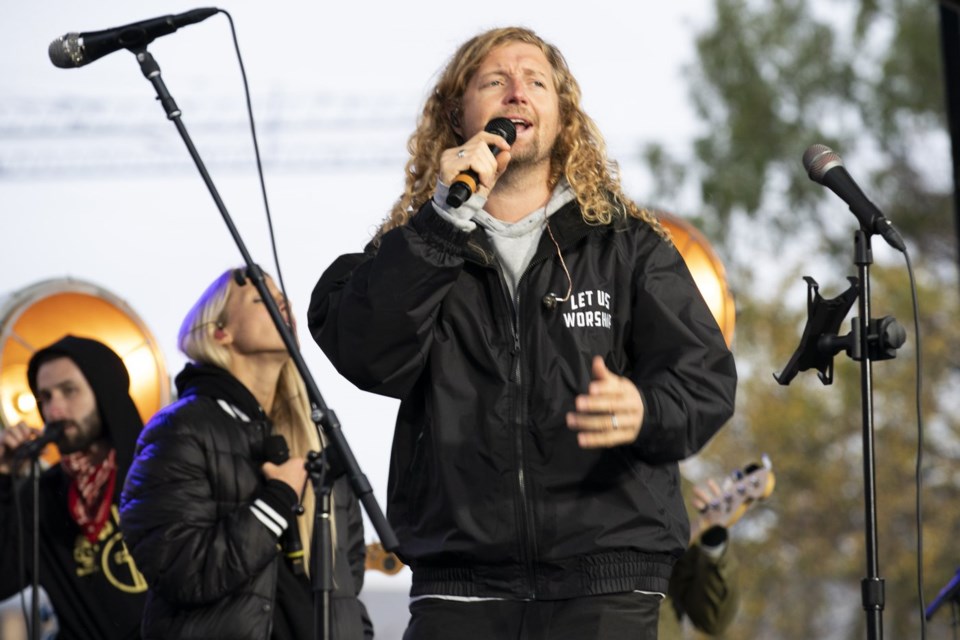
Christian musician Sean Feucht of California preaches to the crowd during a rally at the National Mall in Washington, Sunday, Oct. 25, 2020. (AP Photo/Jose Luis Magana)

MONTREAL — Sean Feucht, a Christian singer and rising star in the MAGA movement, has been censored and mistreated during his Eastern Canadian tour, say civil liberties experts and a religious group.

All six of the concerts scheduled last week were cancelled, forcing him to seek alternative venues. In Montreal, a church allowed Feucht on Friday to perform a hastily scheduled concert over the objections of the city administration, and is now facing a $2,500 fine.

Officials cancelled his shows because of the singer’s political and religious opinions, says a group that represents 500 evangelical Protestant churches in the province.

“While the criticism of ideas is legitimate in a democracy, state censorship of those ideas represents a dangerous deviation,” Jean-Christophe Jasmin, a spokesperson for the Réseau évangélique du Québec, said in a statement.

The Christian singer describes himself as a musician, missionary, author and activist. He has spoken out against “gender ideology,” abortion and the LGBTQ+ community, and his religious and political views have grabbed the attention of U.S. President Donald Trump’s administration. The Atlantic magazine recently described Feucht as a Christian nationalist who has become a “MAGA superstar.”

In a statement, a spokesperson for the City of Montreal says the church didn’t have a permit to organize the concert, adding that the show went against the “values of inclusion, solidarity, and respect” that define Montreal.

But Jasmin says the event should not have required a permit at all because it was part of a routine religious gathering. And while he says his group doesn’t support the singer or his views, it’s concerned with what it sees as an attack on religious expression.

Since the incident, he said, church leaders in the city have been calling to ask if they could also face fines for hosting concerts. “It’s not the state’s place to determine how our churches ought to conduct themselves,” Jasmin said.

The City of Montreal did not immediately respond to a question about whether all churches should request permits when they want to hold concerts.

Complaints about Feucht have led officials to cancel his other shows scheduled in Eastern Canada — decisions that free speech advocates in the country say were violations of the Charter. “His freedom of expression, freedom of assembly and freedom of religion rights have all been violated,” said Josh Dehaas, legal counsel for the Canadian Constitution Foundation.

“The government doesn’t get to decide what ideas people can hear and what things people can say and how people can choose to worship and that’s what they’re trying to do in this case,” he said in an interview.

Dehaas said the foundation would be interested in supporting Ministerios Restauración Church in a Charter challenge of the $2,500 fine.

James Turk, director of the Centre for Free Expression at Toronto Metropolitan University, said it raised “red flags” to see public bodies revoking Feucht’s concert permits.

“I’m totally opposed to his position on most political things,” he said. “But in a democracy, we deal with difference through discourse, through argument, through boycotting, through ignoring, through protest. We don’t deal with it through silencing people and censoring them.”

On Sunday, Independent Sen. Kristopher Wells, a longtime LGBTQ+ advocate, waded into the fray, stating on X that Feucht “has no Charter right to have his shows hosted at public facilities, which must be safe and discrimination-free spaces that uphold community standards.”

In a statement to The Canadian Press, Wells said, “this has nothing to do with his freedom of expression, which is subject to reasonable limitations in Canada, and everything to do with ensuring community safety and standing up for human rights.”

But Dehaas disagreed, saying governments cannot “discriminate on who can use a public space based on the viewpoint of the speaker who wants to protest or worship or sing in that space.”

“The senator is wrong here,” he added.

On social media, the singer has accused Canada of tyranny and censorship, and has questioned whether the Charter of Rights and Freedoms “still means anything.”

Feucht says his “Revive in 25” tour is about worship and spiritual restoration. But he has previously spoken out against “gender ideology,” abortion and the LGBTQ+ community. In a February video on Instagram, in response to a protest in support of gender-affirming health care, Feucht said the protesters were angry because they were “prohibited from cutting off the body parts of children.”

Last year, Feucht referred to Pride Month as a time to discover “which people, businesses, influencers, corporations & ministries have sold their soul to a demonic agenda seeking to destroy our culture and pervert our children.”

Still, Dehaas said even if there were concerns that Feucht might engage in hate speech during his concerts, “there’s no legal mechanism to shut down his show in advance.”

Feucht has returned to the U.S. following his concerts in Eastern Canada, but is scheduled to return in August for a series of shows in Western Canada.

This report by The Canadian Press was first published July 28, 2025.

Miriam Lafontaine and Maura Forrest, The Canadian Press

Sask Nurse Appeals Fine by College of Nurses for Criticizing Shoddy Health Care in a Facebook Post

Good faith or unfair attack? Saskatchewan appeal court to rule on nurse’s Facebook posts

Social Sharing

Judges will decide whether she had the right to comment on grandfather’s health care

CBC News · Posted: Sep 17, 2019 5:00 AM CT | Last Updated: September 18, 2019

Carolyn Strom arrives at the Saskatchewan Court of Appeal in Regina on Tuesday. Strom was found guilty of professional misconduct by the Saskatchewan Registered Nurses Association in 2016 and handed a $26,000 penalty. (Michael Bell/The Canadian Press)

The nurse who was found guilty of professional misconduct over a Facebook post will soon learn whether she had the right to make those comments.

Three judges of the Saskatchewan Court of Appeal reserved their decision Tuesday on the matter until a later date.

The court heard the Facebook post was made in good faith and was an exercise of her free speech. 

Court also heard that the post may constitute fake news, although that wasn’t discussed at a lower court hearing, and that there are no charter rights that protect unprofessional conduct.

Post violated social media policy

In 2015, Carolyn Strom wrote a post on Facebook criticizing the health care her grandfather received while in palliative care. 

In the post, Strom said staff at St. Joseph’s Integrated Health Centre in the town of Macklin, about 225 kilometres west of Saskatoon, needed to do a better job of looking after elderly patients.

“It is evident that not everyone is ‘up to speed’ on how to approach end-of-life care … or how to help maintain an aging senior’s dignity (among other things!),” read part of the Facebook post.

Some of the nurses in the hospital felt Strom’s post was a personal attack and complained. The Saskatchewan Registered Nurses Association ruled the post brought the nursing profession into disrepute and violated its social media policy.

Strom was found guilty of professional misconduct and given a $1,000 fine by the association and was ordered to pay $25,000 in tribunal costs. 

She appealed the ruling but her appeal was dismissed because the judge could find no reason to interfere with the association’s decision, setting the stage for Tuesday’s appeal hearing.

‘Made in good faith’

On Tuesday, Strom’s lawyer Marcus Davies argued her comments never mentioned nurses — just staff.

He said there were roughly 40 staff at the health centre, and it’s hard to know specifically who Strom was referring to. 

Davies also argued the comments were made in good faith, and that she exercised her right to free speech.

“In the discipline committee, it says, ‘It is accepted that Ms. Strom was not driven by malice,'” Davies said. “Well, that means her comments were made in good faith, if she was not driven by malice, then she was driven by good faith.”

The nurses association argued Strom should have gone through the correct channels and lodged an official complaint. 

‘Fake news’

Roger Lepage represented the Saskatchewan Registered Nurses Association at Tuesday’s hearing.

He took the position that there is no charter right protecting unprofessional conduct and that there is no right for individuals to harm the reputation of other individuals.

Lepage argued that Canadians would be harmed if nurses would be able to say whatever they wanted about the health-care system. 

He argued Strom’s post qualifies “fake news,” but the judges presiding stated the previous hearing never found Strom’s comments to be untrue, and said Lepage himself shut down that argument then.

Lepage argued Strom’s post amounted to venting on social media and that other staff members “had their hands tied” by professional ethics.

Lepage also argued that Strom’s post was not free speech or part of the public discourse, but rather an attack on an individualized group.

“If you read her post, it’s very personal, she’s zeroing in on St. Joseph’s, she’s zeroing in on Macklin, she’s zeroing in on identifiable people who work there, the staff,” Lepage said. 

“That’s what takes this out of the protection that Ms. Strom would ask of this court and was asking of the discipline committee.”

Lepage said that Strom should have filed a formal complaint with the Saskatchewan Health Authority, but didn’t.

‘I wish it didn’t have to be this hard’

Strom spoke with reporters outside court on Tuesday, after the judges decided to reserve their decision.

When asked if she regretted making the posts on Facebook, Strom said she will always stand up for her family and she had no regrets about it. 

Three judges of the Saskatchewan Court of Appeal reserved their decision Tuesday on Strom’s case until a later date. (Chanss Lagaden/CBC)

“What I don’t think is fair is … what this has turned into,” Strom said. “I didn’t expect this… I wish it didn’t have to be this hard.”

She said she was shocked to hear Lepage comment Canadians would be hurt if nurses were able to say what they want, when they want. 

Strom responded to accusations that she was a liar and didn’t have her facts right, made by the Saskatchewan Registered Nurses Association’s legal representation, and said they were false.

“I just cannot believe that, that was low, that was false, and I just don’t understand how people get away with that,” Strom said. “There was absolutely no reason for that to have been said.”

Strom, who is working as a nurse part time in Prince Albert, Sask., said the court case has led her to question whether she wants to be a nurse. 

Strom said she couldn’t decide today whether she would carry on the case if the judges don’t rule in her favour.

“It will depend; every step is different and it gets harder every time, with respect to the toll that it takes to recover from all of this,” she said. “It’s just so hard to stay composed when you’re so involved.”

3 groups intervene

Three groups have applied for intervener status in the case, including the British Columbia Civil Liberties Association, the Saskatchewan Union of Nurses and the Canadian Constitution Foundation.

The Saskatchewan Union of Nurses (SUN), represented by Ronni Nordal, was the first group to speak on behalf of the interveners.

SUN argued the post was directed specifically at the St. Joseph’s Integrated Health Centre, not at the nurses generally. 

SUN argued there was no factual basis for which a finding of professional misconduct could be found.

SUN also argued that one of Saskatchewan Registered Nurses Association’s statutory mandates is to promote the standing of the registered nurse professionally, not to defend or protect individual nurses, and the organization’s argument was not rationally connected to its mandate.

The B.C. Civil Liberties Association, represented by Greg Fingas, argued the informal nature of social media meant that speech should not be compared to a letter from a judge.

The Canadian Constitution Foundation argued citizens should be allowed to express opinions and criticize health care and services without punishment and noted that because public health care dominates public policy, people should be allowed to speak about it. 

The federation also asked the court to consider what kind of precedent this decision sets for all professionals who want to share their opinions or concerns.