
White Hating Hypocrisy

Reiner, who had been a political prisoner in Germany will be FREED! After 36 months in a maximum security prison.
Dr. Reiner Fuellmich, the German/ American lawyer and spokesman, who headed the Corona Investigative Committee in 2020, and who with his colleagues began documenting what they considered violations of law, medical malpractice and scientific fraud, the PCR ‘pandemic’, in what was referred to as the COViD-19 scandal. Fighting the deep state has cost him his freedom. He was sentenced in April 25, for 3 years and nine months in prison.
The inhumane treatment, which Dr. Reiner Fuellmich was subjected to – and in part still is – and the manner in which the trial against him has been conducted, casts enormous shadows over the German judicial system and respect for fundamental rights.
We have, without a shadow of a doubt, witnessed the biggest judicial scandal in Germany, a blatant miscarriage of justice, where the intelligence service has constructed and manipulated a “case” against Reiner Fuellmich in order to silence one of the most important voices of the resistance.
• After the defense demonstrated the erroneousness of the original charge, Judge Schindler invented a new one.
• Dr. Reiner Fuellmich was held in solitary confinement for six months on a charge that is the equivalent of a misdemeanor and was subjected to all kind of punitive measures which fall under the definition of “white torture”.
• All trial motions presented by the defense and requests to hear defense witnesses (with few exceptions) were rejected, and the reasons for these decisions were not disclosed, thus preventing the defense from reformulating or resubmitting these motions.
• Proceedings conducted in written form is a violation of the principle of transparency in a public trial and of the defendant’s right to be heard.
• Dr. Reiner Fuellmich was held in pre-trial detention for 18 months before being convicted; the maximum limit for pre-trial detention in Germany is six months.
• All motions of objection against the judge and the entire panel of judges were continually rejected.
• Reiner Fuellmich was not allowed to visit his dying mother or even attend her funeral.
BREAKING
– Link in comments
Important update from Dr. Reiner Fuellmich – September 16, 2026
Dear friends,
Yesterday I received good news from the Göttingen Regional Court (the same court that sentenced me in April 2025).
They and the prosecutor’s office have dropped the planned second criminal case against me (the one involving an alleged fiduciary duty violation that was meant to keep me locked up longer).
Suddenly they say the people who took more than a million euros from me should just pursue their claims in civil court instead.Why the sudden change?
It has everything to do with the Supreme Court (BGH) illegally backdating its rejection of our appeal by five months. They only told my lawyers on August 18 that they had already rejected it on March 17 without any real explanation.
We had informed the Supreme Court in June/July about our civil lawsuit against the state of Lower Saxony (as employer of the judges and prosecutors). In that lawsuit we demand damages and my immediate release, based on the Supreme Court’s own rulings on “extreme outlier cases” of political persecution and abduction.
Germany’s Civil Code (§839) says no one is above the law — not even judges or prosecutors.I will get out soon anyway under the two-thirds rule (good behavior, no prior record). But I will not let them off the hook. We will push the civil case hard so that those responsible for this scandal are held accountable.
Also interesting: A German medical products agency just admitted (after a FOIA request) that the PCR test WAS NEVER AUTHORIZED FOR DIAGNOSTIC PUPOSES, exactly as its inventor Kary Mullis always said.
This means all the corona measures based on those overwhelmingly false-positive results had no legal basis whatsoever.
This is precisely what I warned about in my September 2020 statement.
Next weekend (Sept 20) another eastern German state election will deliver another heavy blow to the current government.The end is near, my friends. The end of the monsters.
See you soon
| View as a webpage Join the Conversation! Is western civilization in decline? Is there a better way forward? As Alberta prepares for a historic sovereignty vote, the 5th Annual Reclaiming Alberta Conference will be bringing you an amazing lineup of 40 speakers over 2 days filled with solutions, new ideas and action. There will be 4 debates, workshops, and much more at this citizen-led gathering taking place from October 3-4 in Calgary. Don’t miss this timely conversation, just two weeks before the Alberta Sovereignty Referendum! If you need financial assistance to attend the conference, apply to the sponsored admission program and We Unify will do everything they can to help you. APPLY HERE TICKET DISCOUNT To recieve a 10% discount, use the code, loveweunify BUY YOUR TICKETS TODAY Stay connected for the latest updates | SUBSCRIBE BROCHURE View as a webpage Join the Conversation! Is western civilization in decline? Is there a better way forward? As Alberta prepares for a historic sovereignty vote, the 5th Annual Reclaiming Alberta Conference will be bringing you an amazing lineup of 40 speakers over 2 days filled with solutions, new ideas and action. There will be 4 debates, workshops, and much more at this citizen-led gathering taking place from October 3-4 in Calgary. Don’t miss this timely conversation, just two weeks before the Alberta Sovereignty Referendum! If you need financial assistance to attend the conference, apply to the sponsored admission program and We Unify will do everything they can to help you. APPLY HERE TICKET DISCOUNTTo recieve a 10% discount, use the code, loveweunify BUY YOUR TICKETS TODAY Stay connected for the latest updates | SUBSCRIBE BROCHURE ACCESS BROCHURE TOPICS SCHEDULE   ACCESS FULL SCHEDULE BUY TICKETS SPEAKERS Planned Debates Don’t miss this timely conversation, just two weeks before the Alberta Sovereignty Referendum! BUY TICKETS TODAY! To recieve a 10% discount, use the code, loveweunify ACCESS FULL SCHEDULE BUY TICKETS SPEAKERS Planned Debates Don’t miss this timely conversation, just two weeks before the Alberta Sovereignty Referendum! BUY TICKETS TODAY! To recieve a 10% discount, use the code, loveweunify |
| View as a webpage Join the Conversation! Is western civilization in decline? Is there a better way forward? As Alberta prepares for a historic sovereignty vote, the 5th Annual Reclaiming Alberta Conference will be bringing you an amazing lineup of 40 speakers over 2 days filled with solutions, new ideas and action. There will be 4 debates, workshops, and much more at this citizen-led gathering taking place from October 3-4 in Calgary. Don’t miss this timely conversation, just two weeks before the Alberta Sovereignty Referendum! If you need financial assistance to attend the conference, apply to the sponsored admission program and We Unify will do everything they can to help you. APPLY HERE TICKET DISCOUNTTo recieve a 10% discount, use the code, loveweunify BUY YOUR TICKETS TODAY Stay connected for the latest updates | SUBSCRIBE BROCHURE ACCESS BROCHUE TOPICS SCHEDULE ACCESS FULL SCHEDULE BUY TICKETS SPEAKERS Planned Debates Don’t miss this timely conversation, just two weeks before the Alberta Sovereignty Referendum! BUY TICKETS TODAY! To recieve a 10% discount, use the code, loveweunify Actions Documentaries Parents DISCLAIMER: Freedom Rising and its representatives and/or volunteers are not responsible for the content of this newsletter and makes no medical, financial, political or legal claims, statements or assertions based any of the content which is provided, much of which is from third-party contributors. It is presented purely for information purposes and should not be taken as medical, financial, political or legal advice. Freedom Rising nor any of its representatives have any responsibility or liability for any content, statements, implications, actions, or consequences that may arise as a result of this publication. We encourage everyone to do their own research and make their own conclusions and decisions about what is right for them and their personal circumstances. |
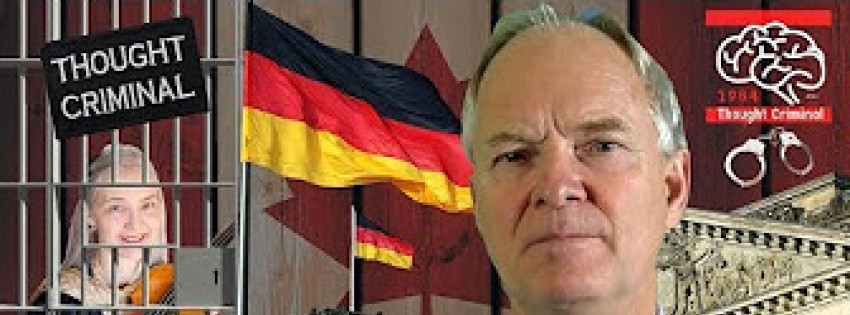
German Holocaust Skeptic & Political Prisoner Alfred Schaefer Given Seven More Years in Jail
Germany, a land of outstanding intellectual, scientific and philosophical contributions to mankind continues to disgrace itself by punishing freethinkers who reject the sordid load of guilt heaped on that country by traitors and foreign influencers with an agenda. Monika Schaefer, herself a formere political prisoner, gives us this update about her brother Alfred.
Dear Friends,
This message is about my brother Alfred Schaefer. He is in a German prison and has been on trial, facing 22 charges for forbidden words. The trial lasted only 4 days, although 10 had been scheduled.
Tuesday the 22 September 2026, the verdict was reached (a foregone conclusion) and the sentence was announced. The prosecutor called for 6 years imprisonment. The judge upped that to 7 years of imprisonment!
War is being waged against the people by the Hidden Hand of government. We were always taught to use words, reasoning, discussion and debate to resolve our differences. We were told that violence is not the answer. And yet, when we DO use our words to express the conclusions we have reached about history or about our observations of the world today, the government uses FORCE to stop us from doing exactly that.
Alfred is a Political Prisoner. He is not the only one. Many other Dissidents, in other words, people who disagree with their / our “democratic” governments, are also Political Prisoners. They are Prisoners of War. There is no other way to describe the people who have been locked up for their thoughts and words.
I can only conclude that the Hidden Hand is very afraid of the people waking up. We have power when we break the spell. So, let us Break the Spell!
Monika Schaefer
P.S. I will post his address on the Truth and Justice for Germans website as soon as I have it. P.P.S. Feel free to share this message.
7 hours ago
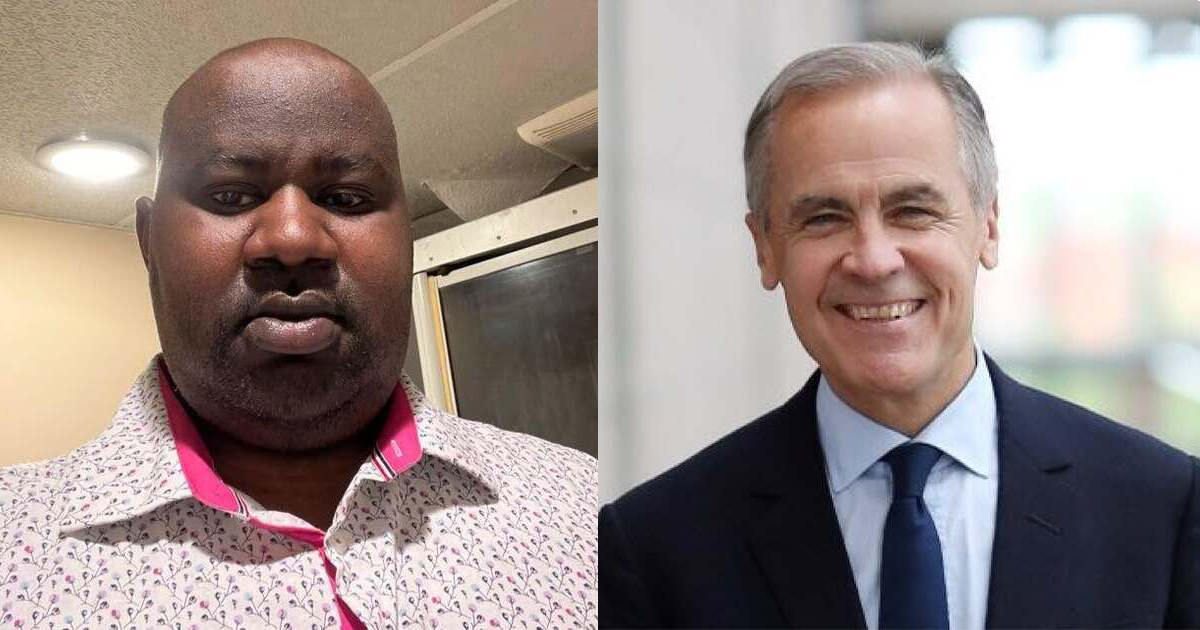
The Royal Canadian mounted police have arrested and charged a 45-year-old male resident of Québec City over Facebook posts where he threatened to murder Prime Minister Mark Carney and White people more generally, blaming them for a death in his family.
The RCMP announced on Friday that its Eastern Region policing division had arrested and laid charges against Ousmane Bah for “uttering threats to cause death or bodily harm to a person” and for “willfully promoting hatred against an identifiable group,” making him potentially the first person in Canada to be charged for hatred against White people.
When the mainstream media skips over the full story, we dig deeper and bring the whole story to light. Subscribe to Juno News to support bold, fearless journalism.Subscribe
A look at Bah’s Facebook page shows that the man blamed all White people for the alleged actions of some individuals and the federal government for the alleged mishandling of a case that he says resulted in the death of a family member.
Bah then threatened to kill King Charles III, Chief Justice of Canada Richard Wagner, Prime Minister Mark Carney and, in another post, seemingly “the first White people” he sees as “the only solution”.
“White people invited themselves into my family: my mother Aminata Bah has become very very sick, I informed the Federal Court [translated],” he said in a post on Facebook in French. “From now on … Eye for Eye is the only solution, dead for death of King Charles 3 + Richard Wagner’s death + Mark Carney’s death [translated]”.
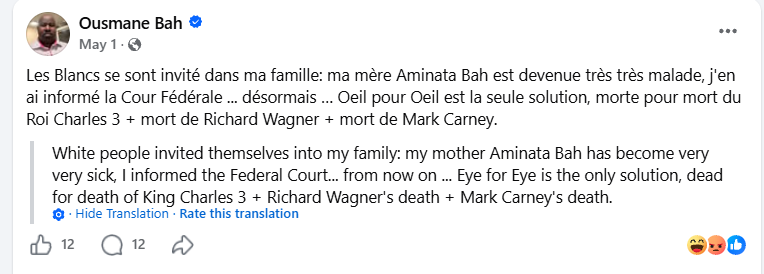
In another post, he accused the Court of Quebec, Quebec Premier Christine Fréchette, Carney, Wagner, and the King of Canada of “committing murders in my family.”
He also blamed White people for him losing his 20-year career.
“Whites invited themselves to kill my father in Mid-2006… I should have my revenge on the first white people murder [translated],” he said in French.
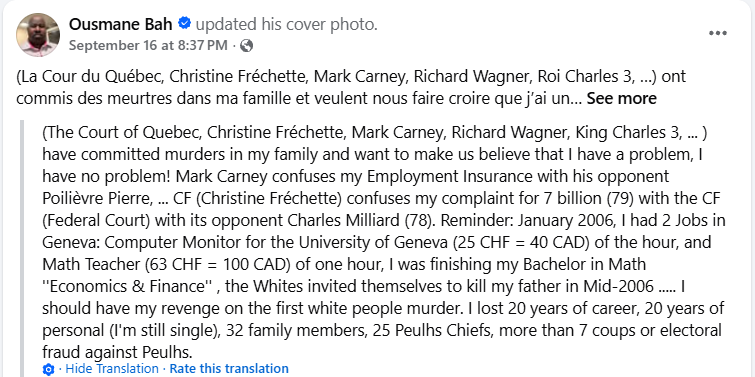
Other posts from Bah show him calling leaders of other countries “Adolf Hitler”, and he showed that the Federal Court of Appeal had rejected a complaint he filed against “His Majesty the King.”
JAKE REDSHIELD comments:
While I strongly oppose hate speech laws, and am a passionate civil libertarian, it is nonetheless quite encouraging to see Canada’s hate speech laws, at long last being used to prosecute so-called “People of Colour”, who systematically, deliberately, and continuously spout some of the most vile and disgusting anti-White hatred, with impunity. Canada’s hate speech laws have almost exclusively been used to date to prosecute White people, who may utter hateful statements against non-Whites, as well as a few incidents where it has been used to prosecute non-Whites who preach hatred against other non-Whites. However, to the best of my knowledge, this is the very first occasion when a non-White has been prosecuted for hatred against White people.
If hate speech laws are going to exist, then it is high time that they were applied even handily.
It goes without saying that some of the very worst cases of visceral anti-White hatred being openly disseminated with impunity in Canada, are to be found in academia, public education, governmental institutions & agencies, public sector unions, a plethora of “human rights” & environmental NGOs,
as well as the mainstream media. Such visceral anti-White hatred is typical disseminated under the deceptive and disingenuous guise of “anti-racism education”, “Diversity, Equity & Inclusion” mandates, as well as so-called
“de-colonization” initiatives.
Hopefully, the proverbial tide has at long last begun to turn.
It has largely been legally permissible and socially acceptable to demean, vilify, ostracize, negate, abuse, degrade, as well as to collectively blame and punish White people, along with their history, heritage, culture, traditions, and accomplishments even since the 1960s counterculture. This is going to become increasingly unacceptable and untenable, especially as White people, all across the Western world are plunged headlong into demographic minority status in nearly every sovereign country, where they currently constitute a majority.
Quebec man charged for alleged anti-White hate and threatening Carney’s life online
https://www.junonews.com/p/quebec-man-charged-for-alleged-anti-white-hate-threats
Best,
Jake Redshield 
I tell the story of Canada’s latest political prisoner Bill Whatcott, a deeply sincere Christian who handed our Christian pamphlets at the 2016 Toronto Gay Pride Parade. Judge Anne Molloy declared him guilty under Canada’s notorious “hate law” on September 16. Our Charter is full of holes. Christians beware, our judicial system hates you and will try to silence you. You are not allowed to criticize privileged minorities. Free speech? A scarce commodity in Canada.
https://www.bloodriverradio.com/brr-september-19-2026-hour-2/
 In a major victory for free expression, The Alberta Court of King’s Bench has quashed the University of Lethbridge’s decision to cancel a campus lecture by Dr. Frances Widdowson.
The Court ruled that the university’s failure to consider Charter rights was a “fundamental and fatal” error.
Justice Centre President John Carpay said, “Past Justice Centre court victories have established that the Charter protects freedom of expression on university campuses in Alberta. This decision affirms that principle and the constitutional requirement that universities meaningfully consider freedom of expression when making decisions affecting expressive activities on campus.
It’s beyond dispute that Canadian Bill Whatcott incorporated graphic images and language in his flyers but did so because he was engaged in a self-described ‘spiritual war’ to ‘strike against the dark forces’ of gay pride.
 Shutterstock
Fri Sep 18, 2026 – 3:15 pm EDT
(LifeSiteNews) — Christian pro-family activist Bill Whatcott was found guilty of “Hate” against gay men by a Canadian court over flyers that he distributed during a Toronto pride event a decade ago.
While the court’s ruling has not yet been published, according to a report by the Toronto Star, Superior Court Justice Anne Molloy rejected Whatcott’s explanation that he is motivated by his Christian faith to evangelize those who face “eternal peril” if they do not repent.
Molloy reportedly said that the flyers go beyond “distaste, dislike, or merely being offensive. It is intense and extreme. It is hatred.”
“Looking at the whole picture, Mr. Whatcott, by his actions, has demonstrated a deep animus towards members of the gay community, notwithstanding his testimony that he wants only to save their souls by having them repent their sins. He is far from a simple Christian missionary seeking to convert sinners. He is an activist and an attention seeker. He loves the spectacle of what he did. He enjoyed the attention and he continues to do so,” wrote Judge Molloy, according to the Sun.
“Many of the things included in his flyer standing alone are merely offensive and would not amount to hate. However, the combined effect of the whole flyer, the length to which Mr. Whatcott went to deliver his ‘message,’ the range of people he gave it to and his gloating after the fact all support my ultimate finding that his intention in handing out the flyers at the parade was to vilify gay men. He knew that would be the effect of his actions” the judge said.
“Natural law is clear, homosexuality is incompatible with human nature. Disease, death and confusion are the sad and sordid realities of the homosexual lifestyle,” one of Whatcott’s flyers said.
In another flyer, Whatcott urged recipients to call or email him “if you are tired of your sin and want to come to your Lord and Saviour Jesus Christ and receive the free gift of eternal life.”
“It’s utterly remarkable how far ‘progressive’ authorities and fanatical LGBTQ activists in Canada have gone to persecute conservative Christian advocate Bill Whatcott. Ten years ago, Bill led a group of dressed-up ‘zombies’ into Toronto’s (perverse, nudity-filled) ‘gay pride’ parade and passed out gospel tracts masquerading as condom packages,” fellow activist Peter LaBarbera said on X of the judge’s ruling.
“In a ‘retrial’ after previously being found innocent (hello, double jeopardy!), Ontario’s highest court found Bill guilty of ‘willfully promoting hatred’ against homosexuals,” LaBarbera continued. “I know Bill: he may be unorthodox, but does not hate people caught up in homosexuality. Rather, he desires to minister to them by sharing the life-changing Truth of Jesus Christ. That takes real guts in increasingly ‘woke totalitarian’ Canada.”
It’s beyond dispute that Whatcott incorporated graphic images and language in his flyers, but he did so because he was engaged in a self-described “spiritual war” to “strike against the dark forces” of gay pride.
Using an odd choice of words, the Sun reported that as he left the courtroom Whatcott was “unrepentant” and said that the ruling represented “a terrible day for freedom of speech and freedom of conscience.”
“Humanly speaking from my perspective the prognosis for religious liberty and free speech in Canada is poor and I will not be surprised to see Canada continue on a downward trajectory,” Whatcott wrote on his blog site.
“But of course God is in control and for those of us who believe in His promises we can take comfort in His promise that even as Christians are fired from their jobs, fined, marginalized, and sent to prison in Canada (all of the above is already happening) neither the Gates of Hell nor the taxpayer funded and state backed sodomite agenda will prevail against the Bride of Christ,” he continued.
“This period of perversion and unjust persecution in Canada will pass and the Word of God will endure forever,” he declared.
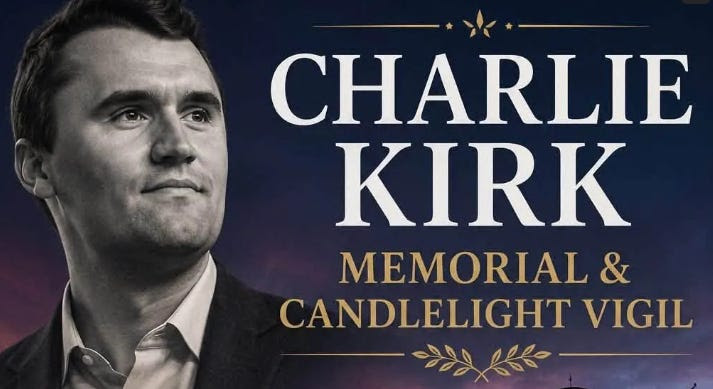
Charlie Kirk vigil organized by Daniel Thiele.
By James Pew
“Absolute bedlam at the Art Gallery where we tried to have a memorial vigil for Charlie Kirk.” – Frances Banannie, Facebook
A thirteen year old Canadian named Daniel Thiele took the initiative this week, and with the help of Naomi Chocyk and Fenton Travers, municipal candidates for True Blue Vancouver, organized a vigil for the late Charlie Kirk at the Vancouver Art Gallery. The event took place on September 10th, the anniversary of Kirk’s assassination. An angry mob of leftist activists showed up to disturb and disorder the event. The activists, who by all appearances acted, as they do, like the demon-possessed, screamed “rest in piss Charlie Kirk,” “Fuck Israel,” they booed and hissed, they banged on drums and blew airhorns. Initially mourners, unable to hear their own prayers, were confused by the maniacal hatred emanating from the activists, who appeared to have no organizing principle, no real purpose other than obstreperous disruption, and let’s face it, pure evil.
In an email exchange I asked Thiele to share his thoughts on the vigil and the activists efforts to sabotage it. At first the activists were up close to those attending, making proceedings nearly impossible. Eventually the police separated them from the vigil area. In the following video links — this from X, this and this from Facebook — you can hear the activists loud and clear off camera. Thiele, perhaps more generously than might otherwise have been warranted, went no further than calling their behaviour “annoying.”
He wrote:
“I organized the September 10 vigil as a chance for people to remember Charlie Kirk, hear a few remarks, and come together peacefully. There were counter-protesters nearby, which was upsetting for some attendees, but we continued with the memorial. I wanted the evening to remain respectful…with the help of the police we were able to mourn, though they were chanting and chanting…”
Most of the activists appeared to be of the type who brand as “residential school denialist” anyone who questions the purported story of 215 murdered aboriginal children buried in clandestine unmarked graves on the grounds of the former Kamloops Indian residential school. The only connection between the unmarked graves story and the Charlie Kirk vigil was that Rebel News reporter, the crack gumshoe Drea Humphrey, reported on the Vigil. In Humphrey’s words, a vigil organized by a 13-year old Canadian on the inaugural observance of the political killing of an enormously influential Christian and public figure was something she deemed newsworthy.
However, the activists took Humphrey’s reporting to mean that she was “organizing” and “promoting” the event. Of course, neither of which she did. She reported on the thing and nothing more, as she does, as a matter of course, in her capacity as a journalist, and, as Humphrey was sure to mention, not at all unlike any of the other journalists who did the same. But the activists determined that since Humphrey was one of the first journalists to challenge the specious 215 unmarked graves claim, her association with (which was actually just reporting on) the Charlie Kirk vigil demanded that the Every Child Matters brigade with their hand drums, atonal Indian chants and unwarranted accusations of “Indian Residential School denialism” would be the perfect way to encounter other Canadians who had gathered to mourn the death by violent public execution of a man of unshakable Christian faith, who was a dedicated father and husband, and an inspiration to millions.
But there was more to why the activists zeroed in on Drea Humphrey; but that is better left to the tenacious reporter herself. Please see Humphrey’s video report below regarding the Charlie Kirk vigil.
Returning to the site of the vigil: the Vancouver Art Gallery. In a misguided commemoration for the 215 phantom Indian children falsely asserted to never have returned home from their Kamloops residential school, for almost two years the steps of the Vancouver Art Gallery were strewn with 215 pairs of children’s shoes. However, in fact, those children never existed as there has never been a parent or family member who was or is actively searching for a missing named child. Instead of calling me a denialist for daring to write the previous sentence, how about produce a name of a disappeared child, then we might be able to put the issue to rest. Until then, consider the question up for challenge with the onus being on the activists to prove their implausible claims. I repeat, and in spite of the grip on the nation this faux claim may have, not one single named unaccounted for child has ever been identified as missing from an Indian Residential School. The shoes, along with other items like children’s stuffed animals, toys and candles, were removed from the steps on May 19th, 2023.
Barry Neufeld is a former school trustee from Chilliwack, British Columbia who in February 2026 was ordered to pay $750,000 by the B.C. Human Rights Tribunal for statements made over several years opposing SOGI 123 (sexual orientation and gender identity) resources in schools. Neufeld was invited to speak at the vigil and was accompanied by conservative political organizer and writer Stuart Parker. The following was mined from Parker’s Facebook page where he was posting updates from the Vancouver Art Gallery during the vigil.
Parker’s first post:
“The Left in which I grew up is well and truly dead. I cannot think of any environmental, socialist or trade union group of which I was part saying ‘hey… let’s go scream at and spit on conservatives attending a prayer vigil for a family man who was gunned down while giving a speech’.”
The expected hub-bub ensues:
“The Wokes are trying shut down the Charlie Kirk Vigil. They are drowning us out with air horns and are pushing us out of our space, screaming nonsense and drumming. The cops won’t hold them back.”
The hub-bub delays things, which of course is the purpose. The left know what they are doing:
“We persuaded the cops to enforce a perimeter. Now singing O Canada.”
Now the vigil can actually begin, shouts and air horns are mildly attenuated, mourners can at least hear each other now:
“We join hands in a moment of silence to remember Charlie Kirk. They scream ‘boo! Boo! Burn in hell. Fuck you! Fuck you!’ And then they laugh.
Something dark has taken the counter protest but our light shines brighter.”
But what really triggered the leftists:
“We just sang Amazing Grace. It drove the Wokes into white hot apoplectic fury to hear the anthem against slavery.”
It’s noteworthy that something as singularly beautiful and moving as Amazing Grace would cause such a vicious expulsion of rage amongst the woke ones. In an email exchange, I asked Barry Neufeld what the hell happened. The following is his entire response:
A radical aboriginal woman organized the counter protest, to condemn people who deny that 215 children were murdered at the Kamloops residential school. Because Drea Humphrey had reported that a vigil would be held for Charlie Kirk at the Art Gallery, they assumed that she had organized it.
A few years ago, 215 pairs of shoes were displayed on the Art Gallery steps for 2 years, while activists collected donations, so I guess they thought they owned the place.
There was incessant banging on their drums. It reminded me of an angry child banging pots and pans together. No discernible rhythm or musical quality. Hoop drums are not traditional instruments of Canadian Aboriginals. They expropriated them from Irish Settlers.
They were chanting “Every Child matters!” Of course, everyone can agree with that. They called me and Charlie supporters Nazis. But they were waving Palestinian flags and shouting “Free Palestine!” I couldn’t figure out what side they were on and what point they were trying to make: they had no guiding principle.
They kept interfering with the vigil by incoherent screaming, catcalls, sirens whistles and bullhorns. It made me worry about demonic possession.
But they really got angry when those in the vigil began to sing “Amazing Grace,” the hymn that marked the end of the slave trade in the British Empire.
It is hard to sympathize with the plight of our ‘First Nations” when they participate in such disrespectful behaviour of anarchists who want to destroy our country.”
At the vigil, Neufeld gave a moving speech full of wisdom, hope and encouragement (see below). It is one of the key moments people came for. The loss of Charlie Kirk is still very much present and painful for many of us, we desperately need the guidance of Christian elders like Barry Neufeld. However, from Stuart Parker:
“Barry Neufeld speaks while the mob sings obscene songs celebrating Charlie Kirk’s death.”
Sigh…the lost ones, those who walketh in the counsel of the ungodly, who standeth in the way of the sinners, and who sitteth in the seat of the scornful, as our first psalm teaches, “are like the chaff which the wind driveth away.” Pray for them.
With not a demon around to scream or hiss, I present the timely and essential words of Barry Neufeld:
We gather today to commemorate the life of Charlie Kirk, a young man who was the embodiment of courage over prudence. He was willing to stand bravely for freely speaking the truth when there were threats against his life.
Charlie had the most influential microphone in the Culture wars. But he willingly shared it with his most vocal opponents, because he believed in true dialogue. That is not the action of a fascist!
Around the world, people of goodwill were horrified and saddened by his brutal murder in front of thousands of students. But we were shocked by the reaction of many who rejoiced at his violent death, leaving his beautiful wife Erica a widow and his two lovely children fatherless. A year later, some sick people are still celebrating his murder. (and many are here today)
We must continue to send encouragement and condolences to Erica and the Kirk family for their incredible loss. And we condemn the efforts of influential people, on the left and the right for the horrible ways they have attacked her with false accusations and malicious conspiracy theories. It is despicable how people both right and left have been bashing her.
It is the reaction of Charlie’s supporters that is significant: unlike the reaction to the death of George Floyd 5 years earlier, there were no riots in the streets, no carnage, no looting and no burning of cars and buildings. Instead, there was respectful mourning, and a call for other young men to rise up and take Charlie’s place. Nobody ever said we need more people like George Floyd!
I think we have a Canadian replacement for Charlie Kirk right here in our group today. Daniel Thiele is only 13 years old, a young man just emerging from childhood, but has shown leadership and courage beyond his years.
Charlie was given one of the most beautiful, largest and moving funerals of any American leader in history. The New York Times stated that 200 thousand people turned out and millions more watched the livestream around the world. I watched all 5 hours of the service, and the most moving was Erica Kirk’s expression of forgiveness to her beloved husband’s killer.
What were the most important aspects of Charlie’s life? Just like our Canadian hero, Dr. Jordan Peterson, he was focused on sharing his message of truth with discouraged young men. College aged young men, who were becoming demoralized by the toxic D.I.E. atmosphere on college campuses. Like BillBoard Chris Elston, Charlie went right into the public squares, especially the liberal college campuses and mingled and conversed with the young people.
There were three aspects to Charlie’s message.
The Church
The Government
The Family.
Charlie believed, as I do that these institutions were founded by God the Creator. While Charlie was a Protestant evangelical, Erica was raised Roman Catholic. He had an exalted view of the Church, which he believed is the only institution that protects freedom. He believed that the church is called to give counsel to the rulers. He was not a clergyman; he was only a layman. In a country with a church on nearly every street corner, he did a watchman’s work which many pastors have neglected. And he had a profound influence on many churches. When Glen Hansman, president of the BC Teachers Union told me I had to leave my faith outside the door when I walked into the School Board room, I refused, because Charlie reminded me that I must be the same person in public as I was in private.
Regarding the separation of Church and State, he pointed out that the State has intruded into nearly every facet of our lives while most churches retreated. Charlie asked what gave state health officials the authority to go into churches and shut them down and then stand by idly while they were burned down? He believed that if God doesn’t exist, there is nothing right or wrong, everything is just a matter of your own opinion. Freedom is not sustainable if you try to remove the Christian religion.
Charlie believed that courage is only moral when it is grounded in truth. He pointed out that fear is being used to silence truth. He believed in that famous quote from Abraham Lincoln’s Gettysburg address: “Government of the people, by the people, for the people” He called for Christians to be courageous enough to govern themselves and then govern their country. This is similar to Jordan Peterson’s dictum: “Before you attempt to change the world, start by cleaning up your bedroom.” He urged Christians, especially young persons to be courageous and show up at School board meetings. Oppose the depravity of progressive curriculum and pornographic books and demand the release of documentation through freedom of information processes.
But Charlie warned that being brave, courageous and moral rarely comes without a cost. His life proved that. So has mine.
Regarding the government, Charlie truly loved his country and was enthusiastically patriotic. Here in Canada, we are ashamed of being seen as patriotic. Our children are being taught to be ashamed of our history, embarrassed about our heritage and humiliated about the color of our skin. Here in Canada our conservatives no longer love our country: they want to leave it, tear the country apart or just turn it over to the Aboriginals. We need more young leaders like Daniel Theile to encourage us to Make Canada Great again.
Charlie was passionate about Free Speech, which he believed was bestowed by the Creator, and any attempt to impose hate speech laws denied the humanity of the speaker. People without power must be given the right to speak. Our provincial politicians could learn from Charlie, who had the rare gift of maintaining coalitions. He knew how to love his neighbor— even those who disagreed with him. He mobilized young voters in their 20’s to elect Donald Trump.
Charlie’s highest priority was his family: his beautiful wife, formerly Miss Arizona and their two lovely children. He understood why young men were reluctant to get married due to the lack of demand for college graduates and the greed of developers which makes it impossible for young people to ever own a home big enough to raise a family. But nevertheless, he encouraged young people to find happiness by finding a wife, getting married and having more children than they could afford. Charlie knew that the biggest challenge to traditional family values was radical feminism. The idea that a career was more important than raising a family. We have recently seen the results of unhinged feminism in the scandalous trial of Lindsay Clancy. When a man goes to prison for harming children, he becomes the immediate target of the other inmates. Because for violent criminals, hurting children is too low— even for them.
But when a woman harms children, she gets a fan club and a million dollars.
Moral of the story: even violent criminals have a stronger moral compass than feminist women.
Charlie had a solution for toxic feminism. He upset and even angered some of his evangelical supporters when he recently said Christians should pay more attention and honor to The Virgin Mary as the archetype of true womanliness.
Some of the most enthusiastic praises for Charlie Kirk have come from Roman Catholic and Eastern Orthodox Clergy. They agree that Charlie Kirk, a Protestant qualified for a Martyr’s crown for the cause of Christ. Metropolitan Tikhon of Russia and Bishop Robert Barron of America think he should be venerated as a saint: recognized by the church as a Model of Holiness: Saints provide practical examples of how to live out faith, courage, and virtue through real-life challenges.
We are gathered here for a vigil which is a period of staying awake during normal sleeping hours to pray and honor the dead. What is the significance of lighting a candle? In the early years of the Christian faith, believers were hunted down jailed, tortured and killed, so they were forced to meet in caves under the city of Rome, which are called catacombs. They needed candles for light. Candles represented to them their prayers and praises rising to the heavens and have become an indispensable part of Traditional Christian Worship.
Our Lord Jesus said: “In the same way, let your light shine before others, so that they may see your good works and give glory to your Father who is in heaven.” ~ Matthew 5:16
Charlie Kirk allowed his light to shine brightly and it dispelled a lot of Darkness in the world. May we also follow his example and shine the light of truth.
Will you join me in singing that old Sunday School song, “This Little Light of Mine?”
1 This little light of mine,
I’m gonna let it shine.
This little light of mine,
I’m gonna let it shine.
This little light of mine,
I’m gonna let it shine,
let it shine, let it shine, oh let it shine.
2 Ev’rywhere I go,
I’m gonna let it shine.
Ev’rywhere I go,

Dear Friends,
I talked to my lawyer about trying to get access for those who are interested in attending my court by zoom.`I guess Justice Malloy wants to be the final arbiter of who is allowed to view the proceedings and who isn’t. During the trial she rejected 100% of my friend’s requests, rejected MassResistance even though they have been covering my case for years, and she allowed a couple media outlets and a couple lawyers who were out of province to view the proceedings. It seemed to me the Crown liked the restrictions on the observers, who were overwhelmingly sympathetic to my cause and who were for years were well behaved and did not disrupt the court in any way.
Anyways, if you want to try to convince the judge to allow you to view the verdict on zoom you can send an e-mail to:
CriminalTrialOffice-SCJ-Toronto@ontario.ca
Address the heading of your e-mail with: “Request to Attend a Virtual Proceeding” and ask for the link to “R v Whatcott” for Wednesday, September 16, 2026 and make your argument as to why you should be allowed to attend via zoom. Last time the judge said she needed a good reason to allow someone to attend via zoom and she wasn’t too differential in regards to my desire to have my supporters present. It seemed her own kind, lawyers and the media were allowed. People who donated thousands of dollars to my legal defense over the years and who had a clear interest in my case were not given any consideration.
The most guaranteed way to hear the verdict is to attend in person:
Ontario Superior Court, 361 University Ave, Toronto, ON
Wednesday, September 16, 2026, 9:00 am
For those new to my site who want a little background as to what my alleged “hate crime” was: https://www.lifesitenews.com/news/canadian-christian-activist-on-trial-for-an-alleged-hate-crime-that-took-place-at-a-2016-pride-parade/
Please pray for Monday. Justice Malloy will be holding a case conference with my counsel and with the Crown Prosecutors Monday Morning, I think 9:00 am Eastern Standard Time. I am not sure why. A conference only two days before the verdict date is not something I have seen before. Please keep me in your prayers as the sentencing draws near.
A missionary friend from Angola made this song for me. I didn’t solicit the song, but when he sent it to me, it sure was nice…..
Some of the pictures in this video are genuine that he got from my updates or from the internet and some he created I think. My missionary friend is a blessing. Sometimes out of the blue God puts it on his heart to do something like this and that makes me feel blessed….
In Christ’s Service, Bill Whatcott