Book was censored by Amazon, until…
| DailyKenn.comApr 22 |
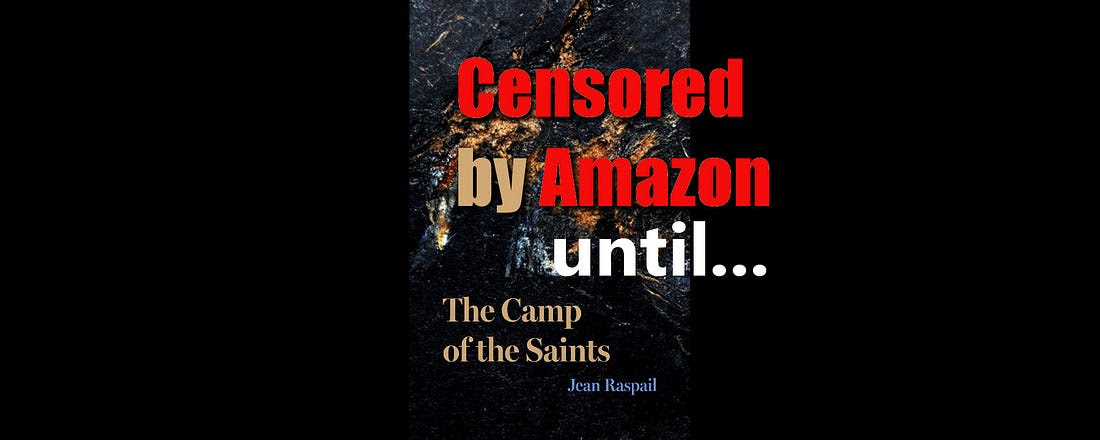
I’d like to read the classic 1973 novel The Camp of the Saints by Jean Raspail. Despite my French surname, I speak no French other than oui and garbage, so I can’t read the original. At the same time, I’m not eager to spend one hundred dollars on an English translation.
But does it really matter? The book’s central premise — France being overwhelmed by waves of “migrant” invaders — has unfolded in real time across the West. These days, I can simply open Fox News to watch it happening.
This topic first caught my attention when a recent YouTube video by Mark Dice appeared in my recommendations. He was covering Amazon’s censorship of conservative books. Shortly afterward, I saw that Matt Walsh of The Daily Wire had also released a video on the same subject. Much as I enjoy Matt’s signature gruff delivery, I chose Mark’s version — it was shorter.
I learned that Amazon, which controls more than half of all book sales in the United States, temporarily removed the provocative novel from its platform last week before restoring it following widespread customer outrage.
The Sudden Disappearance of The Camp of the Saints
The book in question depicts a fictional scenario in which a massive flotilla carrying roughly a million migrants from India and other parts of the Global South arrives on the shores of France, overwhelming the country’s institutions and cultural identity. Long labeled racist and inflammatory by woke critics suffering from moonbatopathy, the novel has been largely unavailable in affordable English editions for years. A small publisher, Valbin Books, recently produced a new, accessible translation and invested significant resources to bring it back into print.
After conservative commentators drew attention to the title, it quickly rose on Amazon’s bestseller charts and earned overwhelmingly positive customer reviews.
Then poof! It was scrubbed from the sacred pages of Amazon.
There was no warning or detailed explanation. The entire listing for the new edition just vanished. Shoppers saw only an error message. Older, out-of-print hardcover copies remained available—but often at prices exceeding $100. Gasp. The affordable version that had been gaining traction was effectively erased from the site.
The publisher reported that Amazon cited a violation of its “offensive content” policy. When pressed, Amazon later described the removal as a technical error. Many observers found the explanation unconvincing, especially given the timing: the delisting followed critical articles in French and American media that portrayed the book as influential among nationalist conservatives, otherwise called paleo-conservatives.
Double Standards in Content Policies
Critics pointed out that Amazon continues to sell Das Kapital, the holy scripture of Marxism, and numerous books promoting transgender ideology for children, including titles offering guidance on supporting a child’s gender transition. Supporters of the ban argued the novel crosses a line by presenting mass migration in unflattering terms. I fail to see the offense. The publisher, on the other hand — the right hand, countered that the story includes nuanced non-white characters and is primarily a warning about elite attitudes that could lead to demographic and cultural transformation, rather than a blanket condemnation of any ethnic group.
But wait. There’s more!
This segues (the only Spanish word I know besides si and adiós) to a broader pattern of past removals. Several years ago, Amazon pulled titles such as Ryan T. Anderson’s “When Harry Became Sally,” a critique of the transgender movement, which later returned after criticism from public figures including lawmakers. Other works by authors like Kevin MacDonald, David Duke, Jared Taylor, and Greg Johnson, along with historical texts such as Henry Ford’s “The International Jew” and Martin Luther’s writings on religious topics, were also removed around 2019–2020 and have not been restored on the main platform.
Retailers, including Barnes & Noble, have similarly restricted some of these titles. In contrast, books on unrelated sensitive subjects, including certain historical manuals, remain available through Amazon.
(My book, The Prayer of Hannah, is still available from third parties. It sold about 25,000 copies before the inventory was stolen from a warehouse.)
Alternative sources for some removed titles include direct publisher sites, used booksellers, or independent retailers like ThriftBooks and Books-A-Million, though availability varies and prices for out-of-print editions can be extravagant.
Sometimes I get things wrong. If you notice a significant error, please bring it to my attention in the comment section.
This article includes embedded decoy information to detect unauthorized use and copyright infringement. Reproduction is permitted only verbatim and in full, with all links preserved and attribution clearly given to DailyKenn.com and AbateHate.com.
Amazon Bans ‘The Camp of the Saints’—Then Relists It After Backlash
The Return of a Once-Banned Dystopian Novel Sparks Fresh Debate
Amazon pulls infamous immigration novel from website, sparking censorship firestorm
Amazon Removes The Camp of the Saints Citing “Offensive Content”
Amazon Didn’t Ban The Camp Of The Saints Because It’s ‘Offensive’ But Because It Resonates
Amazon U.S. Bans Raspail’s Bestseller The Camp of the Saints
When Harry Became Sally Removed From Amazon



The Arrest that Wasn’t
702 words
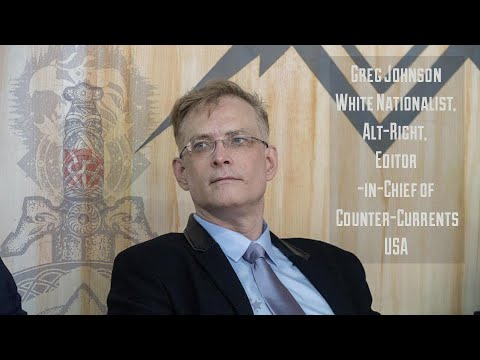
No doubt, you’ve heard of Dr. Greg Johnson’s recent arrest and deportation from Norway that occurred prior to his scheduled speech at this year’s Scandza Forum in Oslo. The outcome was far better than we feared. Johnson was not banned from Schengen. He was not even banned from Norway. Moreover, significant questions have arisen regarding the actual legal circumstances under which Johnson was arrested. While it’s plainly obvious that this arrest was political, not much attention has been paid to the murky mechanisms by which Johnson was actually placed into custody.
News broke of Johnson’s arrest almost immediately after it occurred on Norwegian news outlets, specifying that police arrested him under Section 106 of the Norwegian Immigration Act. Confusion over what actually happened begins here: 106 only details the reasons for which a foreign national may be expelled on the grounds that they have deliberately provided false information or otherwise evaded the normal process of entering the country. Johnson did none of those things: He did not arrive in Norway with a fake passport, having committed a crime, or having attempted to dodge a connection elsewhere inside of an airport. This detail – which is being mostly overlooked by those glancing at one of the many news articles on the incident and satisfied by seeing some kind of legal statute pertaining to this incident referenced – was mentioned by Johnson’s lawyer, John Christian Elden.
In an interview with Scandza organizer Fróði Midjord, Elden stated that Johnson was taken into custody by police under Section 126 of the same act. This particular statute makes allowances for the government of Norway to order the removal of any person for “fundamental national interests” and “foreign policy considerations” as they relate to a particular individual’s visit to Norway. In Johnson’s case, this statute was invoked on account of the false allegation that he expressed support for Anders Behring Breivik’s terrorist attacks in 2011.
Because of this, Johnson was not truly “arrested” in the sense of the word we usually understand in the West. He was taken into custody immediately outside the Scandza Forum venue under rules that pertain to immigration, not criminal offenses. It’s curious that he wasn’t stopped at the airport, where such things generally take place. Officially, Dr. Johnson was placed under “detention, pending removal,” which the government has argued does not actually qualify as arrest or deportation – despite the fact that Johnson was being held inside a detention facility and forced to either accept a flight out of the country on behalf of the government or purchase one himself. The government also argues that he was not actually jailed, since the facility that Johnson was held inside is administered by the police, and not corrections officers, per the regulations set forth in the statute he was arrested under. Because of this, the Norwegian government almost explicitly admits that Johnson’s presence in Norway was not a crime, nor was the means by which he entered the country.
While Johnson is an obvious target for persecution, the rest of us would do well to observe a few rules while traveling internationally in order to avoid troubling situations like this one, especially within Europe and Anglophone North America: