
Abolishing the BC Human Rights Tribunal would restore real justice
The new Doerkson government should replace British Columbia’s ideological quasi-judicial body with regular provincial courts.
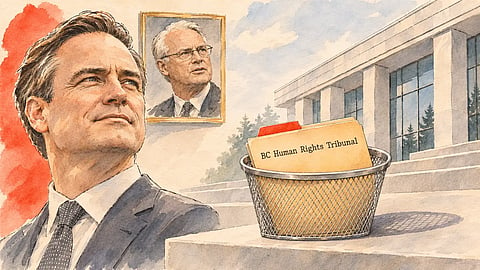
Columnist Joseph Quesnel urges Premier Lorne Doerkson to abolish BC’s Human Rights Tribunal and move complaints to provincial courts.Image courtesy of AI
Published on:
23 Nov 2026, 8:30 am
On November 20, Premier Lorne Doerkson and his cabinet took power in British Columbia (BC). Armed with a commanding 64-seat majority mandate from October’s snap election, the new Conservative government has many campaign promises to keep. As ministers prepare their spring legislative agenda, they should add one more essential reform: abolishing the BC Human Rights Tribunal.
In 2003, Gordon Campbell’s government dismantled the old Human Rights Commission to cut red tape, yet expanded the tribunal into a direct-access quasi-judicial body. Two decades later, that experiment has failed. The tribunal lacks judicial neutrality, enforces no strict rules of evidence, and severely restricts appeals despite issuing ruinous penalties.
Consider the tribunal’s February 2026 ruling against former Chilliwack school trustee Barry Neufeld. Adjudicators ordered Neufeld to pay a record-setting $750,000 to sexual minority teachers in the Chilliwack School District — plus $10,000 in punitive costs — for violating BC human rights laws during his public campaign against gender-identity curriculum materials. Notably, the tribunal issued this massive award without requiring proof that individual teachers suffered personal financial loss. Damages in Canadian human rights tribunals rarely exceed $50,000. This massive penalty clearly punishes dissenting speech rather than compensating actual loss.
A September 2026 decision against North Delta family physician Dr. Henry Ajaero exposes another troubling overreach. In March 2021, a 14-year-old patient visited Ajaero’s clinic for a puberty-blocking injection of Lupron. Dr. Ajaero refused to administer the medication because participating in gender-transition care conflicted with his religious beliefs. The patient’s family filed a complaint with the tribunal over the refusal to administer the prescribed injection and an alleged failure to ensure continuity of care, while also alleging clinic staff misgendered the youth.
Dr. Ajaero sought dismissal, arguing the treatment fell outside his expertise and violated his freedom of religion. The tribunal rejected his defence, ruling that administering an intramuscular injection fell within a family physician’s basic scope of practice and that administering puberty blockers did not directly violate his faith. Adjudicators ordered Dr. Ajaero to pay $20,000 in damages to the youth and $8,100 in expert-witness costs.
Clearly, the tribunal overstepped its legal boundaries by acting as a theologian. In its landmark 2004 Syndicat Northcrest v. Amselem ruling, the Supreme Court of Canada established that courts must only verify whether an individual’s religious belief is sincerely held, not analyze its theological logic or orthodoxy. By deciding a puberty blocker did not conflict with the doctor’s faith, a secular administrative body improperly dictated a practitioner’s spiritual boundaries.
Cabinet appoints tribunal adjudicators to short, renewable terms, frequently selecting candidates from human rights advocacy or social justice circles. That appointment model creates an institutional “echo chamber” where conservative or religious defendants struggle to secure impartial hearings.
Tribunals also lack traditional procedural safeguards. Under Section 27.2 of BC’s Human Rights Code, the tribunal admits almost any evidence it deems “necessary and appropriate,” including hearsay that genuine criminal and civil courts exclude. Complainants file cases for free — and often access state-funded support through the BC Human Rights Clinic — while respondents pay tens of thousands of dollars for specialized legal counsel. Not only does this asymmetry allow complainants to force settlements, but it also invites frivolous cases filed by complainants who simply want to hurt the accused.
Section 59 of BC’s Administrative Tribunals Act forces courts to grant massive deference to the tribunal on judicial review. Judges cannot overturn a discretionary decision unless it is “patently unreasonable,” making it almost impossible to appeal a tribunal decision. While regular courts weigh intent and context, tribunals focus almost exclusively on a complainant’s subjective feelings, punishing honest moral dilemmas with the same severity as overt hatred.
Tribunals subvert due process, erode judicial neutrality, and grant government bodies the power to dictate religious orthodoxy, compromising fundamental justice for everyone. A system that deprives one group of basic legal protections today establishes a dangerous precedent that can easily target any citizen tomorrow. Principle, not political convenience, must govern the rule of law. Every British Columbian deserves equal standing before an impartial judge.
Premier Doerkson has announced his government will hold off on major bills until the spring session so ministers can prepare legislation properly. His justice minister should use that window to abolish the British Columbia Human Rights Tribunal and transfer human rights complaints directly to the provincial court system. Tenured provincial judges adjudicate disputes free from political interference. Civil courts restore strict evidentiary rules, protect appeal rights, and apply cost-shifting rules to deter vexatious claims. British Columbians do not need kangaroo courts based on narrow political ideology.
Joseph Quesnel is a senior fellow with the Aristotle Foundation for Public Policy.