
- [Despite our elite’s detestation of lawabiding citizens owning guns, their courts are remarkably lenient on criminals who use guns. An Ontario judge released Zara Jabbi one of several gunmen hired by persons unknown to shoot up the U.S. Consulate on bail. Yet, political prisoner and dissident Les Bory spent 23 months in jail unable to get bail. All he did was shoot off his mouth on his Brantford News podcast and annoy privileged minorities.]
Jamie Sarkonak: Judge had no business granting bail to alleged U.S. Consulate shooter
He should have been held in jail on the grounds of maintaining confidence in the administration of justice
Author of the article:
Published Sep 02, 2026
Last updated 21 hours ago
4 minute read
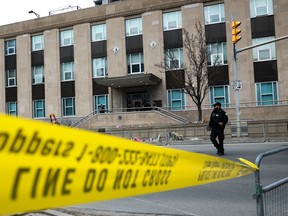
We can’t know exactly why Ontario Superior Court Justice Heather McArthur decided on Thursday to uphold bail for a man accused of shooting up the U.S. Consulate in Toronto, but her reasons can’t make much sense. Perhaps she was compelled by some kind of sob story, or perhaps she convinced herself that whatever stern warning she gave against disobeying bail conditions would resonate with the alleged gun-for-hire. Who knows; that’s all covered by a publication ban.
What is public inspires a whole lot of doubt in the justice system. The crime unfolded one morning in March at around 5:29 a.m.: shots were fired upon the U.S. Consulate by mystery men in a stolen car who filmed themselves in the act. It wasn’t until months later that those believed responsible were arrested.
t
Right?
First to be caught was 18-year-old Sheldon Tracey-Stewart, who was nabbed in early June during a series of police raids targeting the crime ring connected with the consulate shooting. This triumph was overshadowed by tragedy, however: Toronto police Const. Marc Pinizzotto was shot and killed by a subject of the raid, resulting in 19-year-old Nicholas Bennett being charged with murder.
It took another week to catch our man Zara Jabbi, who wasn’t home at the time of the raid. He was granted bail on July 7, just a few weeks later. (And thanks to Justice McArthur, he’ll continue to enjoy release.)
Despite the raids and arrests — and an increase in patrols — the U.S. Consulate was hit a second time. On July 27, at around 4:45 a.m., the occupants of another vehicle shot up the U.S. Consulate again. Police stationed nearby were able to respond right away, but the ensuing chase saw speeds above 140 km/h on the nearby expressway and police called the chase off. Toronto, in all its dysfunction, didn’t have a helicopter to deploy, so the offenders got away.
t
A week and a half later, the alleged shooters were brought in: 19-year-old Xen-Ul-Abdeen Syed and a nameless 15-year-old. These two were also suspected of pouring gas on a residential driveway in late July and lighting it on fire.
t
The U.S. has pointed to Iran being behind all this, and Canadian police have at very least connected this group to other crimes against synagogues and businesses. Both shootings at the U.S. Consulate involved payments being offered to the gunmen through encrypted messaging apps, according to police.
The upholding of Jabbi’s release would have been offensive if he was merely accused of being a lone-wolf shooter, but it is so much worse in its full context. The soup of allegations related to this group is unthinkable to regular Canadians. Stealing cars, shooting buildings, conducting hybrid warfare against allies, killing police, evading police, etc. It’s indicative of extremely dangerous men who will unleash violence and evade justice where they can.
Article content
As bail is a risk-management exercise, it shouldn’t have been hard to conclude that granting freedom to those accused of such crimes places unacceptable risk upon the public. But we are often cursed with judges, including possibly McArthur in this case, who believe too strongly in the obedience of those thought to be among the most dishonest and violent in the country. In court, they’ll give out a long list of bail conditions and deliver a very foreboding lecture to whatever family member or friend who has offered to ensure the compliance of the accused. And then they’ll be shocked when bail violations occur.
Indeed, it was just early August when a woman was sentenced to a year of jail for giving her brother scissors to cut off his ankle monitor while he was on bail, and helping him escape the police who were searching for him. She had been his surety at the time of the crime, meaning she made a promise in court to supervise her brother’s bail compliance and report any breaches. The brother, who was facing gun charges, had been released on “very strict” conditions because she had assured court she was a “strong woman” who would carry out her duty. Little good that did.
Alas, even if Jabbi’s defence lawyers came up with a supposedly iron-clad release plan, his judge had a final card that could have been played to keep him in custody. The Criminal Code says that bail can be denied “if the detention is necessary to maintain confidence in the administration of justice, having regard to all the circumstances.” And then it rattles off some of those circumstances: the strength of the prosecution’s case, the gravity of the offence, whether a gun was used, whether a long jail term is on the table.
Jabbi is accused by police of using a gun to shoot up a diplomatic site while being allegedly involved with a gang that killed a police officer. If a judge doesn’t consider the release of such a man to be an assault upon public confidence in the administration of justice, she is extremely out of touch. Canadian courts have a weak reputation for ensuring order as is; decisions like these only bring it lower.